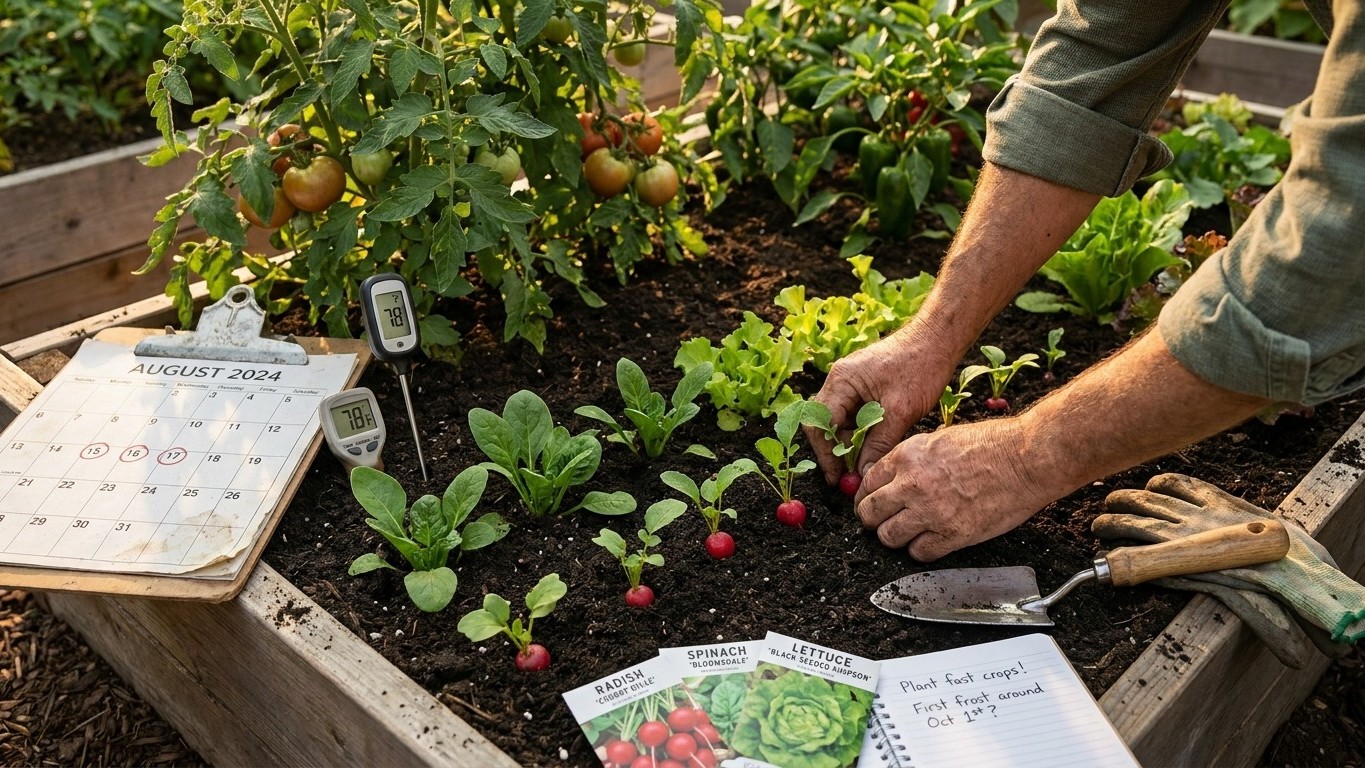

August in Minnesota is a fast-crop month, not a planting-season month. You’re past the last frost window (April 17 to April 30) and running against the first one (October 11 to October 23), so anything that goes in the ground now needs to finish in six to eleven weeks, tops. Think radishes, spinach, and lettuce, not tomatoes.
What goes in the ground in August

The number that actually decides what you can plant this month isn’t the date on the calendar. It’s how much runway is left before that first fall frost hits, somewhere between October 11 and October 23 in the Twin Cities area, according to NOAA’s 1991-2020 climate normals. Sow something on August 1 and you’ve got roughly ten to eleven weeks. Sow it on August 25 and you’re down to six or seven. That shrinking window is the whole game this month, and it means crop choice tightens fast as the days go by.
Soil temperature matters here too, though in a different way than in spring. Garden beds in a Minnesota August often sit in the 75 to 90 degree range at the surface during a dry stretch, which is plenty warm for germinating radish, arugula, and turnip seed. Lettuce and spinach are the pickier ones: they can stall or bolt straight to seed in that heat, which is why timing and a little afternoon shade matter more than the thermometer alone.
Quick crops worth the risk
Early August still leaves enough runway for a few slower crops. By the third or fourth week, only the fastest options make sense.
| Crop | Days to Maturity | Best Sow Window in August |
|---|---|---|
| Radish | 25-30 days | All month |
| Arugula | 21-30 days | All month |
| Spinach | 40-45 days | First half |
| Leaf lettuce | 30-45 days | First half |
| Beets | 50-60 days | Early August only |
| Bush beans | 50-60 days | Early August only |
| Fall peas | 60-70 days | Early August only |
Tomatoes, peppers, squash, melons, and corn are off the table as new seed this month. There simply isn’t enough season left for them to go from seed to harvest before frost shuts things down.
What to start under cover
Direct-sown lettuce and spinach often refuse to germinate, or bolt straight to flower, once garden soil bakes through a dry August stretch. Starting those seeds indoors under lights, or in a shaded cold frame, sidesteps the heat problem and buys the plant a calmer start before it ever touches garden soil.
The math runs backward from your frost date. Take the days-to-maturity for the crop, add another 10 to 14 days for the seedling to settle in after transplanting, and subtract that total from the first fall frost. Lettuce needing 45 days to mature plus 10 days to establish comes to about eight weeks before frost, which lands right around early August for the Twin Cities window. Push a sowing past that point and the plant is racing a clock it can’t win.
Two ways this goes wrong. Start everything in one big batch on August 1 with no plan for where seedlings sit once they outgrow their trays, and you end up with leggy, rootbound plants baking on a windowsill for weeks. Or wait too long, and the transplant goes into the ground still small, with barely enough season left to size up before the cold arrives. Smaller, staggered starts through the month beat one big sowing every time. Broccoli and cabbage transplants for fall harvest are really a July job here; by August, lettuce, spinach, and other quick greens are the only starts still worth the tray space.
What is ready to pick
This is the month the garden pays you back. Tomatoes are coming in at full color with a slight give when pressed. Sweet corn is ready when the kernels run milky under a thumbnail. Cucumbers should come off the vine while still firm and green, before they start yellowing and turning bitter. Zucchini and summer squash are best picked at six to eight inches, before the skin toughens. Green beans should snap cleanly rather than bend.
Curing the alliums
Garlic harvested earlier in the season is likely still curing in a dry, shaded, airy spot, a process that typically runs two to three weeks before the bulbs are ready for long-term storage. Onions with tops that have flopped over are ready to pull and cure the same way. Raspberry canes may be pushing a second flush of fruit, and blueberries are winding down for the season.
None of this is a set-it-and-forget-it month. Ripe produce left on the vine too long invites rot and pests that spread fast to everything nearby, so a walk through the garden every couple of days beats a once-a-week harvest sweep.
The jobs that matter this month
Water, mulch and pest watch
A dry August stretch calls for roughly 1 to 1.5 inches of water a week, delivered as a deep soak rather than a light daily sprinkle. Inconsistent watering, not the heat itself, is the usual cause behind blossom end rot and split tomatoes, so a steady rhythm matters more than the total volume. Top up mulch around established plants and over any new fall seedlings to hold that moisture and keep soil temperatures from spiking.
Tomato cages should already be doing their job, but heavy fruit loads this time of year can topple a cage that seemed sturdy enough back in June. Walk the rows for Japanese beetles on beans and raspberry canes, squash vine borer entry holes at the base of zucchini plants, and tomato hornworms, which are easiest to control by hand before numbers build.
Harvest, cure and plan ahead
Curing onions and garlic properly now, in a dry, shaded, well-ventilated spot for two to three weeks, is what determines whether they store through winter or go soft by December. Deadhead spent annuals and cut back leggy perennials to encourage a fall bloom. If a favorite open-pollinated plant has gone to seed, this is the window to collect it before rain or birds get there first. And any bed that’s finished producing, an early bean or pea row, for instance, is ready to turn over for a fall green or a cover crop rather than sitting bare.
What not to do in August
The most common mistake is planting warm-season seed, tomatoes, peppers, squash, melons, corn, directly into the ground because the weather still feels like summer. It does feel like summer, but there isn’t enough season left for those crops to go from seed to harvest before the October frost window closes in.
A close second is reaching for a high-nitrogen fertilizer on tomatoes and peppers late in the season. That pushes leafy growth at the expense of fruit ripening and delays the plant’s natural hardening off, leaving it more vulnerable when the first cold snap arrives.
Letting the garden go thirsty through a dry stretch, then soaking it heavily once cracked tomatoes or blossom end rot show up, is another classic. The damage is already done by the time the symptom appears; steady watering prevents it, a rescue soak doesn’t reverse it.
Powdery mildew on squash and cucumber leaves and squash bugs clustering at the base of plants both get worse fast if the response is “it still looks fine.” By the time leaves are fully coated in white film, that planting’s yield for the season is usually done. Catching it early, and pulling badly infested leaves, buys the plant more productive weeks.
Checking this against your own county
Minnesota spans USDA Hardiness Zones 3a to 5a, a range built on average extreme minimum winter temperature, and that spread alone tells you a statewide month is a starting point, not an instruction. The frost dates above reflect the Twin Cities, the mild end of the state; northern Minnesota runs two to three weeks tighter at both ends of the season, and elevation or a nearby lake can shift things further in either direction. For a planting calendar tuned to your own county, the University of Minnesota Extension is the source to check.
Common questions
Can I still plant tomatoes in Minnesota in August?
No. There isn’t enough time left before the first fall frost (October 11 to October 23 in the Twin Cities) for tomato seed to mature. Existing plants already in the ground will keep producing into fall.
What vegetables can I direct sow in Minnesota in August?
Radishes and arugula work all month. Spinach, lettuce, beets, bush beans, and fall peas need to go in during the first half of the month to have enough time to mature before frost.
When should I plant garlic in Minnesota?
Not in August. Garlic goes in the ground later in fall, closer to the first frost, so it establishes roots without pushing top growth before winter. This page covers August; check the extension calendar for the fall planting window.
How do I protect August-sown fall crops from an early frost?
A floating row cover or cold frame can extend the harvest window by several weeks. Many of these crops, spinach, kale, and lettuce among them, tolerate a light frost and actually sweeten with the first cold snap.