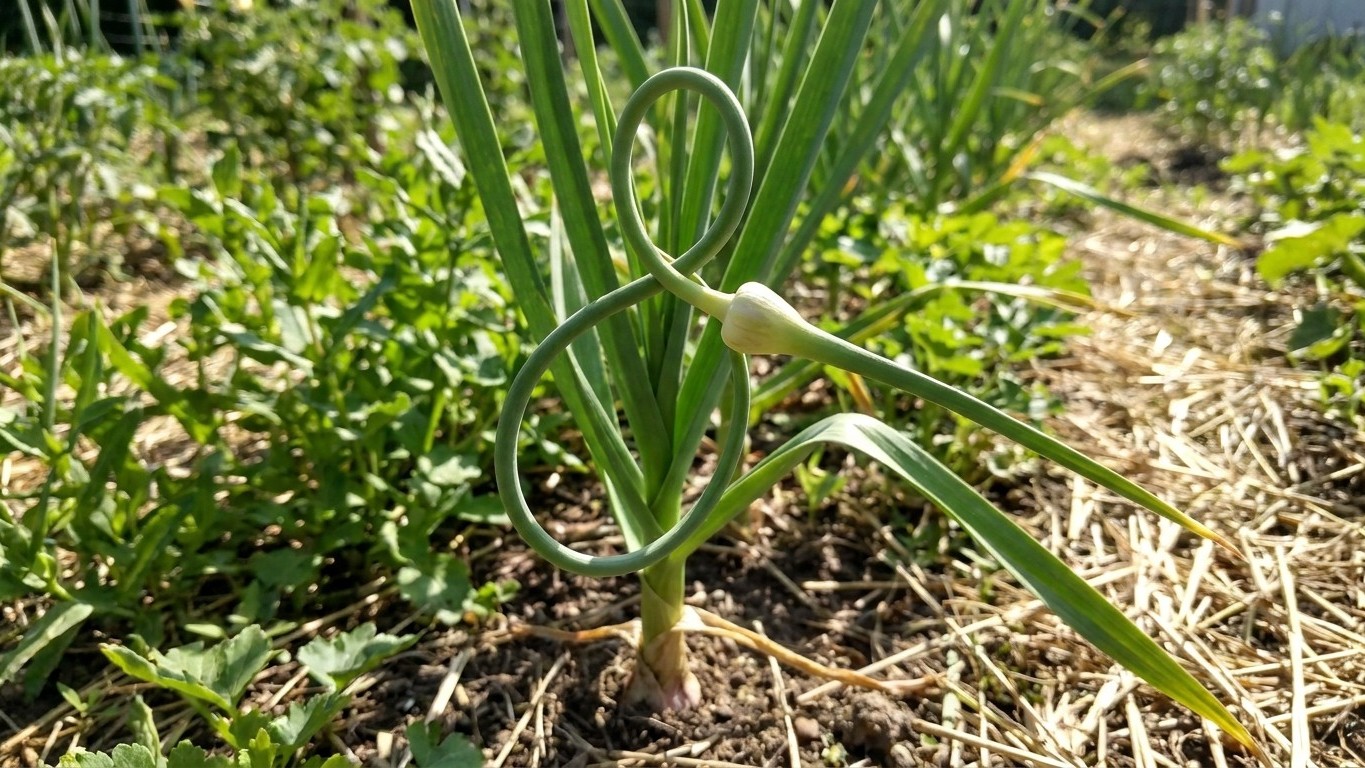

A garlic scape that shows up earlier than the plant usually manages is not a warning sign by itself. It means the bulb below has finished its early leaf growth and started pulling energy into the cloves, a shift that gets triggered when a run of warm days lands on top of a winter that already delivered enough cold. Cut the scape as soon as it curls into a loop, rather than waiting to see whether the plant settles down, because every extra day it stays on pulls energy away from the bulb.
What you are looking at

A garlic scape is a round, hollow, stiff stalk that rises straight out of the center of the leaf whorl, not from the side like a leaf. It tapers to a pointed bud wrapped in a papery bract, then curls into one or two loops before straightening again as it matures and the bract splits to show a cluster of small bulbils inside. Only hardneck garlic sends up a scape at all, so if you are looking at one, you already know which type went into the ground. Softneck varieties almost never produce this structure.
The most common misdiagnosis is confusing scape emergence with the leaf yellowing that signals normal ripening near harvest. They are unrelated events on separate timelines, and treating one as the other leads to either panicking too early or missing a real problem. A few quick checks separate an early but harmless scape from something worth watching:
- Round, hollow stalk rising from the very center of the plant: this is a scape, not a leaf.
- Papery bract at the tip, sometimes already splitting: confirms it is far enough along to cut and use.
- Full, dark green leaf set below the scape: an early but ordinary weather-driven bolt.
- Thin, pale, or fewer leaves than neighboring plants of the same variety: possible stress bolt, worth watching rather than weather alone.
That last distinction matters. A plant under real stress, drought, root damage, a sudden heat swing, can send up a scape early as part of a general decline rather than as a normal seasonal response. If the scape is accompanied by stunted or discolored growth, the story is different from a healthy plant that simply bolted a bit ahead of its neighbors.
What actually causes it
The cause of an early scape acted months before you ever saw it, back at planting and through the coldest weeks of winter. Garlic runs on a nine-month cycle, and most of what determines this season’s bulb was already settled before the plant broke ground in spring.
The vernalization clock
Hardneck garlic needs a sustained stretch of cold after planting to trigger the internal changes that will later become both the scape and the clove divisions inside the bulb. This process, called vernalization, finishes well before active spring growth resumes. By the time a scape breaks through the leaves, the decision to bolt was made months earlier, during that cold period, not during the warm spring week you happen to be standing in the garden.
What varies from year to year and plant to plant is the timing of emergence, not whether it happens. Once the cold requirement is satisfied, accumulating warmth governs how fast the stem elongates and pushes through the leaves. An unusually warm stretch early in spring, or a run of warm days right after a late cold snap, moves emergence earlier than an average year would. A slow, cool spring holds it back. Clove size at planting plays a role too: cloves taken from the larger, outer positions of the bulb carry more stored energy and tend to bolt earlier and more consistently than small cloves planted on the same date.
The exact number of cold weeks needed to satisfy vernalization, and the temperature threshold that counts as cold enough, differ by source and by variety. Check your state extension service’s garlic planting guide, or the USDA plant hardiness zone rating for your area, before assuming your winter fell short or ran long. If a winter genuinely doesn’t deliver enough cold, the more common result isn’t an early scape at all but the opposite problem, a bulb that never differentiates into cloves, covered separately on Garlic That Grew One Round Bulb Instead of Cloves.
What you can still do this season
What’s already decided, and what isn’t
The bulb’s ultimate size and clove count were shaped by winter cold and by the clove size you planted, and neither of those can be changed once a scape is up. What is still within your control is what happens to the scape and to harvest timing from here forward.
Cut the scape as soon as it curls into a loop, rather than letting it straighten out or mature toward bulbils. This is standard practice because a scape left in place keeps drawing energy that would otherwise go into sizing the bulb. Don’t wait to see whether the plant “catches up,” since there is nothing to catch up on. The plant is simply running its normal sequence a bit earlier than usual this year.
Harvest cues don’t change because a plant bolted early. Watch for the lower leaves to yellow and die back while the upper leaves stay green, the same signal you’d use on a plant that never bolted at all, since ripening and scape emergence run on separate tracks. If a scape appeared alongside a visibly stunted or stressed plant, the bulb underneath may end up smaller or unevenly clove-split, but it is still perfectly edible. Use it fresh in the kitchen rather than counting on it for long-term storage, since small, stressed bulbs tend to cure and keep less reliably than well-grown ones.
One thing worth avoiding on the other side of this: delaying harvest to give an early-bolted plant more time in the ground. Leaving mature garlic in the soil too long, whatever caused the early scape, raises the risk of wrappers splitting before you lift the bulbs, a separate problem covered on Split Garlic Wrappers: Why Bulbs Burst Before You Lift Them.
What does not work
A few common reactions to an early scape change nothing, because they treat a timing event as if it were a nutrition or moisture problem.
Extra nitrogen after the scape shows up is the most common one. Feeding a plant whose scape timing was set by winter cold and spring warmth won’t undo that decision, and pushing fresh leaf growth this late in the cycle can actually slow curing and delay maturity rather than help bulb size.
Extra irrigation, aimed at “de-stressing” the plant, only helps if drought was genuinely the trigger behind the bolt. If the real driver was ordinary weather-driven vernalization and warmth accumulation, watering more does nothing to change what already happened months earlier.
Cutting the scape unusually early, before it has even curled, in hopes of preventing bolting altogether also misses the point. Bolting was decided back in winter. Cutting the scape stops it from competing with the bulb for energy from that moment forward, but it doesn’t erase the fact that the plant already bolted.
Leaving the scape on deliberately, on the idea that letting it fully mature helps the plant “finish its cycle” and benefits the bulb, does the opposite of what growers hope. A mature, uncut scape typically leaves you with a smaller bulb at harvest, not a larger one.
Getting it right next year
The point to actually change something is next autumn, at planting, not next spring when the scapes come up again. Two decisions made at that point do more to shape scape timing and bulb size than anything you can do once the season is underway.
Clove size and planting date
Clove size at planting is the single biggest lever you control. Choosing consistently from the same position in the bulb, generally the larger outer cloves, each year gives you more predictable bolt timing and bulb size than planting whatever is left over.
Planting date matters just as much. Planting too early in the fall risks excessive top growth before winter sets in, while planting too late risks an incomplete cold period by spring. The right window differs by county, not just by state, so check your state extension service’s recommended fall planting dates for your area, and cross-reference the USDA plant hardiness zone map for your general winter cold exposure rather than guessing from a national calendar or a neighboring state’s advice.
If unpredictable early-spring warm spells are a recurring headache where you garden, and scapes consistently show up earlier than you’d like, some growers shift toward softneck varieties that rarely bolt at all, sidestepping the issue entirely. That decision belongs at the planting stage, and the Growing Garlic guide covers the softneck-versus-hardneck choice from the start, before you’ve committed a season to either one.
Common questions
Do I need to cut every scape the same day?
No. Not every plant in a bed bolts on the same day, even within one variety, since individual cloves vary slightly in size and stored energy. Cut each scape as it curls, working through the bed over several days rather than treating it as a single-day task.
My hardneck garlic didn’t bolt at all this year. Is that a problem?
It can point to an incomplete cold period over winter, or in some cases a variety that leans softneck-like in its bolting habit. Dig one bulb early to check whether the cloves have separated properly before assuming anything is wrong with the rest of the bed.
Can I eat the bulbils that form on the scape?
Yes, they’re edible, with a milder garlic flavor than a clove. Most growers save them for replanting instead, since a bulbil takes more than one season in the ground before it grows into a full-size bulb.
Does cutting the scape actually make the bulb bigger?
It generally helps, since it stops the scape from competing with the bulb for the plant’s energy. The effect is modest next to what winter cold and clove size at planting already determined, so don’t expect a small, early-stressed bulb to turn into a large one just because the scape came off on time.