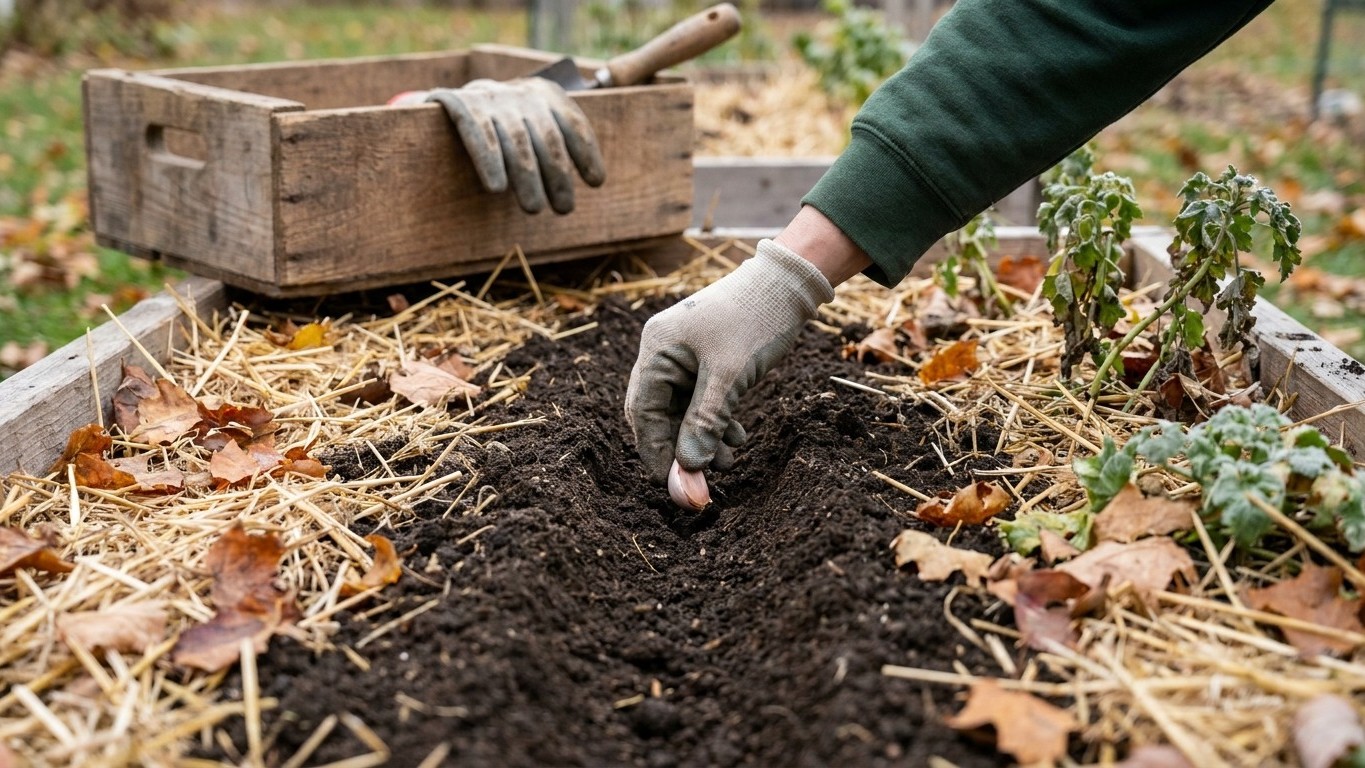

By November, Newfoundland and Labrador has already crossed its average first fall frost, so outdoor vegetable planting is essentially finished for the season across most of the province. Garlic and shallots can still go into ground that hasn’t frozen solid, cold frames and low tunnels keep a handful of hardy greens alive, and dormant bare-root plantings can proceed where the soil is still workable. The bulk of the month’s real work has already shifted indoors and into the toolshed.
What goes in the ground in November

The calendar says November, but the soil doesn’t care what month it is. What matters is whether the ground is still workable or already locked up with frost, and that depends far more on soil temperature and recent weather than on the date on the wall. For the St. John’s area, the average first fall frost lands around October 17, according to Environment and Climate Change Canada’s 1981-2010 climate normals for station ST JOHN’S A. That’s an average, not a guarantee: in roughly half of all years, frost arrives later than that, and in the other half it arrives earlier. By the time November opens, most of the province has already seen at least a light frost, and soil temperatures are dropping fast toward the point where digging becomes a fight with a shovel rather than gardening.
That said, a mean frost date isn’t the same as frozen ground, and there’s a real window between “cold” and “concrete” where a few tasks still make sense. If the soil in your bed hasn’t crusted over, garlic cloves and shallot sets can still go in, planted a few inches deep and mulched heavily so they root before the ground truly freezes. Bare-root fruit trees, canes and dormant shrubs can also be planted while the ground stays workable, since they aren’t trying to grow, just to settle their roots before winter locks everything down.
- Garlic cloves and shallot sets, into unfrozen, well-drained soil, mulched right away
- Bare-root fruit trees, brambles and dormant perennials, if the hole can still be dug
- Cold frames or low tunnels holding over hardy greens like spinach, mache or kale sown earlier in fall
- Chicory roots or rhubarb crowns lifted and moved indoors for forcing in a dark, cool spot
Outside of that short list, direct-sowing new crops in open ground this month is a gamble that rarely pays off. Anything that needs weeks of active root growth before winter simply won’t get it.
What to start under cover
Working backward from a frost window is the honest way to plan sowing dates, rather than picking a date off a calendar and hoping it lines up. The average last spring frost for the St. John’s area sits around May 30, again per Environment and Climate Change Canada’s 1981-2010 normals, and again a midpoint rather than a safe cutoff. Onion and leek seedlings that need ten to twelve weeks indoors before transplanting would be started in late winter, counting back from that late-May mark, not now. Starting them in November means they’d be leggy, rootbound and exhausted long before the ground is fit to receive them, which is one of the two ways indoor sowing goes wrong at this time of year.
The other failure mode, starting too late, isn’t really a risk in November either, since nothing outdoor-bound needs sowing yet. What does make sense under cover this month is smaller and more immediate: windowsill herbs like parsley, chives or thyme sown in pots for kitchen use over winter, continuous batches of microgreens and sprouts that go from seed to harvest in one to three weeks with no transplanting involved, and forcing spring-flowering bulbs such as amaryllis or paperwhites in pots indoors for winter color. None of these are tied to the outdoor frost calendar at all, which is exactly why they suit a month when the garden itself is shutting down.
If you’re tempted to get a jump on spring vegetables now, resist it. The math doesn’t work: eleven or twelve weeks before May 30 lands in early March, not November, and seedlings started this early will have outgrown their pots long before the soil warms enough to take them.
What is ready to pick
Outdoors, there’s honestly very little coming out of a Newfoundland and Labrador garden in November. Anything left unprotected in open ground has likely already been touched by frost, and most annual crops are finished for the season. What still feeds the household comes from what was planned for ahead of time or from what’s stored in the basement, not from fresh outdoor harvest.
Kale and leeks that were left in the ground under a thick mulch or a covering of snow can often be dug or cut as needed well into the cold months, since both crops tolerate hard freezes and actually sweeten with cold exposure. Cold frames sown in late summer with spinach, mache or hardy lettuce can still yield light pickings on milder days, even if growth has nearly stopped. Indoors, sprouts and microgreens are the most reliable fresh crop of the month, ready in days rather than weeks and immune to whatever the weather is doing outside.
The other job this month is checking what’s already in storage before small problems turn into lost crops. Go through stored squash, potatoes and onions by hand:
- Squash: check the stem end for soft spots or a sweetish smell, both signs of rot starting from the inside
- Potatoes: look for sprouting, wrinkling skin or dark, sunken patches, and pull out any that show them
- Onions: press gently near the neck; softness there means the onion is breaking down and should be used or discarded, not left to spread to its neighbors
One bad squash left in a crate can take out several others around it within weeks, so this check is worth ten minutes every couple of weeks through the winter.
The jobs that matter this month
A month with nothing new going into the ground still has plenty of work attached to it, and skipping it now costs real time and money come spring. Dormant pruning of fruit trees and cane fruit is one of the biggest: once the leaves are down and the plant is fully dormant, pruning cuts heal cleanly and there’s no foliage in the way to hide dead or crossing branches. Wait too long into a warmer stretch and buds can start swelling, which makes pruning cuts riskier and slower to heal.
Seed ordering belongs on this month’s list too, and earlier is genuinely better here: popular varieties, particularly cold-hardy ones bred for short seasons, tend to sell out well before spring planting windows open. Alongside that sits the planning work that’s easy to skip but pays off every year it’s done: sketching out next season’s crop rotation so the same family of plants doesn’t land in the same bed twice running, which keeps soil-borne pests and diseases from building up.
Soil testing and amending also make sense now, while beds are cleared and there’s time for lime or organic matter to work into the soil before spring. Turning the compost pile, even just once, keeps it breaking down instead of freezing into an inert lump. Tools deserve attention too: cleaning off soil, oiling metal parts against rust, and sharpening blades means everything is ready to go the first workable day of spring rather than sitting in a shed getting reacquainted with a whetstone.
- Prune dormant fruit trees and cane fruit once leaves have dropped
- Order seed for next season before popular varieties sell out
- Sketch a rotation plan and test or amend soil while beds are clear
- Turn compost, clean and sharpen tools, repair beds and fencing before ground freezes
- Recheck stored crops on a regular schedule, not just once
What not to do in November
The most common mistake this month is reading a stretch of unusually mild weather as a sign the season has turned. A few warm afternoons don’t cancel the fact that the average first fall frost for the St. John’s area has already passed by mid-October, and colder air can and does return without much warning. Pulling mulch off garlic beds or cold frames because it “feels like spring” leaves tender growth exposed right when a hard frost comes back through.
Feeding nitrogen at this point is another classic misstep. Nitrogen pushes soft, leafy growth, which is exactly what a plant doesn’t need heading into freezing temperatures: that new growth won’t have time to harden off and simply gets damaged or killed by the first real cold snap, wasting the plant’s energy in the process. If soil needs feeding, this is the month for slower amendments like compost or well-rotted manure, not a fast-release fertilizer.
Trying to direct-sow anything that needs warm soil, tomatoes, squash, beans, is also a non-starter, no matter how the air feels on a given day. Soil temperature lags behind air temperature by days or weeks, and warm-season seed sitting in cold, wet ground simply rots before it germinates. Finally, don’t assume root vegetables left in the ground are safe indefinitely just because the season has been mild. Even cold-tolerant crops like carrots or beets can be damaged once the ground actually freezes hard around them, so it’s worth lifting the last of them rather than betting on one more mild week.
Checking this against your own county
A province-wide frost window is a starting point, not a instruction specific to your yard. Newfoundland and Labrador covers enormous ground, and elevation, coastal exposure and the long stretch between the Avalon Peninsula and Labrador’s interior can shift frost timing by weeks in either direction from the St. John’s-based averages used here. A garden in a low, sheltered coastal spot may run noticeably milder than one a short drive inland or at higher elevation. The hardiness zone figure often quoted for this region, 6a under the Canadian system used by Natural Resources Canada, applies specifically to the reference city in that dataset and does not describe the whole province, nor does it convert to a USDA zone.
For local frost records and planting guidance built around Newfoundland and Labrador conditions, the province’s own Forestry and Agrifoods Agency is the resource to check.
Common questions
Can garlic still be planted in November in Newfoundland and Labrador?
Yes, as long as the soil hasn’t frozen solid. Garlic cloves planted in workable ground and mulched heavily will root before winter and resume growth in spring.
Is it too late to sow vegetable seeds indoors for spring in November?
For most vegetable transplants, yes. Counting back ten to twelve weeks from the average last spring frost of May 30 lands in later winter, not November, so seedlings started now would likely become rootbound before it’s safe to plant them out.
Windowsill herbs, microgreens and sprouts are not tied to that outdoor calendar and can be started indoors at any point through the cold months.
Why shouldn’t I fertilize my garden beds with nitrogen in November?
Nitrogen encourages soft new growth that doesn’t have time to harden off before hard freezes arrive, which wastes plant energy and leaves that new growth vulnerable to cold damage. Slower amendments like compost are a better fit for this point in the season.
How much can frost timing vary within the province?
The frost dates cited here come from a single station near St. John’s. Coastal, low-lying areas can run milder, while inland, higher-elevation or Labrador locations typically see frost arrive earlier and linger longer, so local records from the province’s Forestry and Agrifoods Agency are worth checking for any specific county.
Gardeners who plant by the Moon can check the November 2026 moon planting calendar, a tradition rather than a proven method.
Related guides
Elsewhere? See what to plant in November in every state and province.