
Carrots can grow well in Arizona, but the answer depends on which soil you’re working with and which part of the state you’re in. The desert’s dominant soil type is sandy and well drained, which suits carrots, but it’s short on organic matter and runs alkaline, so straight-from-the-ground planting often disappoints. When to Sow Carrots in Arizona breaks from the usual frost calendar too, since much of the low desert barely freezes at all, and summer heat, not cold, is what actually limits the season.
The short answer
The soil USDA lists as representative of Arizona is the Casa Grande series, an Aridisol, which is the technical name for a dry-climate soil that tends toward alkaline and often carries salts near the surface. The measured surface horizon runs 64 percent sand, 14 percent clay and 22 percent silt, with a surface pH around 8.5 and organic matter around 0.8 percent. It’s classed as well drained.
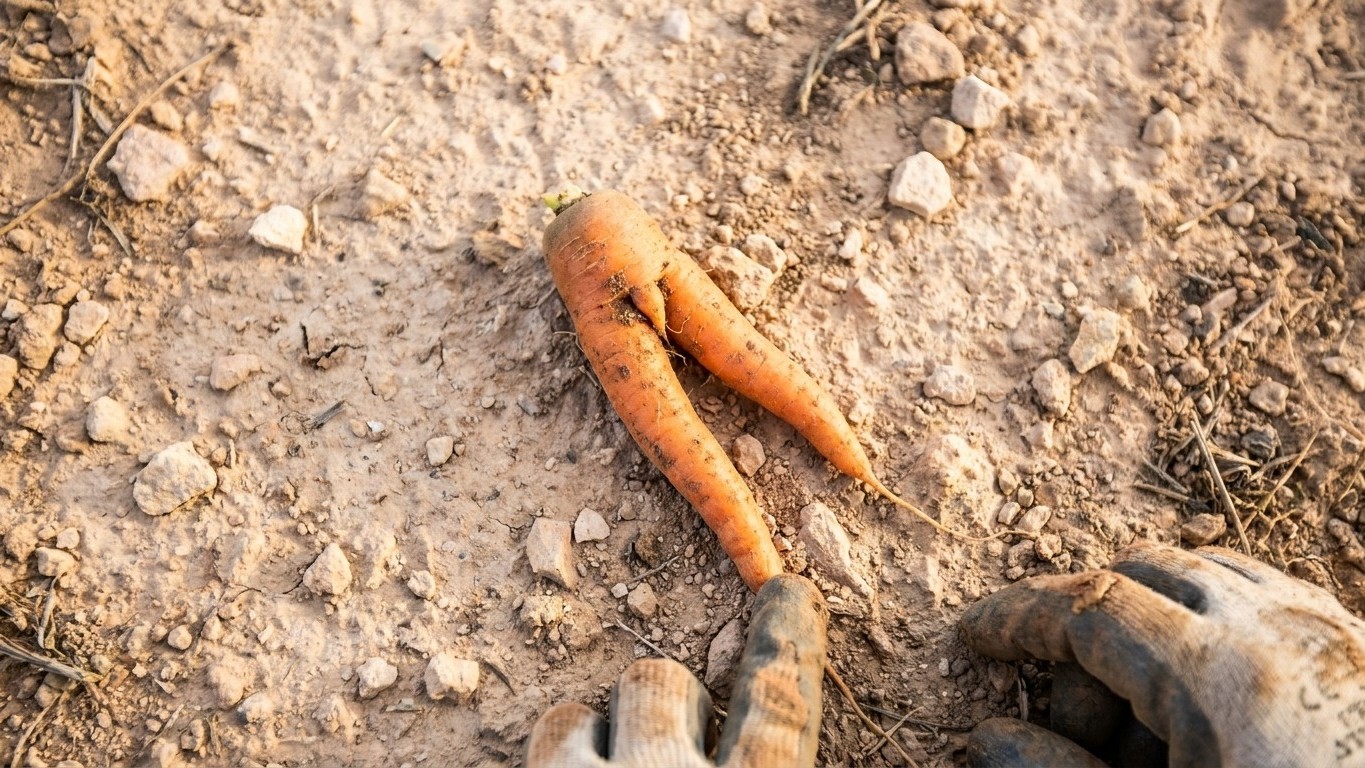
Run that texture against what a carrot actually wants. Utah State University Extension is blunt about it: carrots need deep, sandy, well-drained soil rich in organic matter, and heavy or rocky ground is what makes the root fork. Casa Grande’s sand content and drainage class are on the carrot’s side. The problem isn’t clay, since 14 percent clay is a light load and won’t cause the kind of dense, compacted profile that splits a taproot into two. The problem is what’s missing: organic matter at 0.8 percent is far below the “rich in organic matter” carrots want, and alkaline, low-humus ground tends to compact at the surface even when the subsoil is loose. So, Will Carrots Fork in Arizona Soil? The risk is real but manageable, and it comes down to surface compaction rather than the clay content itself.
So the fix here leans toward compost rather than double digging for clay. Working several inches of compost into the top foot of bed loosens surface crusting, buffers the alkalinity a little, and gives the root system something to push through evenly instead of hitting a hard, sun-baked cap right at germination depth. Double digging still has a place if a particular bed has been compacted by foot traffic or construction fill, but the Casa Grande numbers themselves don’t point to heavy clay as the villain. A raised bed filled with a sandy, compost-rich mix is the more direct route to straight roots if the native ground has been disturbed, graded or capped with caliche-like hardpan, which is common in developed desert lots even where the mapped series looks sandy on paper.
None of this replaces a look at your own dirt. Arizona spans hundreds of mapped soil series, and Casa Grande is a statewide representative figure, not a description of any single backyard. A wash-bottom lot, a hillside parcel, or a yard where a builder scraped and refilled the topsoil can carry a completely different texture and pH than the numbers above. Treat this section as the starting point for what desert ground in Arizona tends to do, not a diagnosis of the bed you’re about to plant.
The test that settles it in your own garden
The state figure is an average; your bed isn’t. A few minutes with a shovel and a jar of water tells you more about whether carrots will fork or thrive than any statewide soil series ever will.
- Dig a test hole at least a foot deep where you plan to sow. Note how far down you can push the shovel before hitting resistance, rock, hardpan or a dense clay layer. Carrots need that depth clear and loose, since anything that stops the taproot partway down is what forces it to fork or stub.
- Check for stones and debris as you dig. Pull out anything larger than a marble along the planned row; a single buried rock or chunk of construction rubble is enough to split a young root in two.
- Feel the texture in your hand. Wet a handful of soil from the hole and squeeze it. Sandy soil falls apart when you open your hand. Clay-heavy soil holds a ribbon shape and feels sticky. Something in between, crumbly but able to hold a loose clump, is closer to what carrots want.
- Watch how water drains. Fill the test hole with water and time how long it takes to soak away. Water that disappears almost immediately points to fast-draining, sandy ground that will need more frequent watering and more organic matter to hold moisture. Water that sits for a long while signals a denser profile that benefits from raised beds or added compost to open it up.
- Repeat the process in more than one spot if the yard has any variation in grade, sun exposure or history (old landscaping, a former driveway, a graded lot). Desert properties in particular can carry a patchwork of native soil, fill dirt and old hardpan within the same few hundred square feet.
When to sow here
Most planting advice starts by Counting Back From the last spring frost. In much of Arizona’s low desert, that math doesn’t work, because there often isn’t a meaningful spring frost to count from at all.
- Check what “frost” even means where you garden. NOAA’s climate normals for a low-desert Arizona station show a 365-day frost-free season on average. Over 30 years of record, a rare cold snap brought the temperature down to 32 degrees Fahrenheit in only 6 of those springs, and when it happened, it landed somewhere between late December and mid-January, not in the March-and-April window most planting calendars assume.
- Drop the frost date and watch soil temperature instead. Because a hard freeze is the exception rather than the rule in the low desert, soil temperature is the more reliable trigger. Wait until the soil holds steady at 40 degrees Fahrenheit at minimum before sowing carrot seed at all.
- Aim for the germination sweet spot. Utah State University Extension puts carrot seed’s best germination range at 55 to 65 degrees Fahrenheit soil temperature. In low-desert Arizona, that window tends to show up in the cooler months, fall into winter, rather than spring, since summer soil runs far hotter than carrots can handle and stalls growth outright.
- Count from seeding, not from a transplant. Carrots go directly into the ground as seed; there’s no seedling stage to transplant. The 70 to 100 days most varieties need to mature are counted from the day the seed goes in the soil, straight through to harvest.
- Higher-elevation Arizona gardens play by different rules. Areas like Flagstaff and similar high country do get real, hard freezes, unlike the low desert. There, the standard guideline of sowing 2 to 3 weeks before the local last spring frost date applies, but a specific date for that region isn’t part of the data used here, so check it with a local source before you plant.
What goes wrong here
- Forked or split roots from compacted or capped ground. Even where the mapped soil is sandy, a desert yard that’s been graded, driven on, or capped with a hard surface layer can stop a taproot cold partway down. Loosen at least a foot of soil before sowing and work in compost so the root has an even path the whole way.
- Poor germination during a heat spell. Carrot seed germinates best between 55 and 65 degrees Fahrenheit soil temperature, and Arizona’s warm season pushes surface soil well past that range fast. Sow during the cooler months, and mulch lightly right after sowing to keep the seedbed from overheating and drying out before sprouts emerge.
- Splitting from uneven watering. Well-drained, sandy ground like the Casa Grande series sheds water quickly, which means moisture at root level can swing sharply between a deep watering and the next one. Roots that get a drought-then-flood cycle tend to split. Water on a consistent schedule and use mulch to slow evaporation between waterings.
- Stunted, pale-looking roots from thin, low-organic soil. Surface organic matter around 0.8 percent, the figure recorded for this state’s representative soil, leaves little to feed the crop or hold nutrients near the root zone. Work several inches of compost into the bed before sowing rather than trying to fix it mid-season with fertilizer alone.
Checking this against your own county
Everything above is a starting point built from a statewide soil series and a single climate-station record. The way to make it specific to your address is a call or visit to your local Cooperative Extension office. The University of Arizona Cooperative Extension, reached through extension.arizona.edu, runs county-level offices across the state that can point you toward a soil test, local planting timing and any freeze data specific to your elevation and microclimate.
That local check matters more in Arizona than in most states, given how sharply conditions shift between the low desert around Phoenix and Tucson and the high country around Flagstaff. A planting date, a frost expectation and even a soil texture that’s accurate for one can be badly wrong for the other, and county extension staff work with exactly that kind of local variation every season.
Common questions
Do carrots need a raised bed in Arizona?
Not always. The state’s representative soil is sandy and well drained, which are both traits carrots like. A raised bed becomes worthwhile mainly where the native ground has been compacted, capped or filled, since that’s what actually forces a taproot to fork.
What’s the biggest mistake gardeners make with carrots in Arizona?
Sowing by a spring frost date that, in much of the low desert, barely exists. Soil temperature, not frost, is the more reliable signal, and summer heat rather than cold is what ends a carrot planting’s window.
How much compost should go into desert soil before sowing carrots?
The sourced data doesn’t give a specific rate, but the general aim is enough to visibly darken and loosen the top foot of soil, since the state’s soil averages only about 0.8 percent organic matter at the surface.
Is Flagstaff’s carrot-growing season the same as Phoenix’s?
No. Flagstaff and other high-elevation Arizona areas get real, hard freezes and follow a standard frost-based planting timeline, while low-desert areas like Phoenix average a 365-day frost-free season and are limited instead by summer heat.