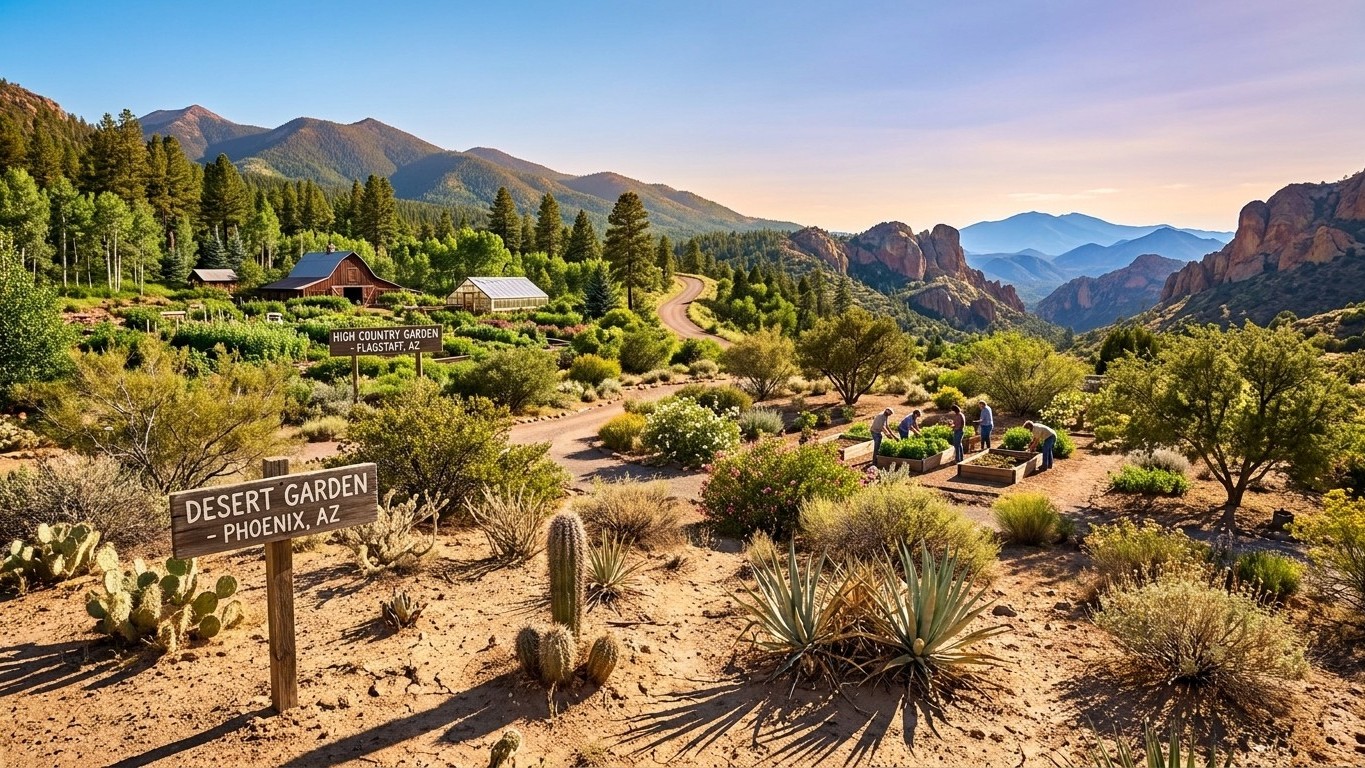

Arizona gardening runs on a completely different clock than most of the country, and late August sits right at the hinge point. If you’re in Phoenix, Tucson, or anywhere in the low desert, this month is mostly about waiting and prepping, not planting. If you’re up in Flagstaff or Prescott, you’re actually closer to a normal Midwest gardening calendar. The state doesn’t have one growing season. It has at least three, and knowing which one applies to your yard changes everything about what you plant right now.
Arizona’s Growing Zones Aren’t What Most Garden Guides Assume

Most national gardening advice assumes a single spring-to-fall growing window. Arizona breaks that assumption completely. The state spans USDA Hardiness Zones from about 4b in the high mountains near Flagstaff to 10b in the low desert around Yuma and parts of Phoenix. That’s a wider range than you’ll find within the borders of most entire regions of the country.
Elevation drives everything here. Phoenix sits around 1,100 feet above sea level. Flagstaff sits above 6,900 feet. That difference of roughly a mile in elevation means Flagstaff’s growing season looks more like Minnesota’s than anything happening 140 miles south. Tucson splits the difference at around 2,400 feet, giving it slightly milder summer extremes than Phoenix but still a desert calendar overall.
This is why a garden guide written for “Arizona” without specifying region is nearly useless on its own. A tomato planting date that works in Prescott could kill seedlings in Phoenix, and vice versa. Before anything else, figure out which of the three broad zones applies to you: low desert, high desert, or mountain/transition zone.
What Low Desert Gardeners Can Do Before Fall Planting Season
Phoenix and Tucson gardeners are living through the tail end of the punishing stretch right now. Daytime highs are still commonly sitting in the triple digits, and soil temperatures stay too hot for most seeds to germinate reliably. Monsoon season, which typically runs from June through September, adds humidity and occasional heavy rain, but it doesn’t cool things down enough to open the door for fall crops just yet.
What late August does allow is preparation. This is the window for starting cool-season seedlings indoors or in a shaded, protected spot, so they’re ready to transplant once temperatures ease—root crops like carrots are a great example, and Growing Carrots in Arizona comes with its own timing quirks worth planning around now, much like Growing Beets in Arizona requires its own careful scheduling, and Growing Sweet Corn in Arizona follows yet another timing pattern entirely, and perennial crops need even more advance planning—Growing Asparagus in Arizona is a prime example, since crowns planted this fall won’t be ready to harvest for a couple of years, and Growing Spinach in Arizona follows a similarly tight cool-season window. It’s also prime time to refresh raised beds, work compost into soil that’s been baking for months, and repair or install shade cloth and drip irrigation before the fall push begins.
A few things genuinely thrive if started now in the low desert, including peppers, which have their own timing quirks worth knowing about, and pumpkins, which need careful timing of their own—see Growing Pumpkins in Arizona (see Growing Peppers in Arizona), alongside crops like potatoes that follow their own dedicated timeline, or root vegetables covered in Growing Parsnips in Arizona—see Growing Potatoes in Arizona for specifics:
- Seeds started indoors for broccoli, cauliflower, and cabbage, ready to transplant in late September
- Herb starts like basil and cilantro kept in partial shade
- Citrus tree planting, since cooler nights ahead reduce transplant stress
The bigger mistake gardeners make this time of year is impatience. Direct-seeding tomatoes, peppers, or beans into 100-degree soil in late August almost always ends in scorched seedlings. Waiting three or four more weeks costs nothing and saves an entire crop.
The Real Growing Season in the Low Desert Runs Backward
Here’s the part that trips up transplants from other states the most: in Phoenix and Tucson, fall and winter are the prime growing months, not spring and summer. Once nighttime lows drop into the 60s, usually by mid-to-late October, the low desert becomes one of the most productive vegetable-growing environments in the country. Lettuce, spinach, carrots, beets, peas, and root vegetables all flourish through the mild winter, often producing through January and into February.
Tomatoes and peppers do get a spring window too, but it’s short and unforgiving. Plant too early and frost damages young plants. Plant too late and the brutal early-summer heat shuts down fruit set before you get much of a harvest. Most experienced low-desert gardeners treat late winter through April as their spring push, then shift entirely to shade management and dormant prep once May heat arrives.
Summer itself, June through September, is largely a survival season for the garden rather than a productive one. Okra, black-eyed peas, and some heat-tolerant herbs like Mexican oregano can push through, but most vegetable gardening pauses. That’s exactly why late August feels like a lull: it’s the last stretch of that survival period before the fall planting rush.
High Desert and Mountain Regions Play by Different Rules
Flagstaff, Prescott, Show Low, and similar higher-elevation towns operate closer to a conventional American growing calendar, just compressed into a shorter window. Last frost dates in these areas typically fall in late May or even early June, and first frost can arrive by mid-September. That gives high-desert and mountain gardeners a growing season of roughly three to four months, tight compared to the low desert’s near year-round activity, but familiar in structure to anyone who’s gardened in the northern Rockies or upper Midwest.
Right now, in late August, gardeners in these cooler zones are in harvest mode, not prep mode. Tomatoes, squash, and beans planted after the last spring frost should be producing heavily. This is also the moment to start watching nighttime temperature forecasts closely, since an early cold snap can end the season abruptly. Covering tender plants on nights when temperatures threaten to dip into the 30s buys extra weeks of harvest.
Soil composition adds another layer of difference. High desert soils tend to be rockier and less amended than the sandy, alkaline soils common in Phoenix and Tucson, which changes how quickly raised beds versus in-ground plots perform. Gardeners moving between these regions, say from a summer home in Prescott to a winter place in Scottsdale, often find that lessons learned in one zone don’t transfer directly to the other.
Water Is the Variable That Ties It All Together
Regardless of elevation, water management separates successful Arizona gardens from struggling ones. The state’s average annual rainfall varies enormously by region, from roughly 8 inches in parts of the low desert to over 25 inches in the higher mountain zones, but even the wetter regions see that rainfall concentrated into short bursts rather than steady distribution. Drip irrigation systems, not overhead sprinklers, are the standard here because they reduce evaporation loss in a climate where a large share of surface water simply evaporates before it reaches roots.
Mulching matters more in Arizona than in most states too. A two-to-three inch layer of organic mulch around plants can meaningfully reduce soil temperature and water loss, which is part of why late August garden prep in the low desert often includes a mulch refresh alongside soil amendment. It’s a small task that pays off heavily once fall planting begins in earnest.
Soil salinity is another factor rarely discussed outside the region. Arizona’s alkaline, mineral-heavy soils and groundwater can cause salt buildup over repeated irrigation cycles, which is why periodic deep watering to flush salts past the root zone is a standard practice for desert gardeners, particularly with citrus and other long-term plantings.
What to Do in Late Summer, By Region
If you’re gardening in Phoenix, Tucson, or another low-desert community, the practical move right now is behind-the-scenes work: start fall seedlings indoors, refresh mulch, check drip lines for clogs after monsoon debris, and hold off on transplanting outdoors until nighttime temperatures ease in a few weeks. If you’re in Flagstaff, Prescott, or another high-elevation town, the priority flips toward active harvesting and frost monitoring, since your growing window is closing rather than opening.
Either way, the season isn’t idle. Arizona gardening rewards patience with timing more than it rewards effort alone, and late August is really just the calm stretch before the state’s two very different growing calendars kick back into gear.
Where to check before you plant
Everything above reflects conditions in one Arizona city, and that matters more here than almost anywhere else in the country. A gap of a few hundred miles in this state can mean a gap of two full hardiness zones, and a planting date that works in the low desert can land three or four weeks off in the high country, or vice versa. Frost history, elevation, and monsoon exposure all shift block by block, not just region by region.
Before you commit seeds or transplants to the ground, check the University of Arizona Cooperative Extension. It’s the land-grant research body for the state, and it publishes planting calendars, frost data, and variety recommendations built from decades of local trial data rather than generic averages.
From there, go one layer deeper and find your own county extension office. County agents track the specific microclimate you’re actually gardening in, and they update frost dates and planting windows as conditions shift year to year. That local number is worth more than any statewide guide, including this one.
Where to Go Next, Crop by Crop
Everything above is about reading the season correctly, but the season plays out differently depending on what’s in the ground. Garlic is the clearest example: most Arizona yards never get the six to eight weeks of sub-40°F chill a clove needs to split properly, and growing garlic here walks through the planting dates and varieties that get around that. Lawns run into the opposite problem — a cool-season grass like tall fescue can look great through fall and winter, then die the moment 90°F heat settles in for the summer, and Arizona lawn care covers what to plant and when to feed it so that doesn’t happen. Tomatoes follow the same heat logic: frost rarely touches them here, but once daytime highs climb too high, blossoms stop setting fruit no matter how healthy the vine looks, and growing tomatoes in Arizona lays out the planting dates, varieties, and local pests that actually matter. Each of these pages assumes the same starting point this one does — that Arizona’s calendar doesn’t work like the one on the seed packet.