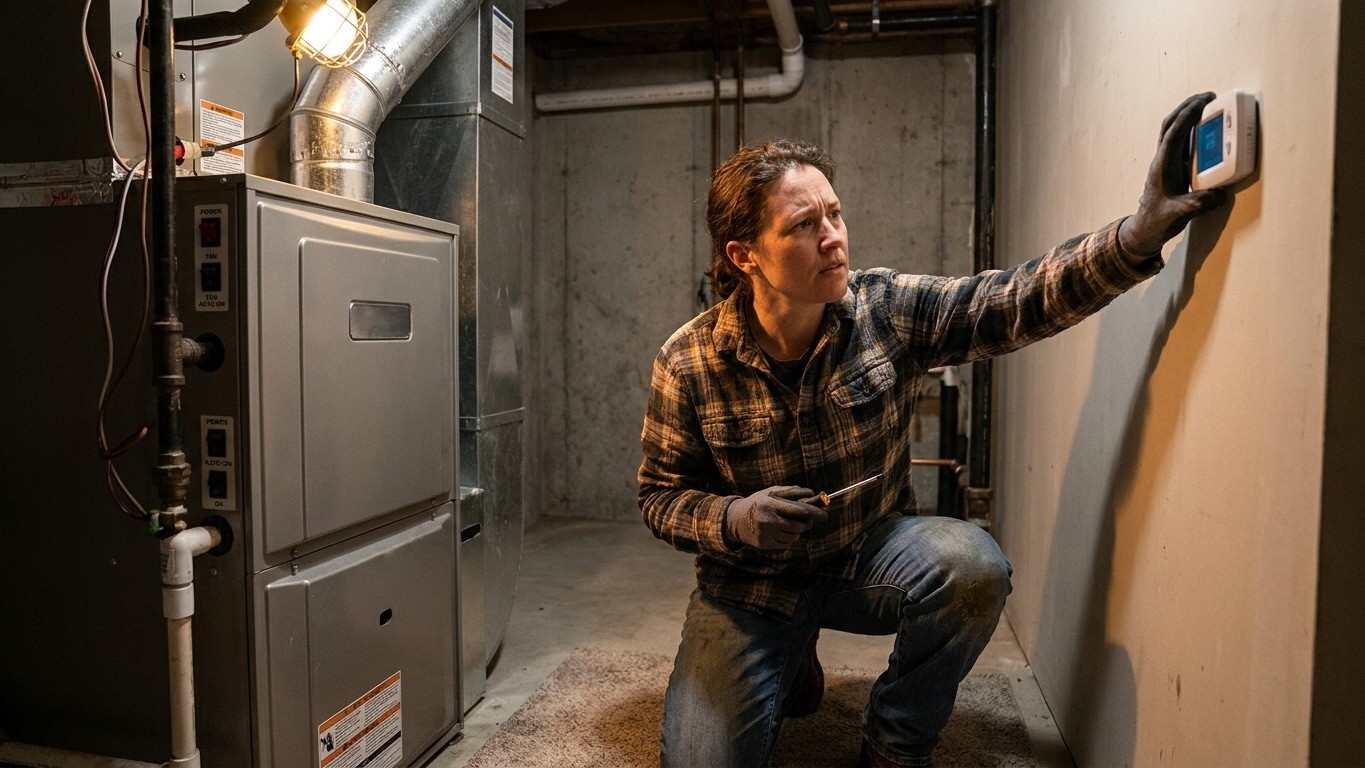

When a furnace stops making heat, the fix is usually cheaper than a service call. Work through checks in order, from the thermostat to the ignition source, before assuming the unit is broken. Most no-heat calls trace back to a switch, a breaker, or a filter, not a failed part. This same order applies whether the air coming out is cold, the system short cycles, or something smells wrong.
It is not making heat at all
The furnace is the most common main heating system in 49 of the 50 states the U.S. Energy Information Administration tracks in its Residential Energy Consumption Survey (Hawaii’s number is suppressed because the sample was too small to report, which is not the same as zero). The lead runs wide: 90 percent of homes in Utah rely on one, against 33 percent in Florida. Wide range, same basic wiring underneath, whether the ignition is gas or electric.
Work through these checks in order
The order matters more than any single step. Work down this list, and stop as soon as one item fixes the problem:
- Thermostat mode and setpoint. Confirm it’s set to Heat, not Cool or Off, and that the setpoint sits a few degrees above the current room temperature. A thermostat holding at 68°F in a 70°F room won’t call for heat no matter what’s wrong downstream.
- Thermostat batteries. A blank or dim display on a battery-powered thermostat means no signal ever reaches the furnace. Swap the batteries before touching anything else.
- The furnace power switch. Most furnaces have a switch that looks exactly like a household light switch, usually mounted on or near the unit or at the top of the basement stairs. It gets flipped off by accident more often than owners expect, frequently during unrelated work nearby.
- The breaker. Check the electrical panel for a tripped breaker feeding the furnace. Reset it once; if it trips again immediately, stop resetting it and call a technician instead.
- The air filter. A filter clogged enough to choke airflow can trigger a safety shutdown that looks, from the thermostat, exactly like a dead furnace with no other symptom. Pull it and hold it to a light; if you can’t see through it, that’s likely the whole problem.
- The front access panel. Furnaces have a safety switch that only closes when the front panel is fully seated. A panel that’s slightly off its latches, often after a filter change, will keep the unit from starting even though nothing else is wrong.
- Pilot light or ignitor activity, on gas furnaces. Look for any sign of an ignition attempt: a pilot flame, a glow from an igniter, a clicking sound. No activity at all points toward the gas valve, ignition control, or a safety switch, not toward anything a homeowner should open up.
Where homeowner troubleshooting stops
That’s also where the list ends for anyone without HVAC training. Gas lines, the burner assembly, and the heat exchanger are not homeowner work; misdiagnosing any of them risks a gas leak or a cracked exchanger that leaks combustion byproducts into the house instead of outside. If the first six checks come up clean and there’s still no sign of ignition, that’s the point to call a technician rather than keep going.
It runs, but the air is cold
The normal heating sequence
A furnace that runs but blows cold air is a different problem than one that won’t start at all, and the two get confused constantly. In a working cycle, the thermostat calls for heat, the ignition source lights, there’s a short delay while the heat exchanger warms up, and only then does the blower turn on to push warm air through the ducts. Cold air during that first minute of a cycle is normal; the delay exists so the system doesn’t blow room-temperature air before there’s any heat to move. Cold air for the entire cycle, start to finish, is not normal.
What usually causes cold air mid-cycle
Three things usually explain it. The fan setting on the thermostat may be set to ON instead of AUTO, which keeps the blower running continuously and mixes in cold air between burner cycles, since the burner runs far shorter than the fan does on that setting. The burner itself may be lighting and then dropping out within seconds, a sign of an ignition or gas supply problem that needs a technician. Or the system may be overheating internally and tripping its high-limit switch, shutting the burner down early while the blower keeps running on whatever heat is left, then on nothing.
That last cause almost always traces back to airflow. U.S. ENERGY STAR notes that “Airflow problems can reduce your system’s efficiency by up to 15 percent,” and a furnace starved of air overheats its own heat exchanger faster than it can move that heat into the house. A dirty filter is the single most common cause of restricted airflow, and it’s also the cheapest one to fix.
It starts and stops every few minutes
Short cycling is a furnace running for a few minutes, shutting off, then restarting soon after, sometimes ten or more times an hour. The start is the hardest moment for any heating system, drawing more current and stressing components harder than steady running does. A furnace that short cycles wears out its ignition system and blower motor faster than one running full, even cycles, and it heats less evenly while doing it.
Four common causes, ranked by who fixes them
| What to check | What it usually means | Homeowner work? |
|---|---|---|
| Air filter | Restricted airflow tripping the limit switch early | Yes, replace or clean |
| Return and supply vents | Furniture or rugs blocking airflow, same effect as a dirty filter | Yes, clear the vents |
| Thermostat location | Sun through a window or heat from a nearby lamp fools the thermostat into reading the room warmer than it is | Yes, relocate or shield it |
| Furnace sizing | An oversized furnace satisfies the thermostat in minutes, then repeats the whole cycle | No, requires a right-sized replacement |
The first three are worth ruling out in an afternoon. The fourth is not something to chase with filters and vent adjustments: an oversized furnace was oversized on installation day, and no amount of maintenance changes that math. A technician who measures the home’s actual heating load, not just its square footage, is the only real fix for that one.
Smells, and the one alarm that matters
Three smells, three different meanings
Furnaces produce distinct smells, and they don’t mean the same thing. The first time a furnace runs each season, dust that settled on the heat exchanger over the summer burns off, producing a burnt, dusty smell that clears in a few minutes and doesn’t return. That one is normal and expected.
A burning smell that doesn’t fade, or that shows up well into the heating season rather than on that first run, is not normal. It can point to dust buildup severe enough to matter, a wiring issue, or a component running hotter than it should. Shut the furnace off and call a technician rather than waiting to see if it clears on its own.
A gas smell isn’t a troubleshooting item at all. Leave the house, then call the gas utility or 911 from outside, not from inside near the source. Don’t flip switches, don’t light anything, don’t go looking for the leak yourself.
Carbon monoxide: the one that isn’t optional
A combustion furnace produces carbon monoxide as a normal byproduct of burning gas, oil, or propane, and a working carbon monoxide alarm is the cheapest insurance in the house against a blocked flue or cracked heat exchanger sending it indoors instead of outside. Testing that alarm belongs in the same seasonal pass as changing the filter, not on some separate schedule that’s easy to forget.
The pass to make before the first cold night
The night a furnace fails is reliably the coldest one of the season, the same night every technician in town is already booked solid. That’s the argument for running through the furnace’s basics weeks before the first cold night, not after it.
Filter: once a month, three systems
U.S. ENERGY STAR’s instruction is specific: “Inspect, clean, or change air filters once a month in your central air conditioner, furnace, and/or heat pump.” Once a month, not once a season. It also names three systems together, which matters for anyone who assumes filter advice applies to furnaces only; a heat pump pulls air through the same kind of filter and chokes the same way when it’s ignored.
Ducts and thermostat setbacks
A furnace can be running perfectly and a room can still stay cold, because the problem sits between the furnace and the room. ENERGY STAR puts it plainly: “In a typical house, however, about 20 to 30 percent of the air that moves through the duct system is lost due to leaks, holes, and poorly connected ducts.” That’s heat already paid for and produced, leaking into a crawlspace or attic before it reaches a vent. Sealing ducts is a job for a technician with the right equipment, but knowing that figure explains why a working furnace and a cold bedroom aren’t a contradiction.
The U.S. Department of Energy adds one more figure worth knowing before winter, on thermostat setbacks: “You can save as much as 10% a year on heating and cooling by simply turning your thermostat back 7-10 F for 8 hours a day from its normal setting.” That’s an annual figure covering both heating and cooling seasons combined, not a rule that scales per degree or applies to a single night. It’s a reason to run a schedule, not a reason to expect the furnace to fix a duct or filter problem it never caused.