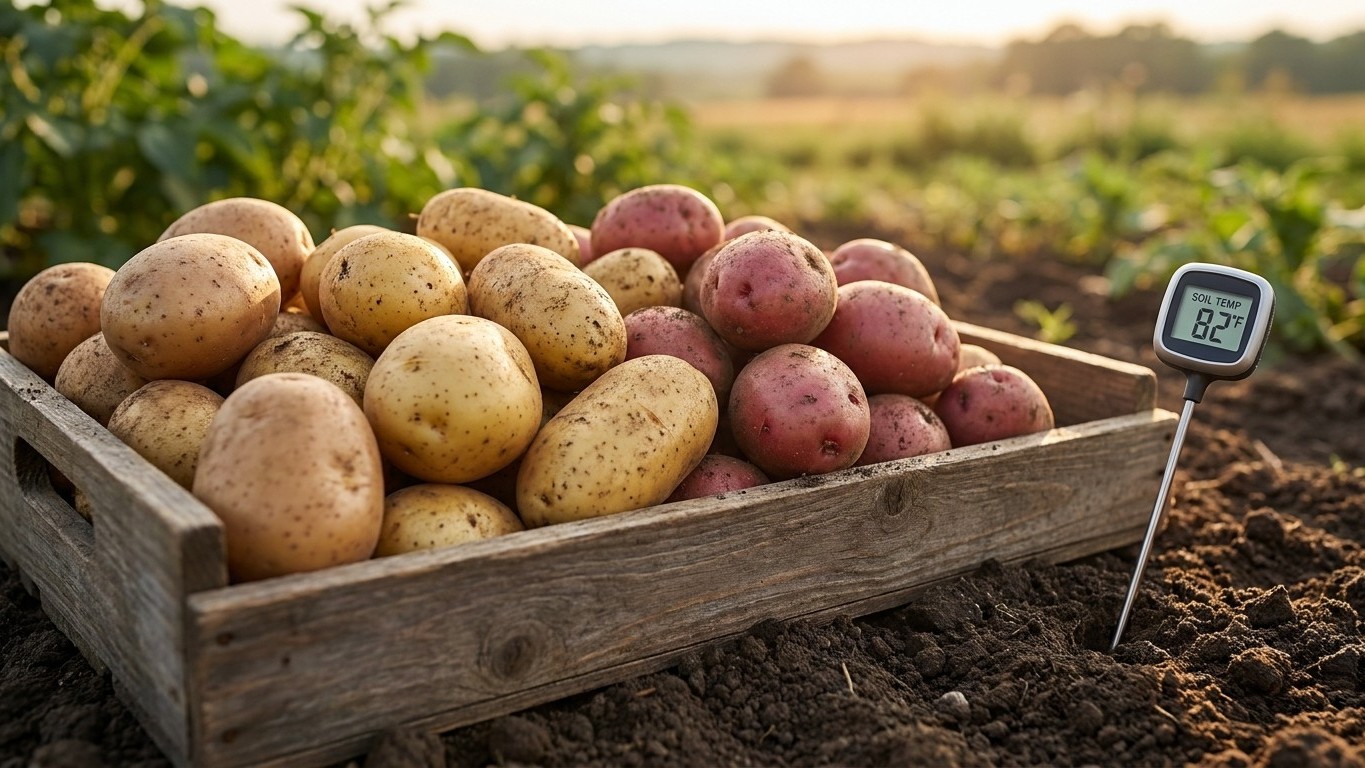

Alabama’s potato season is short and heat-limited: soil above 90°F stops tuber set and fill outright, according to Utah State University Extension and the University of Maine Cooperative Extension’s Bulletin #2077. That single threshold decides which varieties suit the state. Early and mid-season classes, planted 14 to 21 days before the last frost date, size up before summer heat shuts the crop down. Late-season varieties rarely get there in time.
The short answer
The Varieties That Suit Alabama are not defined by a brand name so much as by a season class: early and mid-season potatoes fit the window Alabama actually offers, while late-season types are fighting a clock they usually lose. That’s the finding from Utah State University Extension and the University of Maine Cooperative Extension, the two sources this page relies on for everything below. Neither publishes a days-to-maturity count for named varieties, and neither should be quoted as if it did. What they do publish is the season class, and that’s the number that matters for planning.
Commonly available named varieties fall cleanly into these classes. Irish Cobbler and Yukon Gold are typically grown as early-season potatoes, useful for gardeners who want to dig before the hottest stretch of summer arrives. Kennebec and similar mid-season types give a slightly longer window in the ground, useful for a bigger harvest if the spring stays cool longer than usual. Red Pontiac and other red-skinned types are also grown in early to mid-season classes and are commonly used for boiling, while Kennebec-type whites are commonly used for baking. None of that is a maturity date. It’s a description of what the tuber is for, which is the distinction Utah State and Maine actually draw in their fact sheets, rather than calling a variety waxy or floury.
The reason late-season varieties struggle here isn’t cold. It’s the other end of the calendar. Alabama’s spring closes fast once soil temperatures climb past the 50°F planting threshold, and by the time a late-season variety would normally still be filling out tubers, soil temperatures in much of the state are well past the 90°F ceiling where sizing stops. Watering more doesn’t change that. The plant simply quits putting on size underground, no matter how green the top growth looks.
So the short answer holds regardless of which named variety a gardener picks: choose early or mid-season, buy it as certified seed, and plant by soil temperature rather than by the calendar page. Everything else, including which specific variety ends up in a given garden, is a secondary decision layered on top of that season-class choice.
What actually decides it
Two mechanisms bracket the whole growing window, and understanding both lets a gardener reason through a variety or a planting date this page never mentions.
Soil temperature at planting
Potatoes go in the ground once soil reaches 50°F, which lands 14 to 21 days before the last frost date, according to Utah State University Extension and the University of Maine Cooperative Extension. That’s a soil measurement, not an air-temperature guess, and it’s what actually triggers sprout growth. Plant into soil that’s still cold and the seed piece sits and risks rot before it ever breaks ground. Wait too long past that 50°F mark and the plant loses days it needs before the heat ceiling closes the window from the other direction. The frost date itself, for the reference weather station behind these normals, falls between March 19 and April 3. That’s a station figure, not a guarantee for every county, and gardeners in cooler pockets or at higher elevation should expect their own last frost to land later, sometimes by a week or two.
The heat ceiling that ends the season
Soil above 90°F inhibits tuber set and fill, full stop. This is the mechanism that actually decides which varieties suit Alabama, more than any cold-hardiness trait. An early-season variety planted on time uses the cool spring window to bulk up tubers before soil temperatures climb into that range. A late-season variety, needing more time in the ground, is still trying to size tubers when the soil crosses 90°F, and once it crosses, no amount of irrigation reverses the shutdown. That’s why the fix for a hot territory is never “water it through the heat.” The fix is to not still be growing when the heat arrives, which means picking a shorter season class and planting as early as soil conditions allow.
How to do it
- Check soil temperature in the planting bed, not just air temperature, starting in late winter.
- Order certified seed potatoes in an early or mid-season class; skip uncertified seed, which carries virus that stunts yield.
- Cut larger seed potatoes into pieces with at least one eye each, and let cut surfaces callus for a day or two before planting.
- Plant once soil reaches 50°F, which falls 14 to 21 days before the local last frost date.
- For the reference station used in this territory’s climate normals, last frost falls between March 19 and April 3; count backward from whatever date applies locally, not from this figure alone.
- Hill soil up around stems as plants grow, keeping developing tubers covered and shaded from direct heat.
- Track soil temperature through late spring, and treat a climb toward 90°F as the signal to finish the season, not as a problem to water through.
- Dig the crop as soon as the tops start to die back, rather than waiting for a calendar date that assumes a longer season than the soil will allow.
What goes wrong
- Uncertified seed potatoes carrying virus. Saved or bargain-bin seed pieces often carry viral disease invisible at planting time. Buy certified seed each season instead; it’s the single easiest failure to avoid.
- Choosing a late-season variety out of habit. A late-season potato needs more time in the ground than Alabama’s spring window offers before the 90°F soil ceiling arrives. Stick to early or mid-season classes, which are what Utah State and Maine’s fact sheets actually support for a short spring.
- Planting by the calendar instead of the soil. Waiting for a specific date rather than checking that soil has reached 50°F either delays the crop into the heat or risks seed rot in soil that’s still too cold. Test the soil, not the wall calendar.
- Trying to water through a heat wave. Once soil crosses 90°F, tuber sizing stops regardless of soil moisture. Treat that threshold as the end of the season and harvest, rather than adding irrigation expecting it to restart sizing.
- Using one weather station’s frost date as a statewide rule. The March 19 to April 3 window applies to the specific reference station behind these NOAA climate normals. Rural and elevated gardens typically see later last frosts and earlier first frosts than an airport station records, sometimes by a week or two. Check local conditions rather than treating one station’s figure as a guarantee.
Common questions
Can late-season potato varieties be grown in Alabama at all?
They can be planted, but the heat ceiling described by Utah State University Extension and the University of Maine Cooperative Extension means soil above 90°F stops tuber sizing before a late-season variety typically finishes. Early and mid-season classes are the better fit for a short spring window.
Why does soil temperature matter more than the calendar date for planting?
Because sprout growth and tuber development respond to soil conditions, not the date on a wall calendar. Both cited sources tie planting to the 50°F soil threshold, occurring 14 to 21 days before the last frost date, rather than to a fixed day of the year.
Is the March 19 to April 3 frost window true for the whole state?
No. That range comes from NOAA NCEI’s 1991-2020 climate normals for one reference weather station. Gardens away from that station, especially rural or higher-elevation sites, commonly see a later last frost and an earlier first fall frost, sometimes by a week or two.
Does watering more help if soil gets too hot for tuber sizing?
No. The 90°F soil threshold inhibits tuber set and fill regardless of moisture level, per Utah State University Extension and the University of Maine Cooperative Extension. Once soil crosses that point, the practical response is to finish and dig the crop, not to add water.