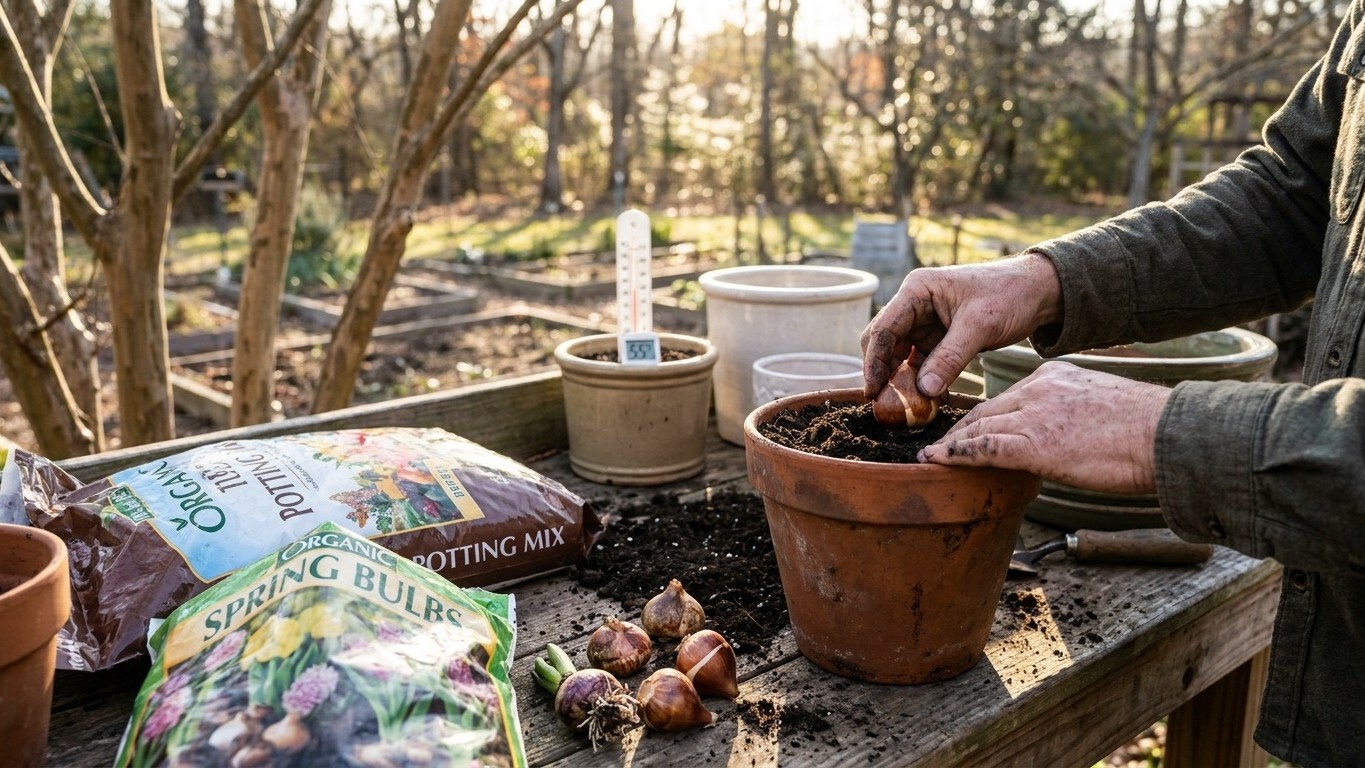

In Alabama, the obstacle with spring bulbs in pots isn’t a pot freezing solid through the roots. It’s a winter too short and too mild to do the chilling work bulbs like tulips and hyacinths require on their own. That flips the usual advice: instead of insulating containers against a hard freeze, the real job is supplying the missing weeks of cold yourself.
Why this matters in Alabama

The number that settles this is 33.1°F, the mean daily minimum of the coldest month at the Huntsville reference station, drawn from NOAA NCEI Climate Normals for 1991-2020. That’s not the record low for the state, and it isn’t an annual average either. It’s what a typical night looks like during the single coldest month of the year. And it sits barely below freezing.
A spring bulb like a tulip or hyacinth needs roughly 12 to 14 weeks with temperatures consistently under 45°F to complete the internal process that lets it flower properly. A coldest-month average minimum of 33.1°F shows that even at its worst, an Alabama winter doesn’t hold that kind of sustained chill for long. Nights dip cold, days often don’t stay cold, and the whole season is short. The ground almost never freezes hard enough or long enough to threaten a bulb sitting in a pot the way it might farther north. The real risk here is a chill deficit, not a frozen root ball.
What the zone range actually tells you
USDA hardiness zones for the state, per the USDA Plant Hardiness Zone Map (2023 edition, built on 1991-2020 normals), run from 7a to 9a. That’s a single system based on one variable: the average annual extreme minimum temperature. It’s also a statewide range, not one number, so a recommendation dated to Huntsville’s 7a-leaning conditions in north Alabama won’t hold for the Gulf Coast counties sitting closer to 9a, where winters run milder still. The practical takeaway stays the same across that range, though: bulbs that depend on a long natural chill are working against the calendar here, and forcing is the tool that fixes it.
How to do it here
Setting the chill clock
Forcing means giving a bulb its cold requirement artificially, on a timeline you control, rather than hoping the ground delivers it. The sequence is the same whether the bulb ends up blooming on a windowsill or gets planted out later.
- Pick bulbs suited to forcing, such as tulips, hyacinths, crocus, or narcissus, and set them in a container with drainage holes and fresh potting mix.
- Plant pointy end up, with hyacinth and narcissus necks left just above the soil line and tulips fully covered, then water once so the mix is evenly moist.
- Move the pot into cold storage and count backward 12 to 14 weeks from the date you want blooms.
- Use an unheated garage that stays above freezing but reliably under 45°F, or the crisper drawer of a refrigerator, kept away from ripening apples or pears since the ethylene gas they release will kill the flower bud forming inside the bulb.
- Check periodically for roots showing through the drainage holes; that’s the sign the chill period is doing its job, not a cue to stop it early.
- Once the full 12 to 14 weeks have passed, bring the pot into low, indirect light at room temperature for about a week before moving it into brighter light to flower.
Adjusting for containers left outdoors
Some gardeners skip the fridge or garage and leave potted bulbs outside for the winter instead. That works here, but a bulb in a pot needs roughly two hardiness zones more cold tolerance than the same bulb planted in the ground, since a container loses heat from every side instead of just the top. Given the 7a-9a range across the state, the safest fix is simple: move the pot against a house wall out of the wind, or sink it into a garden bed and pile mulch over the rim, rather than trusting a stand-alone pot to ride out the winter untouched.
Which bulbs are worth it
Bulbs that force reliably here
- Paperwhite narcissus: needs no cold period at all, blooms in three to four weeks from potting, the easiest option for anyone without garage or fridge space.
- Crocus: a short chill requirement and a compact stem that stands up on its own in a lightweight pot.
- Grape hyacinth (muscari): low growth habit, short chill, almost never topples.
- Hyacinth: a sturdy stem built to hold its own weight once forced.
- Compact narcissus varieties such as ‘Tete-a-Tete’: moderate chill needs and a short, dependable stem.
Bulbs that sulk
- Tall hybrid tulips: they demand the full long chill and grow a stem too heavy for most indoor pots to support without staking.
- Fritillaria: erratic under forced conditions and slow to establish in a container.
- Large ornamental onions (tall allium): heavy flower heads on stems that were never built for pot life.
- Iris reticulata: prone to rot in containers without near-perfect drainage, a tough ask in Alabama’s humid winters.
Paperwhites are worth singling out for one more reason: they’re a one-season purchase regardless. They rarely rebloom well even planted out, so forcing them costs nothing in the long run. They were never going to come back next spring anyway.
What goes wrong, and when you can still fix it
Leaves but no flower
This means the chill period ran short, either too few weeks or temperatures that crept above 45°F for stretches during storage. There’s no saving this year’s bloom. A forced bulb that’s already been through the process usually lacks the stored energy for a second attempt, so replanting it in a garden bed and hoping for a repeat next spring rarely pays off.
A flower you can barely see above the pot
A short, hidden flower usually means the pot was moved into warmth and light before the stem finished elongating. The chill was fine; the transition afterward was rushed. Nothing brings back this bloom’s height, but next time, give the pot a week or two in cool, low light before full warmth and sun, letting the stem stretch before the flower opens.
Rot at the base of the bulb
Soft, discolored bulb tissue points to standing water during the chill period, often from a container without real drainage holes or a mix packed too dense to drain. This one isn’t fixable this season; the bulb is done. For the next attempt, use a pot with functioning drainage and mix in perlite or coarse sand so water moves through instead of pooling around the bulb for weeks at a stretch.