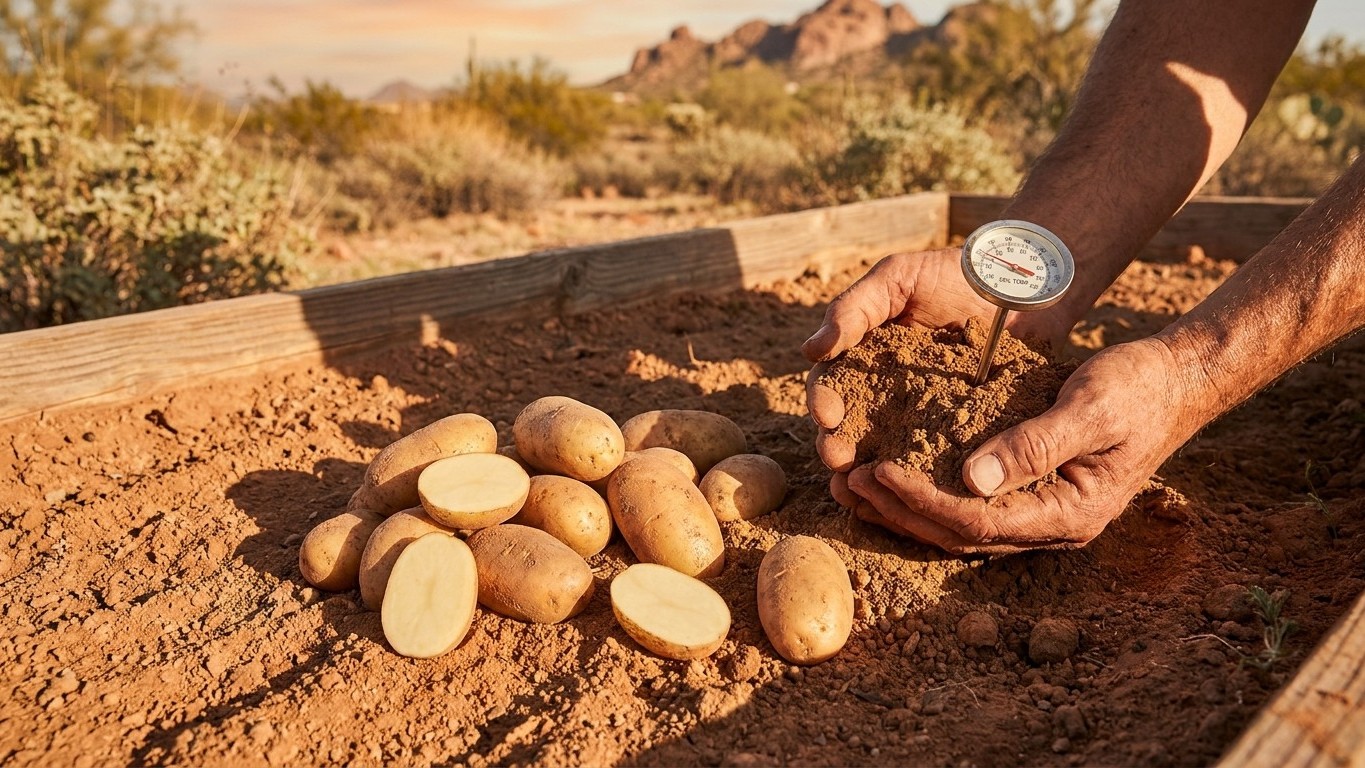

The short answer: in Arizona’s low desert, the Potato Varieties That work are the early-season ones, because that’s the only class with any chance of sizing tubers before soil temperatures cross the ceiling that shuts tuber growth down. In the state’s high country, where a real winter freeze still happens, mid-season and late varieties have room to mature. There’s no single answer for the whole state: what decides it is how fast your local soil warms up, not a variety name on a seed catalog.
The short answer
Start with what doesn’t limit potatoes in most of Arizona: frost. At the Phoenix reference station, NOAA’s 1991-2020 climate normals and daily records (station USW00023183) show freezing temperatures reached only in 6 of the last 30 springs, and NOAA lists the frost-free season there at 365 days. For a low-desert gardener, that number alone says a lot: you’re not really planning around a last-frost date, because most years there isn’t a meaningful one.
What does limit potatoes is heat. Utah State University Extension and the University of Maine Cooperative Extension (Bulletin #2077) both describe the same mechanism: once soil temperatures climb above 90°F, tuber set and fill are inhibited, and watering the plants more doesn’t reverse that. Potatoes are meant to go into the ground as soon as soil reaches 50°F, which the same sources place 14 to 21 days before the last frost date in climates that have one.
Put those two thresholds together and you get the real answer for low-desert Arizona: the growing window runs from the day soil hits 50°F to the day it crosses 90°F, and that window is short because desert soil warms quickly once spring arrives. Only early-season varieties have a realistic shot at finishing a useful bulking phase inside that stretch. Mid-season and late types need more weeks of soil in the productive range than the low desert offers before the heat ceiling shuts them down.
Arizona’s high country is a different story, and the sources are explicit that this shouldn’t be treated as a variation on the desert climate. Around Flagstaff and similar elevations, hard freezes are a normal part of the year. Soil there warms slowly and stays below 90°F for much longer, so mid-season and even late-season varieties have the calendar room to size up properly before autumn cold ends the season. The “short answer,” splits in two depending on where in the state you’re standing: early-season varieties for the low desert, and a fuller range of season classes once you’re up where winter still bites.
What actually decides it
Soil temperature sets the finish line
Everything in this decision traces back to two soil-temperature markers published by Utah State University Extension and the University of Maine Cooperative Extension: 50°F to start, and 90°F to stop. Planting happens once soil reaches that first mark. Growth continues, tubers set and fill, until soil crosses the second mark, at which point the process stalls regardless of how much water goes on the bed. In low-desert Arizona, the gap between those two soil temperatures closes fast in spring, which is exactly why the season class of the variety, early, mid-season, or late, Matters More Than any other single choice a gardener makes.
Elevation changes the climate entirely, not just the timing
The caution behind Phoenix’s frost data is worth repeating plainly: that near frost-free pattern (freeze in only 6 of 30 springs, a 365-day frost-free season per NOAA) describes the low desert, not the whole state. Flagstaff and the surrounding high country do freeze hard, on a normal, expected basis. That single difference flips which factor bounds the growing season. In the low desert, heat above 90°F ends things. In the high country, cold does, and because that cold arrives much later relative to how slowly soil warms at elevation, mid-season and late varieties get the extra weeks in the productive soil-temperature range that they need.
| Reference city | Limiting factor | Season classes that fit |
|---|---|---|
| Phoenix (low desert) | Soil above 90°F stalls tubers | Early-season |
| Flagstaff (high country) | Hard freeze ends the season | Early, mid-season, or late |
A gardener working somewhere in between, at a mid-elevation site the Phoenix and Flagstaff data don’t directly describe, has to reason from the same two mechanisms rather than borrow either city’s numbers outright: measure how fast local soil crosses from 50°F to 90°F, and let that gap dictate season class.
How to do it
- Check soil temperature directly, with a soil thermometer at planting depth, rather than relying on air temperature or a printed frost date.
- Wait until soil reaches 50°F before planting, the threshold both Utah State University Extension and the University of Maine Cooperative Extension use as the planting trigger.
- Match season class to elevation: choose early-season varieties for low-desert locations like Phoenix, and consider early through late varieties for high-country locations like Flagstaff.
- Buy certified seed potatoes rather than saving or using grocery-store potatoes; uncertified seed carries virus into the crop.
- Plant seed pieces once the 50°F soil mark is reached, which in climates with a real frost season lands roughly 14 to 21 days before the last frost date.
- Monitor soil temperature through the growing weeks, since it’s the number that predicts when tuber set and fill will stop, not the air temperature or the calendar month.
- In low-desert plantings, plan to harvest before soil crosses 90°F rather than trying to carry the crop through summer heat.
- In high-country plantings, harvest before the season’s first hard freeze returns, using the longer cold-bounded window to let mid-season or late varieties finish.
What goes wrong
- Planting a mid-season or late variety in the low desert. Tubers never finish filling because soil crosses 90°F before the plant has had enough time in the productive range. Remedy: switch to an early-season variety timed to the 50°F soil mark.
- Treating Arizona as one climate. Using Phoenix’s near-frost-free pattern (freeze in only 6 of 30 springs, a 365-day frost-free season per NOAA) to plan a high-country garden ignores that Flagstaff-area elevations freeze hard on a normal basis. Remedy: use the soil-temperature and frost data for your own reference city, not a statewide assumption.
- Using uncertified seed potatoes. Grocery-store or saved potatoes can carry virus into the seed piece and the crop that follows. Remedy: buy certified seed potatoes.
- Assuming extra irrigation offsets a heat spike. Soil above 90°F inhibits tuber set and fill, and watering does not reverse that mechanism. Remedy: dig the crop before soil reaches that threshold rather than trying to water through it.
- Waiting for a calendar frost date to decide when to plant in the low desert. At the Phoenix reference station, freeze occurred in only 6 of 30 recorded springs, so a calendar date isn’t a reliable trigger there. Remedy: plant once measured soil temperature reaches 50°F, regardless of what the calendar says.
Common questions
Can potatoes grow year-round in Phoenix? No. Even though hard frost is rare there, soil above 90°F inhibits tuber set and fill according to Utah State University Extension and the University of Maine Cooperative Extension, so the practical approach is one spring crop planted once soil measures 50°F, not a year-round planting.
Is there a single potato planting date for the whole state of Arizona? No. Planting is triggered by measured soil temperature reaching 50°F, and how quickly that happens, plus how quickly soil later crosses 90°F, differs sharply between a low-desert reference city like Phoenix and a high-country reference city like Flagstaff.
What does “early-season” mean for a potato variety? It’s the season class published by Utah State University Extension and the University of Maine Cooperative Extension, describing how the variety’s timing compares to mid-season and late types. Neither source publishes an exact days-to-maturity number, so season class, not a day count, is the figure to plan around.
Should saved potatoes from a previous harvest be used as seed? No. Uncertified seed carries virus, which is why both university extensions point gardeners toward certified seed potatoes rather than grocery-store or home-saved tubers.