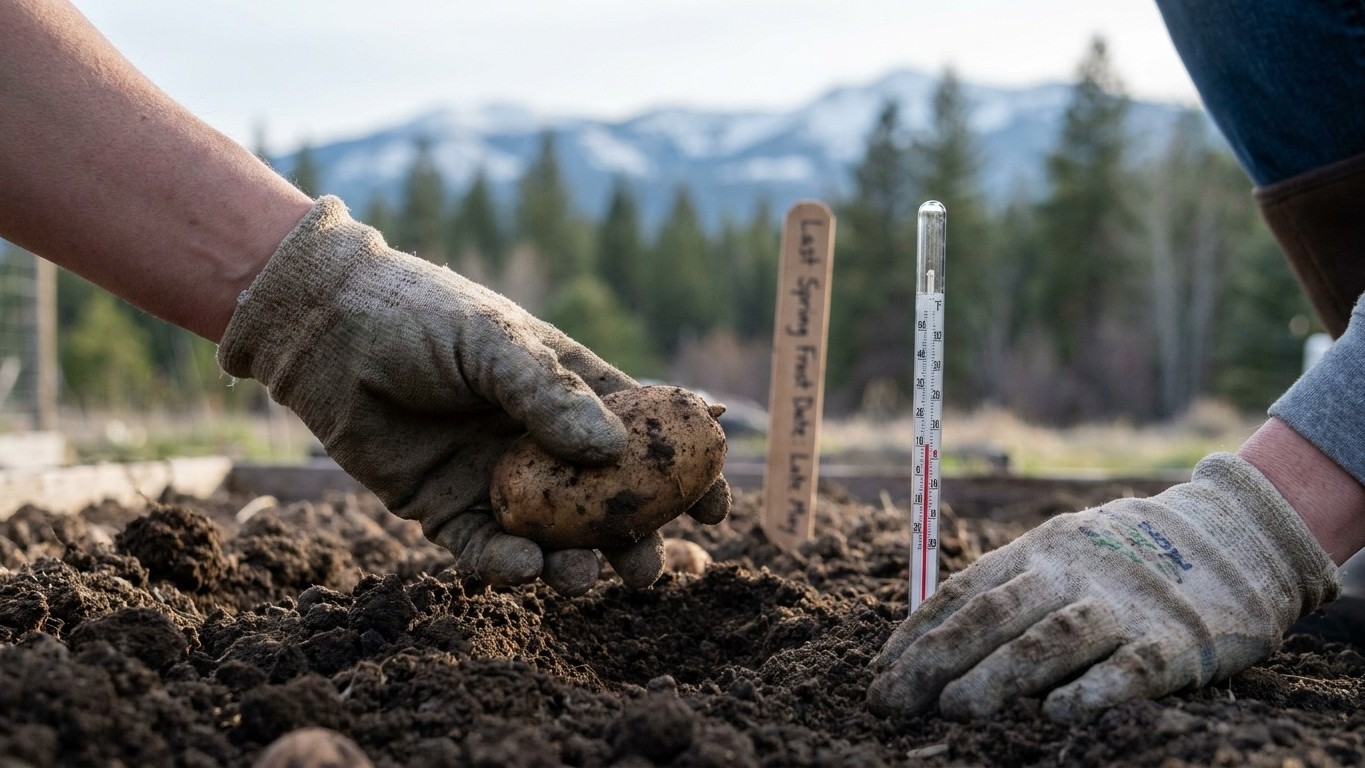

Alberta gardeners count back from the average last frost at Calgary International Airport, May 21, a figure kept by Environment and Climate Change Canada in its Canadian Climate Normals for 1981-2010. Potatoes go into the ground once soil warms to 50 F, which lands 14 to 21 days before that date, so late April into early May near Calgary. Further north or at elevation, push the window later.
The short answer
The number to anchor on is May 21, the mean last spring frost recorded at the CALGARY INT’L A station and published by Environment and Climate Change Canada in the 1981-2010 Canadian Climate Normals. Utah State University Extension and the University of Maine Cooperative Extension both describe the planting rule the same way: potatoes go in as soon as soil temperature reaches 50 F, and that point typically falls 14 to 21 days before the last frost date for a given location. Run that math against Calgary’s May 21 mean and the planting window lands somewhere between roughly April 30 and May 7, depending on how quickly a particular plot’s soil warms that season.
That word “mean” Matters More Than it looks. A mean last frost date is not a cutoff after which frost stops happening. It is the midpoint of a distribution: in one year out of two, the last frost at Calgary International Airport falls later than May 21, sometimes well into the following weeks. Treat the date as a planning anchor, not a promise, and build in some cushion if a hard freeze would set the crop back.
The other qualifier worth saying plainly: May 21 describes one station, not the province. Calgary International Airport sits at a specific elevation and exposure, and Alberta stretches from river-valley farmland to foothill benches to the Peace Country in the north. A gardener in a higher, more exposed spot, or one further north, should expect the local last frost to run later than the Calgary figure, sometimes by weeks. There is no single Alberta date. There is a Calgary date, and a job for each gardener to adjust it against what their own soil and site are doing.
One more note for anyone cross-referencing this site’s US content: Canadian normals here are drawn from the 1981-2010 period, while the American figures elsewhere on this site use the 1991-2020 period. The two aren’t the same baseline, so don’t average them or treat a US city’s frost date as a stand-in for an Alberta one.
What actually decides it
Soil temperature, not the calendar
The 50 F soil threshold is not a rule of thumb pulled from tradition. Seed pieces planted into colder, wetter soil sit without growing, and that idle time is exactly when rot organisms take hold. A calendar date can look identical in two different springs and still describe two very different soils: a dry, south-facing raised bed can cross 50 F well before a heavy, shaded clay plot ten feet away. That is the case this page can’t cover for every reader: a small backyard bed against a south wall, or a slope that catches full afternoon sun, will often be plantable days to weeks ahead of an open field nearby, even though both sit under the same regional frost date.
The heat ceiling on the other end
Utah State University Extension and the University of Maine Cooperative Extension flag the opposite limit too: once soil temperatures climb above 90 F, tuber set and fill are inhibited, and watering does not undo that damage once it happens. This is the mechanism, not a schedule, and it cuts against planting late to “play it safe” on frost. A gardener who waits until well past the frost risk to plant is trading a smaller, more manageable problem (a light frost on emerged foliage) for a bigger one (soil heat shutting down tuber growth during the exact weeks the crop needs to size up). In a warm, exposed Alberta plot, that heat ceiling can arrive sooner than expected, which argues for planting near the early edge of the window rather than the late edge.
Why the mean date cuts both ways
Because the May 21 figure is a midpoint, the decision isn’t simply “plant after it.” A gardener chasing an early crop, or working a site where summer heat risk is real, has reason to plant at the 50 F soil mark even if that lands well before May 21, accepting some frost exposure on tender young shoots (which can often be protected with a light hilling or covering) in exchange for avoiding the heat ceiling later. A gardener in a colder, low-lying spot where late frosts are common has the opposite calculation to make.
How to do it
- Start from the regional frost reference. For anywhere near Calgary, that’s the CALGARY INT’L A mean of May 21; for other parts of Alberta, look for the closest official station rather than borrowing the Calgary figure wholesale.
- Check actual soil temperature at planting depth with a soil thermometer rather than guessing from air temperature or the calendar.
- Order certified seed potatoes. Uncertified seed, including potatoes bought for eating, can carry virus that won’t show up until the crop is already compromised.
- Cut larger seed potatoes into pieces with at least one or two eyes each, and let the cut surfaces callus for a couple of days before planting to reduce rot risk.
- Plant once soil at planting depth reaches 50 F, which for the Calgary reference point typically falls 14 to 21 days before May 21.
- Hill soil up around the stems as plants grow, which protects developing tubers from light and helps buffer soil temperature swings.
- Watch the weather through the following weeks; if a late frost threatens emerged shoots, cover them or hill soil higher for protection.
- Track soil temperature again as summer approaches; where hot spells are likely, favor an early season class and plan to dig before soil temperatures push past the 90 F ceiling for an extended stretch.
What goes wrong
- Planting by the calendar date instead of soil temperature. Seed pieces sit in cold, wet soil and rot before they sprout. Check soil temperature directly at planting depth rather than trusting that a given date means the soil is ready.
- Using grocery-store potatoes as seed. These are not certified and can carry virus that stunts the crop invisibly for weeks. Buy certified seed potatoes specifically sold for planting.
- Treating the mean frost date as a safe cutoff. Since frost falls later than the mean in about half of all years, a late cold snap can still hit shoots that emerged right on schedule. Keep row cover or extra soil on hand to hill over exposed plants if a frost warning comes through.
- Ignoring the heat ceiling during a hot stretch. Once soil runs above 90 F for a sustained period, tuber sizing stalls and extra watering won’t reverse it. Favor an early season class in hot, exposed sites and dig before the hottest weeks arrive.
- Applying one province-wide date everywhere. A gardener in a northern or higher-elevation part of Alberta who plants on the Calgary schedule risks planting too early for their actual local frost pattern. Adjust the reference date based on how the local site compares to Calgary in elevation and exposure, since no single figure covers the whole province.
Common questions
What is the last frost date for potatoes in Alberta?
There is no single figure for the whole province. The reference point available here is Calgary International Airport, where Environment and Climate Change Canada records a mean last spring frost of May 21 across the 1981-2010 normals period. Locations further north or at higher elevation should expect their own last frost to run later than this.
Can I plant potatoes before the last frost?
Yes, and the sources used here recommend it: planting happens as soon as soil reaches 50 F, which typically lands 14 to 21 days before the last frost date, not after it. Frost risk to emerged shoots is managed with hilling or covering rather than by delaying planting past the soil-temperature mark.
What’s the difference between early, mid-season, and late potatoes?
Utah State University Extension and the University of Maine Cooperative Extension describe potatoes by season class rather than a specific number of days to maturity. An early-season potato reaches usable size sooner in the growing season, which matters most where summer heat risks shutting down tuber fill; mid-season and late types take longer to reach full size but aren’t assigned a fixed day count by either source.
Should I buy certified seed potatoes?
Both extension sources treat this as a basic requirement, not an optional upgrade. Uncertified seed, including potatoes intended for eating, can carry virus that reduces yield without any obvious sign until the crop is already affected. Certified seed is inspected specifically to avoid that risk.