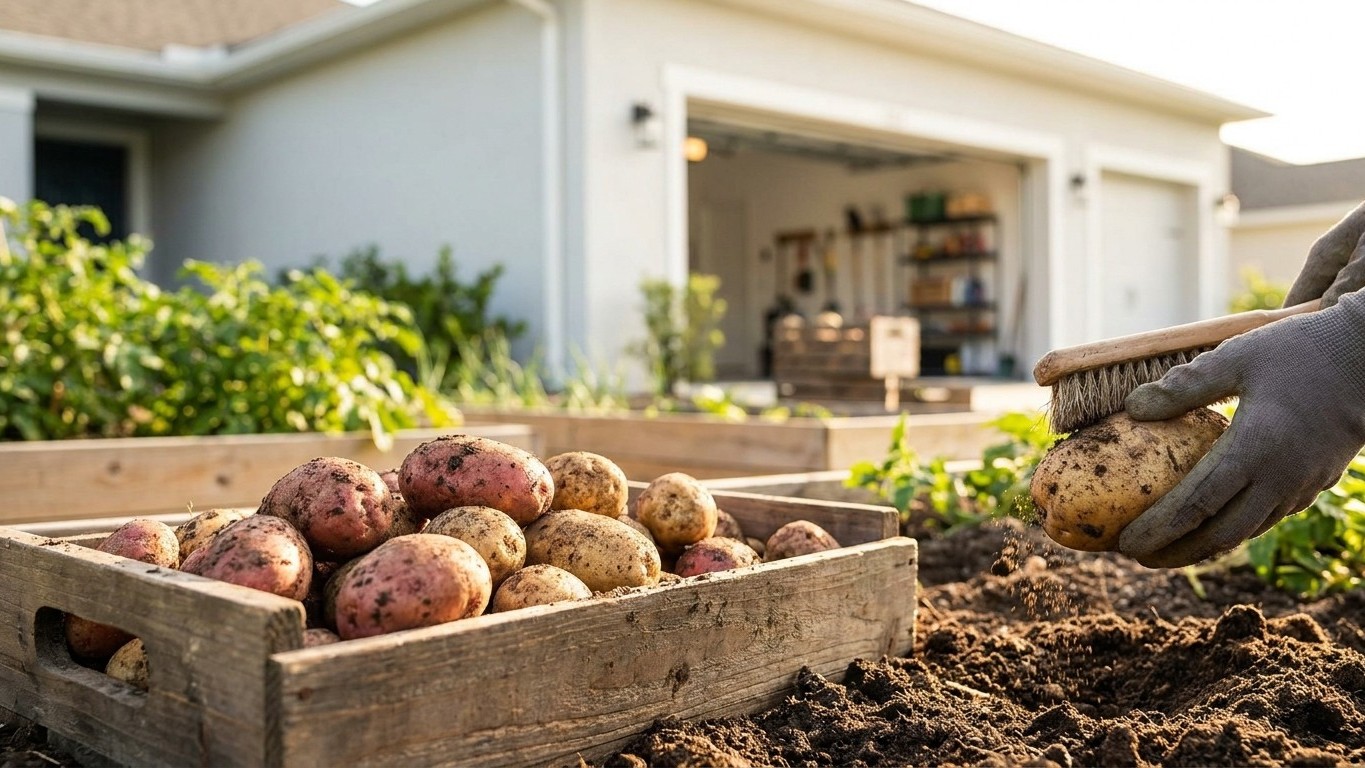

In north Florida, potatoes come out of the ground in spring, not fall, so the region’s frost window matters more for planting than for harvest. What decides whether stored tubers keep is temperature after digging: no unheated space in this climate reliably holds the 40-45 F that curing and storage require, which means refrigeration, not a root cellar, does the real work here.
The short answer
Two numbers frame everything about growing and keeping potatoes in north Florida. The first fall freeze, at the Jacksonville reference station, arrives somewhere between November 26 and December 13, based on NOAA NCEI’s 1991-2020 Climate Normals. The coldest month of the year, on average, has a mean daily minimum of just 42.9 F. Neither number describes a place that gets seriously cold, and that shapes the whole calendar.
Because freezes arrive late and mild, north Florida growers Plant Potatoes in the cooler months and dig them in spring, well ahead of the summer heat that would otherwise cook the plants. Frost isn’t really the threat to the crop here. Heat is. That’s the opposite of how the potato calendar works in most of the country, where digging happens in late summer or fall and storage carries the crop through a genuinely cold winter.
The 42.9 F figure matters for a different reason: it’s the mean minimum, not the average, and not the record low. It describes the coldest nights of the coldest month, on average, not a temperature a room sits at all day. A garage or closet in north Florida during that month might dip near 43 F overnight, but it will likely climb into the 50s or 60s by afternoon. That swing is the reason no unheated indoor space here holds a steady 40-45 F band through an entire storage season. It runs too warm far more often than it runs too cold.
One caution applies before any of this: this frost window is a north Florida figure, tied to an inland station near Jacksonville. Central and south Florida are essentially frost-free, and the growing calendar there inverts entirely, with the main season running through winter and summer becoming the difficult stretch. A gardener in Orlando or Miami working from this page’s frost dates would be planning around a freeze that, for practical purposes, doesn’t happen where they live.
Curing, and where
Curing sets the skin so potatoes survive weeks of handling and storage without bruising or losing moisture. Utah State University Extension puts the target at 55-60 F with high humidity, held for 2 to 3 weeks. That’s a narrow band, and Florida’s spring digging season sits close to it only in the early morning, if at all.
- Dig on a dry day, after the vines have died back, and let the tubers sit on the soil surface in shade for an hour or so to shed loose dirt. Don’t wash them and don’t scrub the skin.
- Get them out of direct sun immediately. By the time north Florida potatoes are ready to dig, spring mornings often warm into the 70s and 80s well before noon, far above the curing range.
- Find the coolest, most humid indoor space in the house. Basements are rare in this state, so the better substitutes are a windowless interior closet, an unconditioned laundry room, or a garage kept out of afternoon sun. A shaded porch works only in the earliest weeks of spring, before daytime highs climb; later in the season it runs too warm.
- Hold the space as close to 55-60 F as the house allows. In practice, that often means a spare room with the air conditioning set a few degrees higher than the rest of the house, since no unheated space in Florida reliably sits in that range for 2 to 3 straight weeks in spring.
- Keep humidity up with damp burlap draped over the tubers or an open pan of water nearby, since air conditioning tends to dry a room out as it cools it.
- Check the skins after 2 to 3 weeks. Cured skin resists a light thumbnail scrape; uncured skin peels or bruises easily.
Storing through this winter
Once cured, potatoes want dark storage at 40-45 F, according to Utah State University Extension, or 38 F at 95 percent humidity, according to the University of Maine Cooperative Extension. Set that against north Florida’s coldest month, which averages a nightly minimum of only 42.9 F and warms considerably during the day, and the mismatch is plain: this state simply doesn’t have a season where an ordinary room sits at 38-45 F around the clock.
There’s a timing wrinkle that makes this harder, not easier. Because the crop is dug in spring rather than fall, storage begins right as Florida is warming toward summer, not cooling toward its coldest month. By the time the coldest month with its 42.9 F mean minimum actually arrives, the harvested crop is typically long gone from storage, already eaten or planted for the next round. The storage window that matters for Florida potatoes falls during the warmest stretch of the year that curing and early storage overlap, not the coolest one.
Freezing, is essentially not a risk anywhere in this state’s potato calendar. The problem runs the other direction: warmth. A garage or pantry that spends the season in the 60s and 70s will push stored tubers toward early sprouting and gradual shrinkage well before a northern grower’s basement would even approach that point. For anyone trying to hold potatoes for more than a few weeks past curing, a spare refrigerator set toward the upper end of its range, monitored with a thermometer, comes far closer to the 38-45 F band than any unheated space this climate offers. Dark, ventilated, and cold is the goal; in north Florida, cold is the piece that has to be manufactured rather than found.
What goes wrong here
- Tubers scald in the field. Digging late in the morning, once the sun is high, leaves potatoes exposed to direct heat on bare soil before they’re gathered. Dig early, before mid-morning, and move tubers to shade within minutes of coming out of the ground.
- The curing space runs too warm to properly cure. A garage or porch that’s already at 75-85 F by the time the crop is dug won’t hold the 55-60 F band Utah State University Extension calls for, and skins set poorly as a result. Move curing indoors to the coolest interior room in the house, with air conditioning if needed.
- Warmth and humidity together invite rot. A closed, damp space that’s also warm is close to ideal for mold and soft rot to take hold before curing finishes. Keep some air movement through the space, and pull out and discard any tuber that shows a soft spot before it spreads to the rest.
- Nothing in the house stays cold enough to store the crop long-term. With the coldest month averaging only a 42.9 F nightly minimum, and warming well past that by day, sprouting shows up sooner here than in a genuinely cold climate. Plan to use or process the harvest within a few weeks of curing, or shift longer storage into a dedicated refrigerator.
- Northern frost schedules get applied where they don’t fit. A planting or harvest calendar built around this region’s fall frost window has no bearing on central or south Florida, which stay effectively frost-free and run an inverted season, winter as the main growing stretch and summer as the stress period. Follow the calendar that matches the actual part of the state, not a single statewide date.
Common questions
When should I harvest potatoes in Florida?
In north Florida, harvest generally happens in spring, once the vines have died back and before summer heat sets in. The fall frost window (November 26 to December 13, per NOAA NCEI) matters mainly for planting timing, not for a harvest deadline, since Florida’s growing season runs opposite the pattern seen in colder states.
Can I store potatoes in an unheated garage in Florida?
Only briefly. With the coldest month averaging a 42.9 F nightly minimum and warming considerably by day, no unheated Florida space holds the 40-45 F range that Utah State University Extension recommends for storage, or the 38 F the University of Maine Cooperative Extension notes for higher-humidity storage. A refrigerator is the more reliable option for anything beyond short-term holding.
Does frost matter for growing potatoes in north Florida?
Some, but less than heat does. The region’s first freeze arrives late in the fall, and three of the thirty years in the NOAA NCEI record saw no freeze at all at the reference station. Potatoes planted in the cooler months and dug in spring largely sidestep frost risk; the bigger threat to the crop is the heat that arrives once spring turns toward summer.
Why do stored potatoes sprout so fast in Florida?
Because ambient storage spaces here run warmer than the 40-45 F (or 38 F) range the crop needs, tubers stay active rather than dormant. Sprouting and shrinkage typically show up sooner than they would in a colder climate, which is why growers who want to hold potatoes for more than a few weeks generally need a dedicated cold space rather than a garage, closet, or pantry.