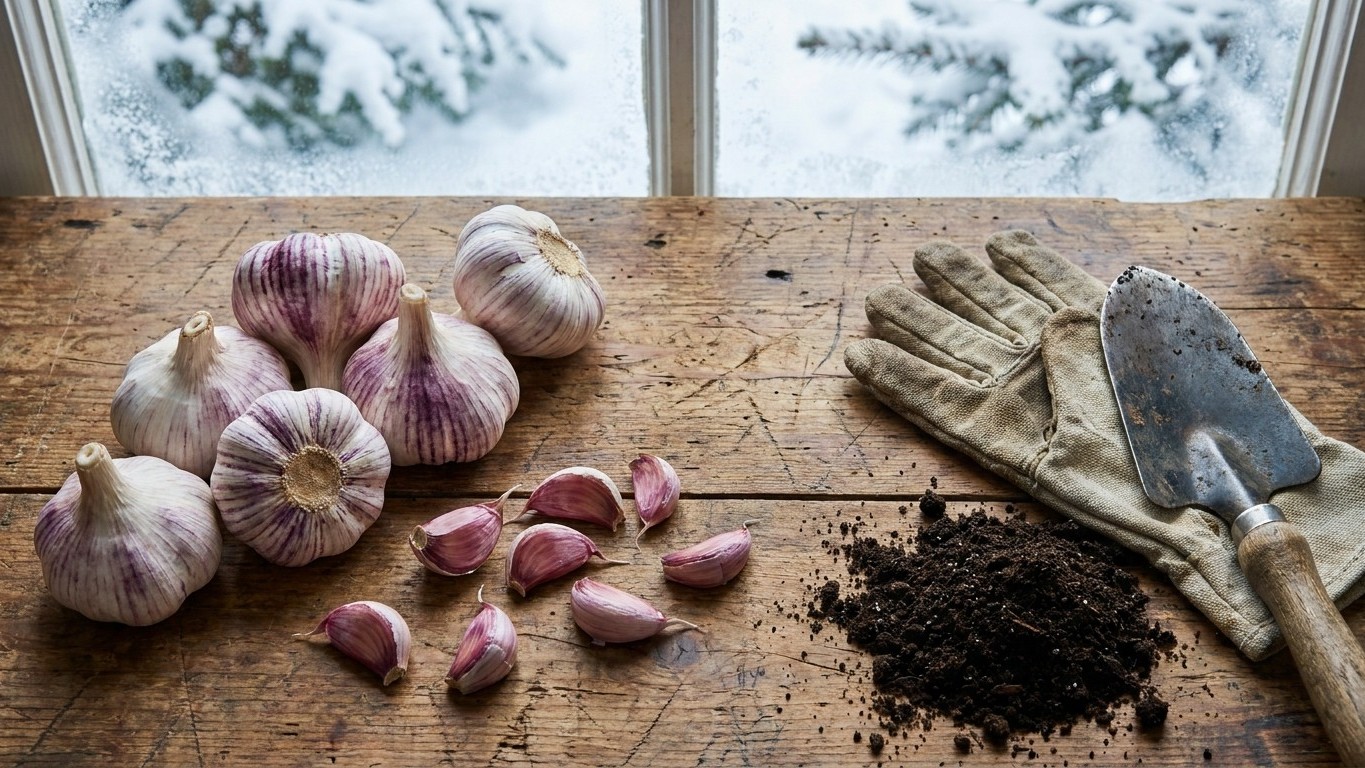

Siberian garlic is a hardneck Purple Stripe type, prized for a clean, medium-to-strong flavor without the sharp bite some strong garlics carry. Plant the cloves in fall, several weeks before the ground freezes solid, so roots can establish before the plant goes dormant. But the exact planting date matters less than the winter that follows: this variety needs a real stretch of cold to split into cloves, and that requirement is what separates a full head from a single round bulb.
What Siberian Garlic actually is
Siberian garlic belongs to the Purple Stripe family, a hardneck type that colors its wrappers with deep violet streaks over papery white skin. The flavor is clean and medium-to-strong, without the harshness a strong garlic often carries, placing it closer to an everyday cooking clove than a specialty roasting bulb. Being hardneck, it grows a rigid central stalk, called a scape, that curls upward in late spring and gets cut off rather than left to flower. Each head splits into 4 to 12 cloves, fewer than most softnecks but noticeably larger and easier to peel, since the skins release almost in one motion instead of clinging in thin layers.
That ease comes at a cost in the pantry: this variety keeps only 3 to 4 months at room temperature, well short of the longer shelf life some softneck types manage. It isn’t a bulb to tuck away and forget; it’s the head to reach for first once harvest comes in. No disease or pest resistance is published for this variety, so growers should plan around general good practice, crop rotation and clean seed stock, rather than counting on any built-in tolerance.
Will it get the cold it needs where you are
Garlic doesn’t divide into cloves just because it’s cold outside; it divides because the bulb passes through a sustained stretch of low temperature after planting, a process that triggers the switch from a single round bulb to a head of separate cloves. Skip that stretch, or cut it short, and a grower lifts something closer to a golf-ball-sized round in midsummer, not a head worth curing. For a Purple Stripe hardneck like Siberian garlic, that cold requirement runs on the higher end of what garlic in general demands, which is exactly where a lot of general planting guides go quiet.
Where the cold comes easy
Regions with long, hard winters give this variety the cold run it’s built for without extra work. The Upper Midwest and Northern Plains, the interior valleys of Alaska, and the mountain West from Wyoming through the Colorado high country all deliver months of ground-freezing cold well past what a hardneck Purple Stripe needs to split cleanly. Gardeners there can plant, mulch, and walk away until spring with reasonable confidence the process will happen on its own.
The marginal middle and the too-mild coasts
Move into the transition belt, the interior Mid-Atlantic, the Piedmont of Virginia and North Carolina, the Tennessee Valley, and the picture gets less certain. Winters there are cold enough most years, but a mild one can shortchange the bulb. The safer move in a marginal climate is to refrigerate the seed cloves for several weeks before planting, mimicking the cold they might not fully get in the ground, then plant as usual once the pretreatment is done.
Along the Gulf Coast, in most of Florida, and through coastal Southern California, winters typically don’t deliver enough sustained cold for a Purple Stripe hardneck to divide reliably, refrigeration or not. That’s not a reason to give up on growing garlic there; it’s a reason to grow a different type. Softneck varieties and some Silverskin types ask for markedly less winter chill to split, and they’re the more realistic choice where frost is rare or brief. Forcing a high-chill Purple Stripe through a mild coastal winter usually ends in the same outcome a failed cold period always produces: a single, undivided round bulb that never became a head.
When to put the cloves in
Garlic planting runs backward from the calendar most vegetables follow. Instead of counting forward from the last spring frost, growers count backward from the first fall frost, aiming to get cloves into the ground with enough time to root before the soil locks up, but not so much time that green top growth pushes through before winter sets in. Roots that form in fall anchor the plant and ready it to resume growth once soil warms in spring; top growth that appears too early just gets damaged by hard freezes.
In cold-winter regions, that generally means planting in the weeks around the first fall frost, often September into October, giving cloves several weeks of mild soil temperature to root before a hard freeze locks things down. In milder regions, the window slides later, commonly October into November. In warm-winter areas where frost arrives late if at all, planting often waits until November or even December, timed less to frost and more to the arrival of cooler, wetter weather that lets roots form without summer-like heat stress.
None of these windows line up the same way everywhere. Extension offices and garden references in different states genuinely disagree on exactly how many weeks before frost is ideal, because local soil, rainfall, and snow cover timing all shift the math. The one point of agreement is the sequence itself: root first, sit dormant through winter, then push rapid growth once the ground warms.
Hardneck or softneck: what this one asks of you
Siberian garlic is a hardneck, and that habit shapes almost every decision a grower makes with it, starting in late spring when a curling flower stalk, the scape, pushes up from the center of each plant. That scape gets cut off, not left to mature, both because it saps energy the bulb needs to size up and because most cooks want the tender young scape itself, which has its own following as a garlicky vegetable in stir-fries and pesto. Skipping that cut is one of the most common ways growers shortchange their own harvest.
In exchange for that extra step, hardneck types like this one give fewer cloves per head, 4 to 12 for Siberian garlic, but each one is noticeably larger and peels away from its papery skin with far less fuss than the small, tightly wrapped cloves of a softneck. The tradeoff shows up again in storage: those same large, easy-peel cloves don’t keep as long, holding only 3 to 4 months at room temperature before quality drops.
That combination of traits lines up with where hardneck garlic tends to thrive. Long, cold winters push hardnecks to perform, and Siberian garlic, with a chill requirement on the higher side even for a hardneck, fits squarely into that pattern. Softnecks, by contrast, generally tolerate milder winters and reward growers with smaller cloves that store for months longer, the trade a warmer-climate grower is usually better off making instead.
Growing and curing it without losing the crop
Plant cloves about 2 inches deep with the pointed end up, spaced roughly 4 to 6 inches apart within the row and 12 to 18 inches between rows, giving each head room to size up without crowding its neighbors. A layer of mulch, straw or shredded leaves 4 to 6 inches deep, matters more for an overwintered crop like garlic than for most fall plantings, since it buffers the soil against freeze-thaw cycles that can heave newly rooted cloves out of the ground before they’ve anchored.
Watering continues through spring as the plant bulks up, then stops three to four weeks before harvest; wet soil right up to lifting invites staining on the wrappers and can encourage rot in storage. The clearest sign the bulb is ready is in the leaves, not the calendar: once the lower third to half of the leaves have browned while upper leaves are still green, the head has generally finished sizing, and it’s time to lift, since waiting for every leaf to die back usually means the wrappers have already started splitting underground.
Curing is where a lot of otherwise good harvests get lost. Bulbs need three to four weeks in a shaded, dry, well-ventilated space, out of direct sun, with air moving freely around them rather than stacked in a pile. Cut or braid only after the necks have fully dried and tightened; trimming a still-damp neck seals in moisture that turns to rot within weeks. Given that this variety only holds 3 to 4 months even when properly cured, the payoff for careful curing is a shorter but genuinely usable storage window, not a wasted crop.
Common questions
Can Siberian garlic be grown in a warm climate without refrigerating the cloves first?
It can be planted, but a mild winter without pretreatment often fails to trigger clove division, leaving a single round bulb instead of a head. Refrigerating cloves for several weeks before planting is the workaround in marginal zones; in consistently mild, frost-poor climates, a softneck or Silverskin type asking for less chill is more reliable.
How does Siberian garlic differ from other Purple Stripe varieties?
Differences between Purple Stripe varieties largely come down to clove count, flavor intensity, and storage life, since all share the family’s colored wrappers and hardneck habit. Siberian’s own figures, 4 to 12 cloves per head and a 3-to-4-month shelf life, place it on the shorter-keeping end of the group.
When should the scape be cut?
The scape should be cut once it curls, before it straightens and uses up energy the bulb needs to size properly. Leaving it on reduces bulb size at harvest, though the trimmed scape itself is edible and often used in cooking.
How long does Siberian garlic actually keep once it’s cured?
About 3 to 4 months at room temperature, noticeably shorter than many softneck varieties. That makes it a variety to use early in the storage season rather than one to plan around for winter-long supply.