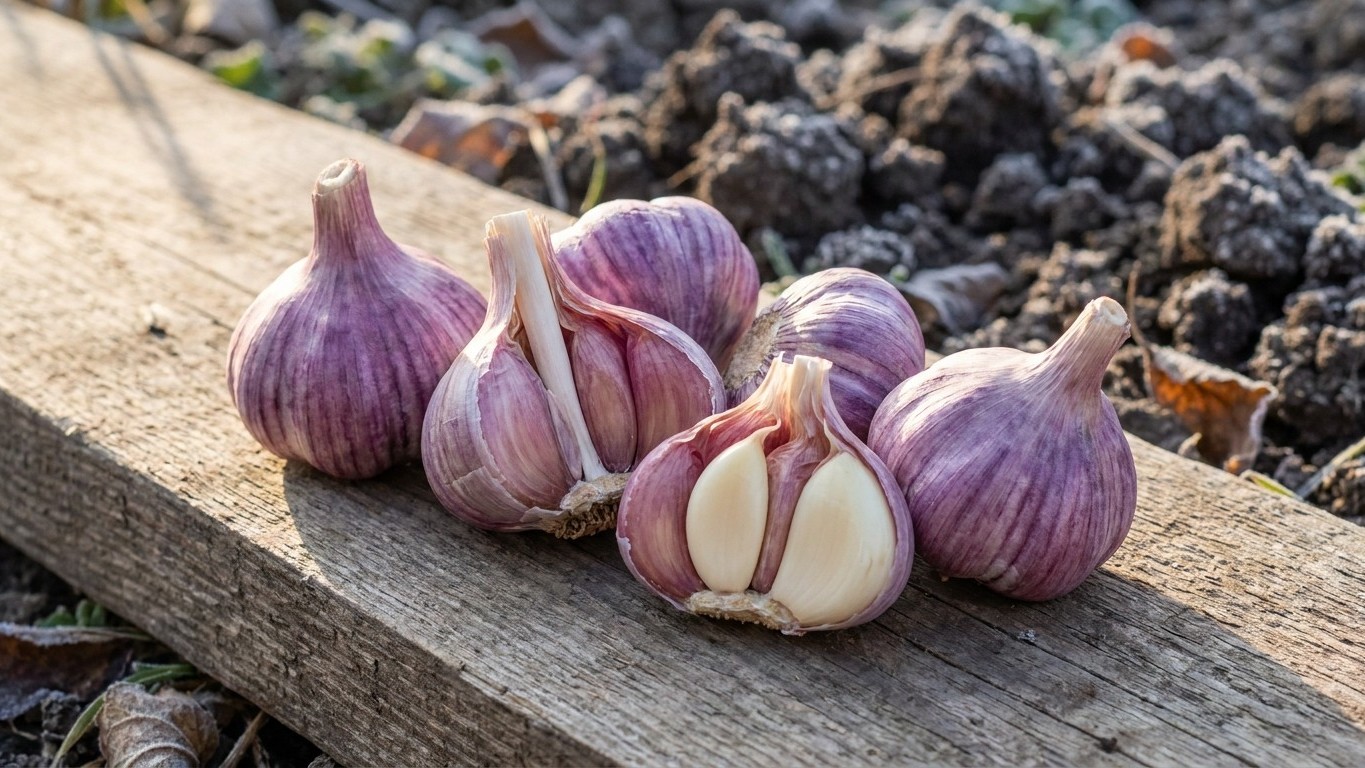

Turban garlic is the earliest type in the ground to send up a scape and the earliest to finish, and Uzbekistan garlic follows that script with a purple-wrapped bulb full of large, easy-peeling cloves. It’s a hardneck that wants a real cold snap after planting, which is exactly what makes the timing question the one worth getting right before you get the one worth eating.
What Uzbekistan Garlic actually is
Uzbekistan garlic belongs to the Turban group, one of the ten recognized botanical types of garlic and, alongside Rocambole and Porcelain, one of the true hardnecks. Hardneck garlics send up a rigid central stalk, the scape, that pushes through the middle of the plant in late spring. That stalk is what separates a Turban from a softneck like Silverskin or Artichoke, and it’s also why the bulb looks the way it does: fewer cloves, arranged in a single neat ring around the stem.
The catalogue description for this variety notes shiny, bright purple wrappers that open to reveal equally colorful, big cloves with an earthy flavor and spicy zing. That’s worth knowing before you plant, because Turban types tend to run hotter and more assertive raw than roasted, and cooks used to mellow softneck garlic are often surprised by the punch a Turban clove carries.
Storage is the tradeoff. Hardneck varieties in general keep shorter than softnecks, and this one is on the short end even by hardneck standards: 4 to 12 cloves per bulb that peel easily, but a room-temperature shelf life of only 3 to 4 months. No disease or pest resistances are published for this variety, so treat it as a standard garlic in terms of susceptibility to rust, white rot and the usual soil-borne problems, and plan to eat it first, ahead of the softnecks that will still be good at Thanksgiving.
Will it get the cold it needs where you are
Garlic doesn’t grow into a segmented bulb just because you planted a clove. It grows into one because that clove sat through weeks of cold soil, and the cold triggered a hormonal shift called vernalization that tells the plant to divide into cloves instead of just swelling into a single round mass. Skip the cold, or shortchange it, and you plant a nice clove in October and lift a nice round bulb in July, no division, no braid-worthy head. That failure mode is the most common disappointment with hardneck garlic, and it’s almost always a climate mismatch rather than a growing mistake.
Where the cold is not in question
In the country’s genuinely cold-winter regions, roughly USDA Hardiness Zones 3 through 6, this is a non-issue. Minnesota, Vermont, Montana, upstate New York, the Dakotas: soil in these regions freezes solid and stays cold for months, delivering far more chilling than a Turban type needs to divide properly. Growers in these zones can plant this variety with confidence and without any workaround. The USDA Plant Hardiness Zone Map is the standard reference for checking where your address falls.
Where it gets marginal
Zones 7 and 8 are the gray area: the Virginia and North Carolina piedmont, much of the Mid-Atlantic, and the milder valleys of the Pacific Northwest. Winters here are cold enough most years to satisfy many hardnecks, but a Turban, planted late or hit by an unusually mild winter, can come up short on chilling hours. Growers who want a guaranteed result rather than a good-odds one can refrigerate the cloves at roughly 40°F for four to eight weeks before planting, simulating the cold the ground might not fully deliver. It’s the standard fix gardeners in these zones use for any hardneck they’re not certain will get enough winter.
Where it won’t work as planted
Zones 9 and 10, covering peninsular Florida, the Gulf Coast, southern Texas and coastal Southern California, don’t deliver the sustained cold a Turban hardneck is built around. Two honest options exist here, and neither is “don’t try.” The first is the same pre-chill trick used in marginal zones, pushed longer and treated as mandatory rather than optional. The second, and often more reliable, is to skip the hardneck entirely and grow a softneck type bred for low-chill climates, such as an Artichoke or Silverskin variety, which needs far less winter to divide properly. There’s no published chilling-hours figure for Uzbekistan garlic specifically, so growers in these zones are working from general hardneck guidance rather than a variety-specific number.
| Region type | Example states | What to do |
|---|---|---|
| Cold winter (Zones 3-6) | Minnesota, Vermont, Montana | Plant as-is, no adjustment needed |
| Marginal (Zones 7-8) | Virginia piedmont, coastal Pacific Northwest | Refrigerate cloves 4-8 weeks before planting |
| Warm winter (Zones 9-10) | Florida, Gulf Coast, southern Texas | Extended pre-chill, or switch to a low-chill softneck |
When to put the cloves in
Garlic is a fall-planted, summer-harvested crop everywhere in the country, but the specific window shifts by region and, honestly, by whose regional guide you’re reading. The anchor point that matters more than any calendar date is the first fall frost. Cloves need enough time in the ground to root and establish before the soil freezes hard, but not so much time that they push significant green top growth, which can get damaged over winter and set the plant back in spring.
In cold northern regions, that generally means planting from mid-September through October, giving roots four to six weeks to establish before a hard freeze locks the ground. In milder, transitional zones, the window slides later, often into November, since the ground stays workable and frost-free longer into the fall. In warm-winter zones, growers planting Turban types after a pre-chill period often wait until late November or even December, timing the planting so the cloves spend their coldest weeks in the refrigerator rather than in ground that was never going to get cold enough anyway.
Regional extension offices and garlic growers don’t fully agree on exact dates within these windows, and that’s worth saying plainly rather than papering over with false precision. The safer approach for a first-time grower is to watch the ground, not the calendar: plant once nighttime temperatures are reliably falling but before the topsoil has frozen, and err toward the earlier end of your regional window rather than the later one. Turban types, being early to mature, tend to forgive an earlier planting date better than a late one.
Hardneck or softneck: what this one asks of you
Uzbekistan garlic is a hardneck, and that habit sets the whole growing rhythm. A rigid central scape emerges in late spring and curls as it grows; it needs to be cut, not left to flower and set seed, because garlic is harvested as a bulb and letting the scape run diverts energy away from the cloves the grower actually wants. Cutting the scape also happens to produce a genuinely useful kitchen scrap: the curled stalks are edible and popular chopped into stir-fries or blended into pesto.
Hardnecks in general trade quantity for size: fewer cloves per bulb, arranged in a single ring, but each clove noticeably larger and easier to peel than what a softneck offers. Uzbekistan garlic fits that pattern exactly, with 4 to 12 large cloves that peel cleanly. The other side of that trade is storage life. Hardnecks don’t keep as long as softnecks, and this variety sits at the shorter end even among hardnecks, holding for only 3 to 4 months at room temperature before quality drops.
None of this is accidental, and it maps directly onto the climate question above. Hardnecks like this one evolved their scape and vernalization requirement in regions with long, real winters, which is exactly where they perform best and store as expected. Softnecks, with no scape and a much lower chilling requirement, are the better fit for growers in genuinely mild winter regions who don’t want to fuss with refrigeration.
Growing and curing it without losing the crop
Plant individual cloves pointed end up, about 2 inches deep and 4 to 6 inches apart, in rows spaced roughly a foot apart, in soil that drains well. A layer of mulch, straw or shredded leaves 3 to 4 inches deep matters more for an overwintered crop than it would for a spring-planted vegetable, since it buffers the freeze-thaw cycling that can heave cloves out of the ground before they’ve rooted properly.
Watering continues through spring bulb development but should stop roughly two to three weeks before harvest, letting the soil dry out so the outer wrappers can firm up rather than staying damp and prone to rot. The scape appears in late spring on this variety, earlier than on most other types, and should be cut once it curls, both to redirect energy into the bulb and to give an early signal that harvest is approaching. The bulb itself is ready when the lower four to five leaves have browned while the upper leaves are still green, generally around early to midsummer for a Turban type.
Curing is where a lot of otherwise well-grown garlic gets ruined. Lift the bulbs gently, don’t wash them, and hang or lay them in a shaded, well-ventilated space for two to three weeks until the outer wrappers are papery and the neck is fully dry. Curing too fast in direct sun, or storing before the neck has dried, invites mold that can wipe out a harvest well before that 3 to 4 month clock even starts running.
Common questions
Can I grow Uzbekistan garlic in a warm climate with no winter chill at all?
Not as a straightforward fall planting. Refrigerate the cloves for several weeks before planting to simulate the cold, or grow a low-chill softneck type instead if you want to skip that step entirely.
How long does Uzbekistan garlic actually keep once cured?
Around 3 to 4 months at room temperature, shorter than most softnecks, so plan to use it before your other stored garlic.
Do I need to cut the scape, or can I leave it?
Cut it once it curls. Leaving it diverts the plant’s energy into the scape instead of the bulb, and garlic is grown for the bulb, not for any seed the scape might otherwise attempt to set.
Is this variety resistant to garlic rust or white rot?
No resistances are published for Uzbekistan garlic. Treat it as a standard garlic in terms of susceptibility and manage it with normal crop rotation and airflow practices.