
Zoysiagrass breaks a rule most warm-season lawns live by: shade kills them, or cold does, rarely both spared. This one shrugs off more shade than Bermuda and more cold than St. Augustine, but it charges patience for that trade. Establishment is slow, sometimes a full season slower than either rival, filling in inch by stubborn inch instead of racing across bare dirt. That trade — toughness for speed — is the whole story here, and it’s worth knowing before you judge a thin new lawn too soon.
What Zoysiagrass actually is

Zoysiagrass is a warm-season grass, according to Clemson Cooperative Extension’s HGIC 1214. That single fact decides its whole calendar: it grows through the heat of late spring, summer and early fall, then goes dormant and browns with the season’s first hard frost. The brown is not dead grass. It is the same dormancy every warm-season lawn goes through, and the color returns once the ground warms in spring. If you’re used to a cool-season lawn that stays green through winter and struggles in August, zoysiagrass runs the opposite calendar entirely, and the two aren’t interchangeable plant for plant.
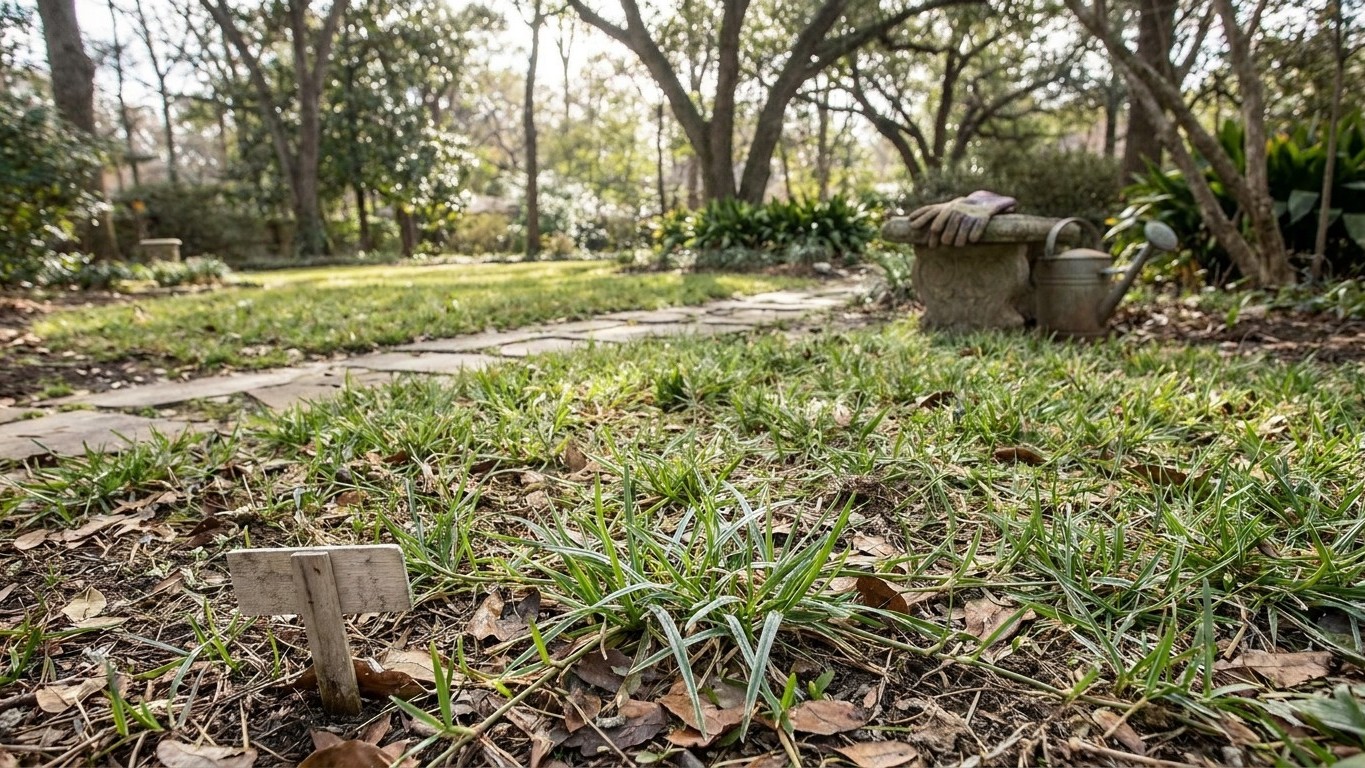
In an existing lawn, zoysiagrass is usually easy to spot once you know what to look for. It forms a dense, fine to medium-textured turf that spreads sideways by both above-ground stolons and below-ground rhizomes, which is what gives it the tight, carpet-like feel underfoot that many homeowners plant it for in the first place. A few checks separate it from other warm-season turf:
- Stiff, pointed blade tips rather than the soft, rounded tips of St. Augustine
- A wiry, springy feel underfoot even at a short mowing height
- Spreading runners visible at the lawn’s edge, working into beds and walkways over a season or two
- A slow green-up in spring, well behind Bermuda growing in the same yard
That slow green-up shows up everywhere else in this grass too. Clemson rates it very good for cold hardiness and excellent for shade, the best combined score of any warm-season grass they list, but nothing about zoysiagrass moves fast. Before choosing among the warm-season options, it helps to see the full lineup of grass types and where each one wins and where it doesn’t.
Where it works, and where it fails
Zoysiagrass earns its shade-and-cold combination in a specific slice of the map. NOAA’s climate data for each state’s reference city shows where a hot summer and a mild-to-moderate winter line up well enough for zoysiagrass to be a real first choice, where the two conditions pull in different directions, and where the winter simply runs too long for it.
First choice, compromise, or no
| State (reference city) | Days at 90°F or more | Coldest month avg. low | Fit for zoysiagrass |
|---|---|---|---|
| Arizona | 169 | 45°F | First choice |
| Nevada | 131 | 39°F | First choice |
| Texas | 102 | 43°F | First choice |
| Florida | 73 | 41°F | First choice |
| Mississippi | 71 | 35°F | First choice |
| Louisiana | 71 | 45°F | First choice |
| Arkansas | 69 | 31°F | First choice |
| Alabama | 58 | 32°F | First choice |
| South Carolina | 55 | 38°F | First choice |
| Hawaii | 19 | 66°F | First choice |
| California | 2 | 49°F | First choice |
| Oklahoma | 71 | 29°F | Transition |
| Kansas | 58 | 22°F | Transition |
| Utah | 52 | 22°F | Transition |
| Idaho | 48 | 24°F | Transition |
| New Mexico | 42 | 26°F | Transition |
| Tennessee | 40 | 28°F | Transition |
| Colorado | 40 | 17°F | Transition |
| Kentucky | 37 | 27°F | Transition |
| Nebraska | 28 | 14°F | Won’t hold |
| Iowa | 18 | 14°F | Won’t hold |
| Delaware | 18 | 25°F | Won’t hold |
| West Virginia | 16 | 26°F | Won’t hold |
| Ohio | 15 | 23°F | Won’t hold |
| Indiana | 15 | 20°F | Won’t hold |
Across the eleven first-choice states, zoysiagrass grows well because summers are hot enough to keep it actively growing and winters are mild enough that cold damage isn’t a real risk most years, going by NOAA’s figures for each reference city.
The eight transition states are where zoysiagrass earns its reputation. No grass, warm-season or cool-season, is a clean fit here, but zoysiagrass’s cold hardiness, rated very good by Clemson Cooperative Extension, lets it survive winters that would thin out Bermuda or St. Augustine in the same yard. It still won’t match a cool-season grass for early spring green-up.
In the six states where it won’t hold, plant a cool-season grass instead. Under the dry shade of trees, fine fescue is the standard answer, covered in Fine Fescues: The Best Grass for Dry Shade. Every figure above comes from a single reference city, not the whole state: Texas alone spans from the Panhandle to the Rio Grande Valley, and a county at the edge of any of these states can sit a full climate zone away from the number in this table.
Shade, drought, traffic: what it will take

Clemson Cooperative Extension rates zoysiagrass excellent for shade tolerance, good for drought tolerance and very good for wear tolerance, the same fact sheet that carries its warm-season and cold-hardiness ratings. Each of those words means something specific once you’re standing in your own yard.
Shade: it will grow where Bermuda won’t
An excellent shade rating means zoysiagrass is the warm-season grass to plant under a mature oak or maple where Bermuda thins to bare dirt and centipede gives up entirely. It still needs some direct light to hold density. Under a full, dense canopy with almost no sun reaching the ground, no warm-season grass will thrive, zoysiagrass included, and a shade-tolerant cool-season option like fine fescue is worth considering instead if the site is that dark.
Drought: good, not indestructible
A good drought rating means zoysiagrass can go longer between waterings than a thirsty lawn grass, but it will still thin and brown at the edges in an extended dry spell without irrigation. That’s a step below the true low-water grasses. Working with poor soil and no irrigation at all, Bahiagrass: For Poor Soil and No Irrigation tolerates worse conditions on less input than zoysiagrass asks for.
Wear: very good, but slow to heal
A very good wear rating means zoysiagrass holds up under kids, dogs and lawn furniture better than most lawn grasses, warm-season or cool. The catch is recovery speed. Because zoysiagrass is slow to establish however it’s planted, according to Clemson, a bare patch worn through by a dog’s running line or a kiddie pool left in one spot for a summer will take noticeably longer to fill back in than the same scar would on Bermuda. Plan traffic patterns with that lag in mind, especially in the first two years after planting.
Seeding or sodding it
Zoysiagrass is established four ways, according to Clemson Cooperative Extension: sod, sprigs, plugs or seed. That list matters because the cost and the wait are completely different depending on which one you pick, and Clemson’s fact sheet doesn’t publish a seeding rate for it the way it does for some other lawn grasses, so check with a nursery or your extension office for a rate specific to the cultivar you buy rather than a blanket number.
The four routes, and what each one costs you in time
Sod gives you a finished lawn the day it’s laid, at the highest per-square-foot price of the four. Plugs and sprigs cost less per square foot but leave bare soil between each piece that has to fill in on its own, and because zoysiagrass spreads and establishes slowly compared with Bermuda, that fill-in period runs longer here than it would with a faster-spreading grass. Seed is the cheapest option up front and the slowest of all, often taking more than one growing season to reach a full, dense stand.
When to plant it
Warm-season grasses go in around May, while cool-season grasses are seeded in mid to late September, according to Clemson Cooperative Extension’s HGIC 1203 fact sheet on establishing a lawn. Zoysiagrass follows the warm-season calendar: plant it once the soil has warmed in spring, not in fall, so it has a full growing season ahead of it before its first winter dormancy.
Whichever method you choose, keep the area weeded and lightly irrigated through that first establishment window, since a struggling zoysiagrass stand is slower to recover from competition than an established one. Budget the extra time into your planting calendar, not just the extra dollars into sod versus seed.
Mowing and keeping it

Mow zoysiagrass at 0.75 to 2 inches, the range Clemson Cooperative Extension gives for this grass. Stay toward the lower end of that range on a lawn in full sun, and toward the higher end where shade cuts into density, since a slightly taller blade helps a shaded stand hold more leaf area to photosynthesize with.
The one-third rule still applies
Never remove more than a third of the blade length in a single pass, on zoysiagrass or any other lawn grass. Scalping a dense, slow-recovering grass like this one is a slower mistake to fix than it would be on a fast-spreading grass, because the recovery runs on zoysiagrass’s own clock, not yours.
Thatch, edges, and a lawn that looks dead but isn’t
Zoysiagrass’s dense, wiry growth habit builds up thatch faster than looser-growing lawn grasses, and a mat of thatch left unchecked will eventually choke the grass it came from. Plan on dethatching as part of routine care rather than a rescue job after the fact. The same spreading stolons and rhizomes that make the turf so dense will also cross a mowed edge into flower beds and walkways if you let them, so an edge cut a few times a season keeps the lawn where you want it.
Expect the whole lawn to go brown with the first hard frost of fall and stay that way until the ground warms again in spring. That’s dormancy, not disease and not a dead lawn, and it’s the same warm-season pattern that governs everything else about how this grass is planted, mowed and repaired through the year.
Common questions
Can I grow zoysiagrass from seed, or do I need sod?
Seed is one of the four options Clemson Cooperative Extension lists for zoysiagrass, alongside sod, sprigs and plugs, so you’re not locked into sod. Seed is also the slowest of the four to reach a full stand, so weigh the wait against the lower cost before you decide.
Why is my zoysiagrass still brown when everything else is green?
Zoysiagrass is slower to green up in spring than Bermuda and most other warm-season grasses growing alongside it in the same yard. Give it time before assuming it’s dead or diseased, especially after a colder than normal winter.
Will zoysiagrass take over my flower beds?
It spreads by both stolons and rhizomes, so runners will cross an unedged border into beds and walkways over a season or two. A cut edge maintained a few times through the growing season stops it well before it becomes a real problem.
Is zoysiagrass worth planting if I’m not patient?
Probably not as your only lawn grass. Every establishment method Clemson Cooperative Extension lists for zoysiagrass is described as slow, so if you need a lawn fast, sod is your quickest route and seed is your slowest, but none of the four is instant the way sodding a fast-spreading grass can feel.