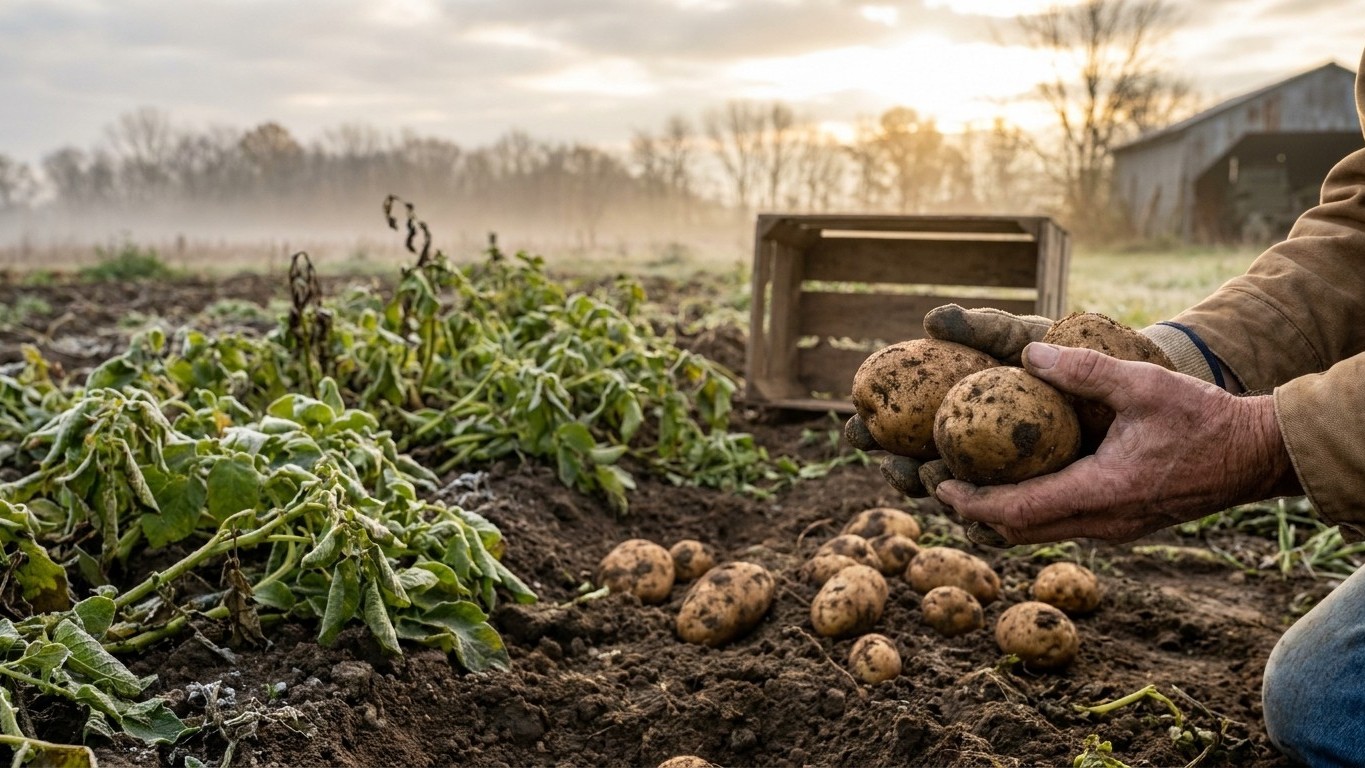

Potatoes in Illinois need to be out of the ground before the first widespread frost, which arrives near Chicago between October 24 and November 3. From there, the crop needs two to three weeks curing at 55-60°F in high humidity (Utah State University Extension), then a dark space holding 40-45°F for the winter. That last part is the hard one here, because Illinois winters average a coldest-month low of just 18.8°F.
The short answer
The two figures that shape everything about growing and keeping potatoes in this state are the first fall frost window, October 24 to November 3, and the mean minimum of the coldest month, 18.8°F. Neither number is a guess. Both come from NOAA NCEI’s 1991-2020 Climate Normals, measured at a reference station near Chicago. Gardens further out in the suburbs or in rural counties tend to see that first frost arrive earlier, sometimes by a week or two, and colder-air pockets at slightly higher elevation can beat even that. Check your own county’s typical frost date before you count on the window above.
When the crop comes out
Potatoes should be dug before that first frost hits the foliage hard, generally in the back half of October for most of the state. Frost damage to the vines doesn’t necessarily ruin tubers still underground, but leaving them in cold, wet soil for weeks after the vines die back invites rot and makes the skins harder to cure properly. The safer target is to have the crop out of the ground with a week or so of dry weather to spare before that October 24 to November 3 window closes.
Will an unheated space hold 40-45°F?
This is where Illinois storage gets complicated. A detached garage or an uninsulated shed will track outdoor temperatures closely once winter sets in, and with a coldest-month mean minimum of 18.8°F, that means long stretches well below the 40-45°F storage target, sometimes below freezing. An unheated space simply will not hold 40-45°F through a typical Illinois winter without some form of insulation, banking, or a heat source. A basement, an insulated root cellar, or an interior closet against a foundation wall is a far more realistic bet than a garage shelf.
Curing, and where
Curing is the step growers skip most often, and it’s the one that determines whether stored potatoes make it to February without rotting. Utah State University Extension specifies 55-60°F with high humidity for two to three weeks, conditions that let cut and bruised skins seal over before the tubers go into long-term cold storage.
Finding 55-60°F in an Illinois fall
Late October in Illinois often runs cooler than the 55-60°F target outdoors, particularly overnight, so an open porch or an outdoor tarp usually isn’t reliable on its own. A basement corner away from a furnace, an attached garage that stays a bit warmer than outdoors, or a mudroom near an exterior wall tends to land closer to that range during the curing window. A shaded, unheated porch can work on the mild afternoons typical in early fall, but as the season slides toward that first frost date, indoor space becomes the more dependable choice. Whatever the location, it should stay out of direct sun and away from drafts that would dry the skins too fast.
The curing steps
- Dig potatoes on a dry day and let them sit on the soil surface for an hour or two, no longer, to shed loose dirt without exposing them to prolonged sun.
- Move them out of direct light immediately into the curing spot, since sunlight greens skins and that green tissue should be trimmed away, not eaten.
- Spread tubers in a single layer, or in shallow crates, so air reaches all sides rather than stacking them in a bin.
- Hold them at 55-60°F with high humidity for two to three weeks, checking periodically for any tuber that’s gone soft.
- Pull out any soft, oozing, or foul-smelling potatoes right away, since one rotting tuber in a crate can spread to its neighbors.
- Brush off dried soil after curing, but skip washing until just before use, since added moisture invites rot in storage.
Storing through this winter
Once cured, potatoes want darkness and a steady 40-45°F according to Utah State University Extension, or 38°F at 95 percent humidity per the University of Maine Cooperative Extension guidance. Both ranges sit well above what an Illinois coldest month typically delivers indoors in an unheated structure, and well below what most heated living space runs. That gap is the entire storage problem in this climate.
A basement is usually the best match available in a typical Illinois house. Basements stay buffered by the surrounding earth and don’t swing with outdoor temperature the way a garage or shed does, and many hold naturally in or near that 38-45°F band once outdoor temperatures drop for the season. A root cellar, if the property has one, does this even better, since it’s built specifically to stay cool without freezing. An attached garage can work on the milder end of fall, but as the coldest month approaches and that 18.8°F mean minimum sets in, an attached garage without added insulation will likely swing below the safe range on the coldest nights, even if daytime readings look fine.
The mismatch to watch for runs both directions. A space that’s too warm, anything pushing past the mid-40s for weeks at a stretch, wakes tubers into early sprouting, which drains starch and softens texture even if nothing visibly rots. A space that gets too cold does worse damage: cell walls rupture, the potato turns soft and eventually mushy once it thaws, and there’s no fixing it after the fact. Between those two failure modes, a monitored basement corner or a cellar, checked with a simple thermometer through the season, gives the closest match to the 40-45°F or 38°F targets that an Illinois home is likely to offer without added heat or insulation.
What goes wrong here
At harvest
- Digging too late. Waiting past the first fall frost window risks cold, saturated soil that promotes rot on tubers still underground; dig with a buffer of dry days before October 24 if your county typically runs on the early side of that range.
- Curing outdoors as temperatures drop. An open porch that felt warm enough in September often falls short of 55-60°F by late October; move curing indoors to a basement or garage corner once outdoor lows start dipping.
- Skipping the humidity side of curing. A warm but dry spot heals cuts poorly; a loosely covered crate or a slightly damp burlap layer over the tubers helps hold humidity without trapping condensation.
In storage
- An unheated garage freezing solid. With a coldest-month mean minimum of 18.8°F, an uninsulated garage will drop well below 40-45°F on ordinary winter nights; move stored potatoes to a basement or insulate and heat the space before deep winter arrives.
- A heated basement running too warm. A finished basement near ductwork or a furnace can sit closer to 60-65°F, pushing tubers to sprout early; choose the coolest, least-trafficked corner instead.
- Pests and disease carried over from the field. Tubers damaged by insects or showing fungal lesions at digging time rarely improve in storage; treat the growing crop with appropriate insecticides and an appropriate fungicide as needed, and store only sound, unblemished potatoes.
Common questions
How early can frost hit in Illinois?
Near the Chicago reference station, the first fall frost typically falls between October 24 and November 3, based on NOAA NCEI’s 1991-2020 Climate Normals. Gardens outside the immediate metro area, especially in low-lying or rural spots, often see frost arrive earlier than that window. Check local frost history for your specific county rather than relying on a single regional date.
Can I store potatoes in an Illinois garage all winter?
Generally no, unless the garage is insulated and kept above freezing. With a coldest-month mean minimum of 18.8°F, an unheated garage will likely drop well below the 40-45°F range Utah State University Extension recommends, and freezing ruins texture permanently.
What temperature is too warm for stored potatoes?
Anything consistently above the 40-45°F range recommended by Utah State University Extension pushes tubers toward early sprouting and softer texture, even without visible rot. A heated basement near a furnace or ductwork often runs too warm for this reason.
Does humidity matter as much as temperature in storage?
Yes. The University of Maine Cooperative Extension pairs its 38°F storage target with 95 percent humidity, and Utah State University Extension likewise calls for high humidity during curing. Low humidity dries and shrivels skins, while proper humidity at the right temperature keeps tubers firm through the winter.