
Count back 14 to 21 days from Halifax’s average last spring frost of May 7, and you land in mid to late April for that reference point, according to Environment and Climate Change Canada’s Climate Normals (1981-2010) for the Halifax Stanfield Int’l A station. That’s the planting window when soil hits 50 F. Everywhere else in Nova Scotia, you adjust from there.
The short answer
Halifax Stanfield’s average last spring frost sits at May 7, per Environment and Climate Change Canada’s Climate Normals covering 1981-2010. Potatoes go in the ground once soil temperature reaches 50 F, and that point typically arrives 14 to 21 days before the last frost date, according to Utah State University Extension’s fact sheet Potatoes in the Garden and the University of Maine Cooperative Extension’s Bulletin #2077. Run the math for the Halifax area and you get a window roughly from April 16 to April 23.
That’s the number. Here’s the catch nobody puts on the seed packet: May 7 is a mean, not a guarantee. Environment and Climate Change Canada’s normals describe an average across three decades of records, which means in one year out of two, the actual last frost lands later than May 7. Some springs it’s earlier. Some springs it’s the last week of May. Treat May 7 as the middle of a window, not a line you can plant right up against and trust.
There’s also the matter of which Nova Scotia you’re gardening in. The Halifax Stanfield station sits in the province’s south-central corridor, close enough to the Atlantic to get some coastal moderation. The Annapolis Valley, the northern shore near the Northumberland Strait, and inland or upland districts don’t share that same frost timeline. A province this shaped by coastline and elevation doesn’t run on one calendar. If you garden outside the Halifax reference area, the honest move is to track your own local frost history rather than borrow Halifax’s number wholesale, because a few weeks of difference is common between a sheltered coastal garden and a low-lying inland one.
What doesn’t change, wherever you are in the province, is the mechanism behind the count. Soil temperature at 50 F is the trigger for planting. The last frost date is the anchor you count backward from. Fourteen to 21 days is the gap between them. That relationship holds whether your local last frost falls on May 7 or three weeks later.
What actually decides it
Two temperature thresholds do all the real work here, and understanding both means you can work out a planting date for any patch of ground in the province, not just the one this page names.
The 50 F soil floor
Potatoes don’t wait for a calendar date. They wait for soil to warm past 50 F, according to both Utah State University Extension and the University of Maine Cooperative Extension. Below that, seed pieces sit in cold, often wet ground and rot before they sprout rather than grow. That’s why the 14-to-21-day window before frost isn’t arbitrary: it’s roughly how long it takes soil to climb from late-winter cold to 50 F once air temperatures start trending up in spring. Soil warms slower than air, and it warms slower still under mulch, in heavy clay, or in ground that stays shaded through the afternoon. A raised bed with sandy loam might hit 50 F well before a low, poorly drained field does, even if both sit under the same regional frost date.
The 90 F heat ceiling
The other end of the season matters just as much, and it’s the mechanism most gardeners never hear about until a harvest disappoints them. Tuber set and tuber fill, the two stages where the plant actually builds the potatoes you’ll dig, shut down when soil temperature climbs above 90 F, per Utah State University Extension. Watering more doesn’t reverse that. Shade doesn’t fully fix it either, since the soil itself is what’s overheating. This is why planting early isn’t just about avoiding frost losses on the front end. It’s about getting tubers set and sizing before summer soil heat closes that window from the other direction. In a place where summer heat routinely pushes soil past 90 F, gardeners plant as early as safely possible and treat the crop as a spring-into-early-summer harvest rather than nursing it through the hottest weeks. Nova Scotia’s Atlantic-moderated climate keeps 90 F soil less common than in a hot inland or continental setting, but the mechanism still applies wherever soil does spike that high, including exposed, unmulched beds in a warm stretch.
Put the two together and the reasoning becomes portable: find your local 50 F soil date, count back 14 to 21 days from your local last frost to sanity-check it, then think ahead to whether your soil is likely to hit 90 F before your chosen variety finishes sizing.
How to do it
- Find your local average last spring frost date. For the Halifax Stanfield reference point, that’s May 7, according to Environment and Climate Change Canada’s Climate Normals (1981-2010). If you garden elsewhere in the province, look for your own nearest long-term station record rather than assuming Halifax’s date applies.
- Treat that date as a midpoint, not a deadline. Because it’s a mean, plan for the real possibility that frost arrives later in a given year, and keep row cover or another protective option ready for young shoots.
- Count back 14 to 21 days from that last frost date to estimate when soil is likely to have warmed to 50 F, per Utah State University Extension and the University of Maine Cooperative Extension.
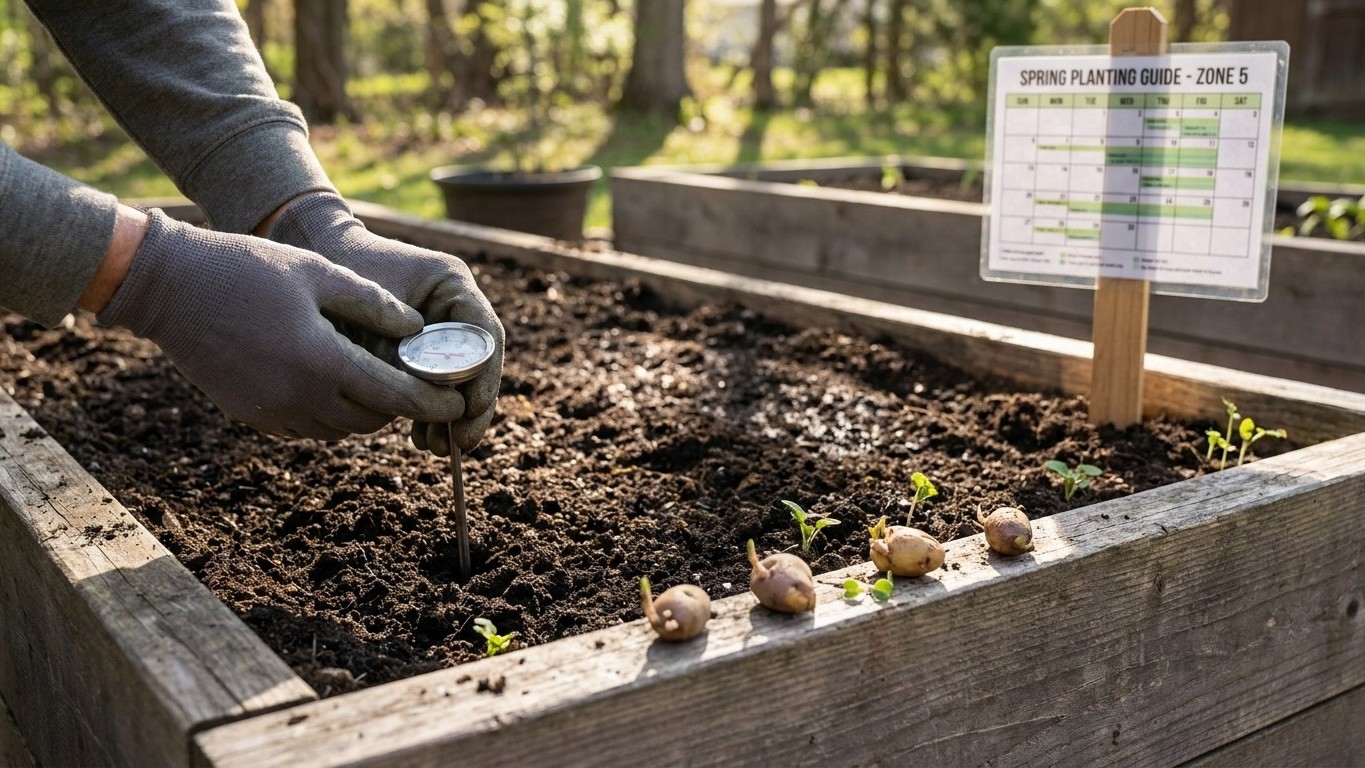
- Confirm with a soil thermometer rather than relying on the calculation alone. Check morning soil temperature at about 4 inches deep for several consecutive days before planting.
- Choose certified seed potatoes. Uncertified seed can carry viruses that stunt plants and cut yield, a problem that doesn’t show up until the crop is already compromised.
- Select a season class suited to your goals rather than chasing a specific days-to-maturity figure, since neither Utah State University Extension nor the University of Maine Cooperative Extension publishes one. Early-season types are ready to dig sooner; mid-season and late-season types stay in the ground longer and generally store better.
- Plant once soil reads 50 F, cutting and curing seed pieces as needed and spacing them to allow room for hilling as plants grow.
- Watch soil temperature again as summer approaches. If your site tends to run hot and exposed, favor an early harvest before soil heat has a chance to climb toward the 90 F range where tuber set and fill slow down.
What goes wrong
- Planting by the calendar instead of the soil. A gardener sees May 7 listed as the last frost date and plants immediately, ignoring soil temperature entirely. If the ground hasn’t reached 50 F yet, seed pieces can rot before sprouting. Check soil temperature directly rather than treating any single date as sufficient on its own.
- Treating the average frost date as a safe date. Because May 7 is a mean from Environment and Climate Change Canada’s 1981-2010 normals, frost lands later than that in roughly half of all years at that station. A hard freeze after planting can damage or kill emerged shoots. Keep row cover on hand through mid to late May as insurance, and don’t assume the season’s frost risk has passed just because the average date has.
- Using uncertified seed potatoes. Seed saved from a grocery store potato or from an unverified source can carry viral disease that reduces vigor and yield without any obvious warning sign at planting time. Buy certified seed potatoes instead, since certification specifically screens for that risk.
- Ignoring soil heat later in the season. A gardener plants on time but then loses size and yield in a hot summer stretch, without realizing soil temperature above 90 F is the cause. According to Utah State University Extension, that heat inhibits tuber set and fill directly, and extra watering does not correct it. In a warm, exposed site, plant early enough that sizing finishes before the hottest soil days arrive.
- Applying Halifax’s frost date to a different part of the province. A gardener in an inland or upland district uses the Halifax Stanfield average and plants too early, only to lose seedlings to a later local frost. Because a province is not one climate, use the frost history for your own area whenever it’s available, and adjust the count-back accordingly.
Common questions
Is May 7 the actual last frost date every year in Nova Scotia?
No. It’s the average from Environment and Climate Change Canada’s Climate Normals for 1981-2010 at the Halifax Stanfield Int’l A station. In roughly half of all years, frost occurs after that date, so it functions as a planting guide, not a guarantee.
What soil temperature should I actually check for before planting?
Look for soil at 50 F, per Utah State University Extension and the University of Maine Cooperative Extension. That’s the threshold at which seed potatoes are safe to plant, rather than sitting in cold ground where they’re prone to rot.
How do I know if my potatoes are early, mid-season, or late?
Check the season class listed by the seed source or supplier. Neither Utah State University Extension nor the University of Maine Cooperative Extension publishes a specific days-to-maturity figure for varieties, so season class (early, mid-season, or late) is the reliable published guide to how long a variety stays in the ground.
Why does certified seed matter if the potatoes look fine?
Viral infection in seed potatoes often doesn’t show obvious symptoms at planting, but it reduces plant vigor and yield over the season. Certified seed is specifically screened to avoid that risk, which uncertified seed, including grocery-store potatoes, is not.