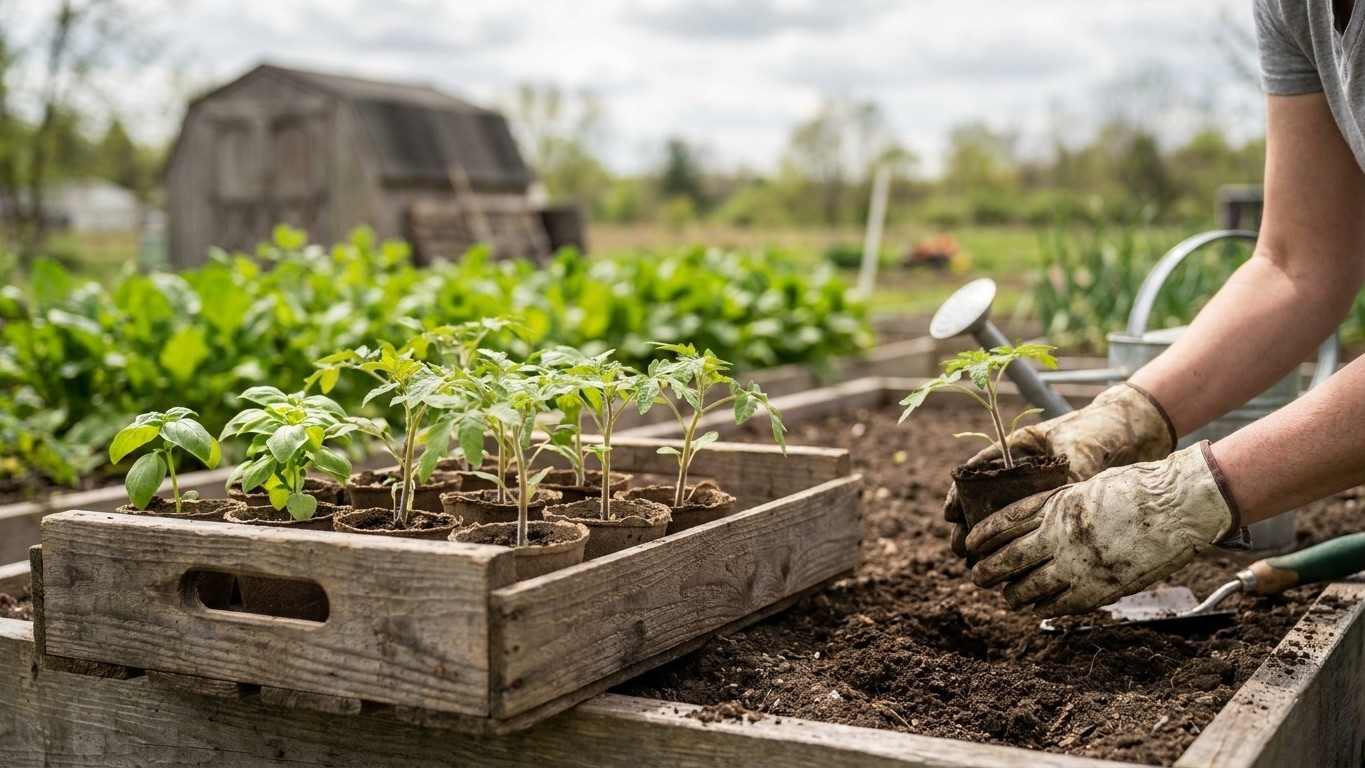

By May, Rhode Island’s reference frost window (April 7 to April 17) has usually closed, which means most of the state can move from cool-season crops to tender transplants this month. Peas, lettuce, and onions have likely been in the ground for weeks. The real decision in May is timing: when soil temperature, not the calendar, says it’s safe for tomatoes, peppers, and squash.
What goes in the ground in May

The frost window that matters here (April 7 to April 17, per NOAA NCEI’s 1991-2020 climate normals for the reference weather station) has typically passed by the time May arrives. That doesn’t mean every crop is safe on the first of the month. Air temperature can feel like summer while the top six inches of soil still sits in the low 50s, and that’s the number tender crops actually respond to.
Cool-season crops that were already growing (spinach, lettuce, peas, brassicas) continue without much drama in May. Direct-sow carrots, beets, radishes, and Swiss chard early in the month, since they tolerate the cooler soil that’s still common in the first two weeks. Onion sets and seed potatoes should already be in or going in now if they weren’t planted earlier; potatoes in particular want soil that’s workable but not waterlogged.
The tender crops (tomatoes, peppers, eggplant, cucumbers, squash, and melons) are the ones where May punishes impatience. Even with the frost window closed on paper, soil in shaded or heavy-clay beds can lag a week or two behind sunny, sandy ground. Wait until nighttime lows are consistently above 50°F before setting out tomatoes and peppers, and hold cucumbers and squash a bit longer if the forecast still shows a cold snap. Sweet corn and snap beans can go in by direct seed once that same soil-warmth threshold is met, typically mid-to-late May across most of the state.
Remember that the April 7-17 window comes from a single reference station. Inland valleys, higher elevations, and low-lying frost pockets away from the coast often see their last frost run later, sometimes by a week or two. If your garden sits in one of those spots, treat early May as still cool-season territory and push tender transplants toward the back half of the month.
What to start under cover
Most of the classic warm-season starts (tomatoes, peppers, eggplant) needed six to eight weeks indoors before transplanting, which puts their start date back in March for a May-into-June setout. By May, starting those same crops from scratch under cover means playing catch-up, and the plants you’d get from a garden center will likely outperform a freshly sown tray at this point.
What still makes sense to start under cover in May is anything with a short runway. Cucumbers, summer squash, and melons only need two to three weeks indoors before they’re ready to go out, so an early-May sowing under lights or in a cold frame can still beat direct-seeding by a couple of weeks and gives you a head start on harvest. It’s also a reasonable window to start a fast-maturing brassica for a second, earlier-than-usual summer crop, since counting backward from the first fall frost (October 24 to November 3) still leaves plenty of runway.
The two ways this goes wrong are predictable. Start too early relative to your actual transplant date and you end up with leggy, rootbound seedlings stretching for light, which check the plant’s growth once it finally hits the garden. Start too late and the seedling never catches up to a direct-sown plant of the same crop, wasting the whole point of starting it under cover in the first place. If you’re unsure, count backward from when your soil will realistically be warm enough to receive that crop, not from the calendar date on a seed packet.
What is ready to pick
May is when the garden starts paying rent again after winter. Asparagus, if it’s established, is in full harvest by early-to-mid May, and cutting it regularly (rather than letting spears open into fern) keeps production going for the rest of the season. Rhubarb stalks are usually thick enough to pull by mid-month, and any overwintered greens (spinach, kale, mâche) that survived under row cover or in a cold frame are often at their sweetest right now, before the weather turns warm enough to push them toward bolting.
Early-sown radishes from late winter or very early spring should be ready within the first couple of weeks of May, and the first lettuce leaves from cool-season plantings can usually be cut for salads by then too. Green onions and scallions planted earlier in spring are typically pulled starting mid-month.
Anything still in storage from last year deserves a check now. Onions and garlic held over winter can start sprouting green shoots as the weather warms, which is a sign to use them soon rather than let them keep drawing on their own reserves. Potatoes in storage should be checked for soft spots or sprouting eyes, and any squash still holding on from fall storage is worth a squeeze test: if the skin gives at all, it’s past its best and should be used or composted rather than left to rot in the bin.
The jobs that matter this month

Soil prep pays off disproportionately in May because everything planted from here forward depends on it. Work compost into beds before tender transplants go in, and resist the urge to till wet soil, which compacts clay and undoes months of structure-building.
Mulching matters more in May than people expect. A two-to-three-inch layer around new transplants holds the soil moisture that’s about to become critical as days lengthen, and it also buffers soil temperature swings during the cool nights that still show up occasionally this month. Stake peas, and set tomato cages before plants sprawl rather than after; wrestling a tomato into a cage once it’s four feet of tangled stem is a job nobody enjoys.
Watering rhythm needs adjusting now too. Seedlings and new transplants want frequent, shallow watering to establish roots, while anything already established benefits more from deeper, less frequent soaking that encourages roots to grow down rather than stay near the surface. Start succession sowing lettuce, radishes, and other quick crops every two weeks so the harvest doesn’t all land at once and then disappear.
Pest scouting starts in earnest in May. Asparagus beetles show up right as spears emerge, flea beetles start peppering young brassica and eggplant leaves with tiny holes, and slugs become active as soil warms and stays damp. Catching any of these early, by hand-picking or targeted treatment, is far easier than dealing with an established population in June. Harden off any seedlings started indoors by setting them outside in a sheltered spot for a few hours a day over a week before transplanting; skipping this step is one of the most common ways a healthy indoor seedling gets sunburned or wind-shocked the day it goes in the ground.
What not to do in May
The most common mistake in May is trusting the air instead of the soil. A run of 70°F afternoons can feel like permission to set out tomatoes and peppers, but if the soil itself hasn’t caught up, those transplants sit and sulk, sometimes for weeks, sometimes permanently. Push a thermometer a few inches into the bed before deciding, rather than going by how the day feels on your skin.
Uncovering cold frames or removing row cover too early after a mild stretch is another classic error, especially since the reference frost window (April 7-17) is a range, not a hard stop, and some springs run cooler than the average suggests. A single warm week doesn’t guarantee the next one, and tender greens that had been hardening off nicely under cover can take real damage from one unlucky late-night dip.
Nitrogen timing trips people up with tomatoes and peppers specifically. Heavy nitrogen feeding right after transplant pushes lush green foliage at the expense of flowering and fruit set, which is the opposite of what most gardeners actually want from these crops. Hold off on nitrogen-heavy feeding until plants are established and starting to flower, then shift toward a more balanced or phosphorus-leaning feed to support fruit development instead of leaf growth.
Checking this against your own county
Everything above starts from a single reference station’s climate normals, and Rhode Island is small but not uniform. Coastal areas tend to warm and cool more gradually than inland spots, and low-lying areas away from the moderating effect of the water can hold onto frost risk longer into May than the April 7-17 window suggests. Elevation shifts these dates further still.
Treat the dates and thresholds here as a starting point, then confirm them against your own conditions with a soil thermometer and a season or two of observation. The University of Rhode Island Cooperative Extension publishes localized guidance and can answer county-specific questions about frost risk and planting windows.
Common questions
Is it too late to plant tomatoes in May in Rhode Island?
No. May is generally the standard window for setting out tomato transplants across the state, once nighttime lows are reliably above 50°F. Early May can still be borderline in cooler inland spots, but by mid-to-late month most gardens are ready.
Can I still direct-sow peas in May?
Peas do best from an earlier, cooler start, so a May sowing will produce a shorter harvest window before summer heat shuts them down. It’s not wasted effort, but expect a smaller crop compared to peas sown in cooler soil earlier in spring.
How do I know if my soil is warm enough for squash and cucumbers?
Push a soil thermometer a few inches into the bed; these crops want consistent soil temperatures in the 60s. If a thermometer isn’t handy, waiting until nighttime air temperatures have held above 50°F for several nights in a row is a reasonable proxy.
Why did my hardened-off seedlings still struggle after transplanting?
Hardening off protects against sun and wind stress, but it doesn’t protect against cold soil. A seedling can be perfectly acclimated to outdoor light and air and still stall if the roots hit soil that’s significantly colder than the pot it came from.
Gardeners who plant by the Moon can check the May 2027 moon planting calendar, a tradition rather than a proven method.