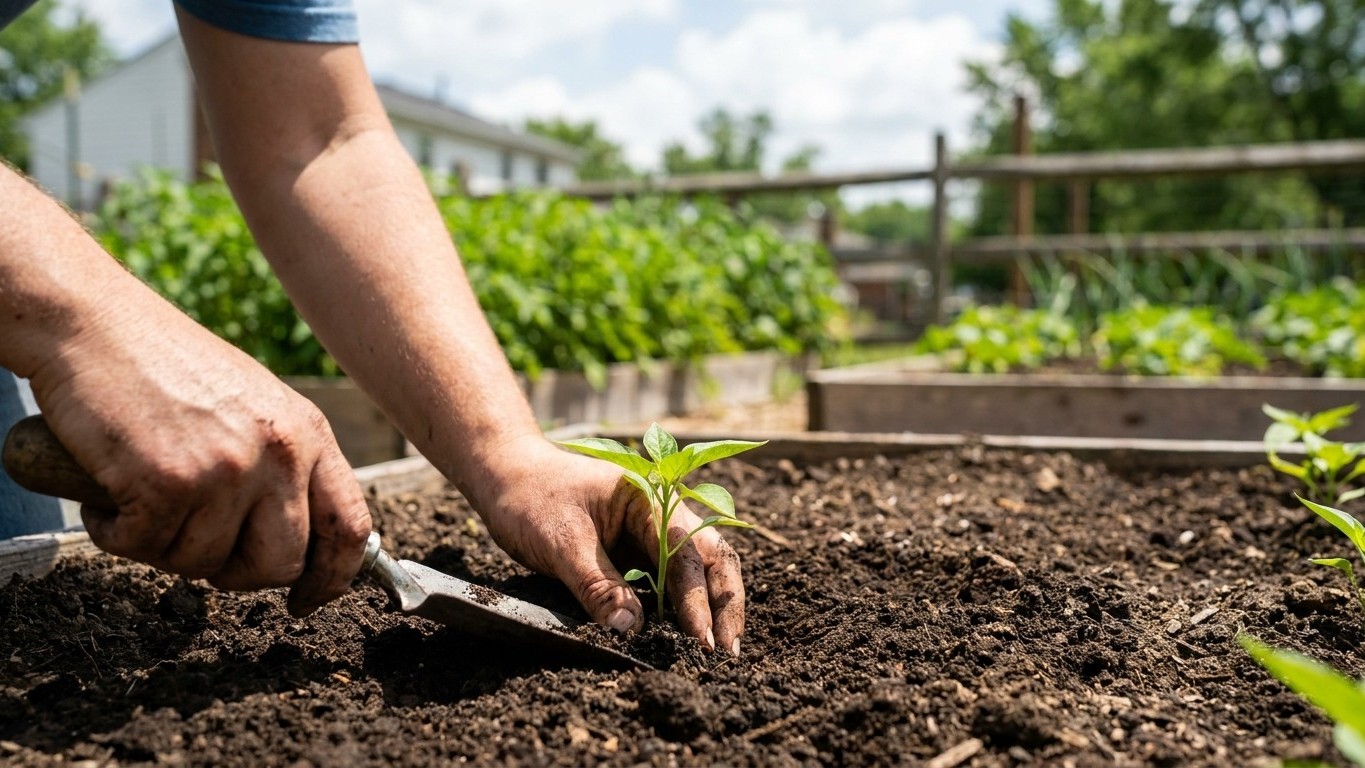

July in Texas means direct-sowing okra, southern peas, sweet potato slips, and heat-loving amaranth, while transplanting pepper and eggplant seedlings that were started earlier in the heat-tolerant stage. It also means starting fall tomato and broccoli seedlings under cover, indoors or in shade, to have transplants ready once the worst heat breaks in late summer.
What goes in the ground in July

Soil temperature, not the calendar, decides what survives being planted in a Texas July. By this point soil temps across most of the state sit well above 85°F at planting depth, which is past the sweet spot for lettuce, spinach, or broccoli germination but exactly right for the crops that evolved to shrug off heat. This is why the safe list this month looks almost nothing like the safe list in April.
Direct-sow southern peas (cowpeas, black-eyed peas, crowder peas), okra, sweet potato slips, Malabar spinach, roselle, and heat-tolerant amaranth. All of these germinate readily in hot soil and are bred, more or less, for exactly this stretch of the calendar. Okra in particular treats a Texas July as its ideal season rather than something to survive.
Transplants are the other safe bet, but only for plants already hardened to heat: pepper and eggplant seedlings that were started weeks earlier under cover can go into the ground now, ideally with afternoon shade for the first week or two while roots establish. Sweet potato slips fall into this same category and are one of the few crops actually planted as a rooted cutting rather than seed at this point in the year.
Why the frost window still matters here
The Houston area’s first fall frost typically lands between December 1 and December 19, based on NOAA NCEI 1991-2020 Climate Normals for station USW00012960 at Bush Intercontinental Airport. That gives a July planting roughly five months before frost risk returns, which is enough time for a full cycle of okra, southern peas, or a sweet potato crop, but not enough for a second round of long-season tomatoes started from seed outdoors. Houston sits at the mild end of the USDA Plant Hardiness Zone Map’s statewide range of 6a to 10a; the Panhandle runs on a different frost calendar entirely, and that gap only widens as the growing season moves toward fall.
What to start under cover
Fall crops in Texas are started backward from the first frost, not forward from today’s date. Using the Houston frost window of December 1 to December 19 as the anchor: a fall tomato variety needing about 75 days to maturity needs to be in the ground by mid-September to have any real shot at ripening before frost risk climbs. Working back another four to six weeks for seedling growth puts the ideal seed-starting window for fall tomatoes right here in July, under cover where the seedlings are protected from the worst of the midday sun.
The same backward math applies to broccoli, cabbage, and cauliflower, all of which need eight to ten weeks as transplants before they go into the garden in early fall. Starting these indoors, in a shaded porch, or under 30-50% shade cloth in July keeps young seedlings from cooking in trays that heat up fast in direct sun.
Two mistakes show up every year at this stage. Starting too early, before there is any real shade or cooling relief, produces leggy, rootbound seedlings that stall the moment they’re transplanted into August heat. Starting too late runs the clock out entirely, since a fall tomato or broccoli transplant set out even two weeks behind schedule may never mature before frost shuts things down. Splitting seed-starting into two batches roughly ten days apart is a simple way to hedge against either outcome.
What is ready to pick
July is when the spring garden and the summer garden overlap in the harvest basket. Spring-planted tomatoes are usually finishing their run, since blossoms stop setting fruit once nighttime temperatures stay above roughly 75°F, but the okra planted back in late spring is just hitting stride. Southern peas, watermelon, cantaloupe, summer squash, and figs round out a typical Texas July harvest.
Okra is ready when pods are three to four inches long and still snap cleanly; leave them a day too long and they turn fibrous. Southern peas can be picked fresh for shelling once pods fill out and lose their glossy sheen, or left to dry fully on the vine for storage beans that rattle inside the pod. Melons signal readiness through the tendril nearest the fruit turning brown and dry, a more reliable cue than the classic thump test.
Squash needs daily attention this month, both to catch fruit before it turns tough and to spot the first signs of squash vine borer damage, which shows up as sawdust-like frass at the base of the stem. Figs ripen fast in July heat and split open within a day of peak ripeness, so a tree loaded with fruit is worth checking every morning rather than every few days.
The jobs that matter this month

Mulch is the single biggest lever a Texas gardener has in July. A three- to four-inch layer over the root zone of tomatoes, peppers, and squash keeps soil temperature down and cuts water loss dramatically, and skipping it now often means losing plants to heat stress that mulch alone would have prevented.
Watering rhythm matters as much as volume. Deep, infrequent watering early in the morning, aimed at soaking the root zone rather than wetting the leaves, builds deeper roots and reduces the fungal disease pressure that comes with evening watering in humid Gulf Coast air. Container plants and raised beds dry out fastest and may need checking daily once temperatures climb past 95°F.
Staking and support need to go in before plants sprawl, not after. Indeterminate tomatoes and vining okra varieties put on rapid growth in July heat, and a cage or stake added after the plant has already flopped does far less good than one installed at planting.
Succession sowing keeps okra and southern peas producing rather than stalling. Dropping a new short row of okra seed every three to four weeks through midsummer keeps a steady harvest coming instead of one big flush followed by a gap. Pest scouting deserves a regular walk-through as well: spider mites thrive in hot, dry conditions and show up as fine stippling on leaves before webbing becomes obvious, and squash vine borer moths are active through summer, making early detection the difference between losing one plant and losing the whole row.
What not to do in July
The most common mistake this month is sowing cool-season seed like lettuce, spinach, or carrots directly outdoors because the morning felt pleasant. Soil temperature at planting depth is still far too hot for these seeds to germinate reliably, and the fix is to start them under cover instead, where temperatures can be moderated, and hold them for a proper fall transplant date.
Overwatering with shallow, frequent sprinkles trains roots to stay near the surface, which then makes plants more vulnerable, not less, during the next heat spike. Watering less often but more deeply produces sturdier plants that handle stretches of extreme heat with less wilting.
Heavy nitrogen feeding at this point in the season pushes soft, leafy growth that wilts fast under direct sun and draws in aphids. A balanced feed with a proportionally lower nitrogen ratio supports fruit and root development, which is where the plant’s energy is better spent in midsummer.
Pulling shade cloth or mulch after a few cooler days is another trap. A brief dip in temperature rarely signals the end of the heat; removing protection early, only to have it snap back to the mid-90s a week later, undoes weeks of soil-cooling work for no real benefit.
Checking this against your own county
Every figure above comes from Houston-area data, which sits at the mild, humid end of a state that spans four USDA hardiness zones. Elevation in the Hill Country, the drier climate of West Texas, and the much longer, colder winters of the Panhandle all shift these windows by weeks in either direction, so a planting date that works near the Gulf Coast can be badly off in Amarillo or Lubbock. Treat everything here as a starting point, then confirm it against Texas A&M AgriLife Extension, which publishes county-specific planting guidance and local frost data for the full range of Texas climates.
Common questions
Can tomatoes still be planted in Texas in July?
Not from seed outdoors. Fruit set on existing spring plants usually stops once nights stay above roughly 75°F, and new transplants for fall need to be started under cover now, using the first frost window to work backward to a September transplant date.
Is it too hot to plant okra in July?
No. Okra is one of the few vegetables that treats a Texas July as ideal conditions, germinating readily in hot soil and producing through the peak of summer heat.
How much water do summer vegetables need in Texas heat?
There’s no single published figure that covers every soil type and crop, but the general principle holds statewide: water deeply and infrequently, aimed at the root zone, rather than lightly every day.
Why are my squash plants dying suddenly in July?
Sudden wilting in an otherwise healthy squash plant is a classic sign of squash vine borer damage at the base of the stem, worth checking for sawdust-like frass before assuming it’s simply heat stress.
Gardeners who plant by the Moon can check the July 2027 moon planting calendar, a tradition rather than a proven method.