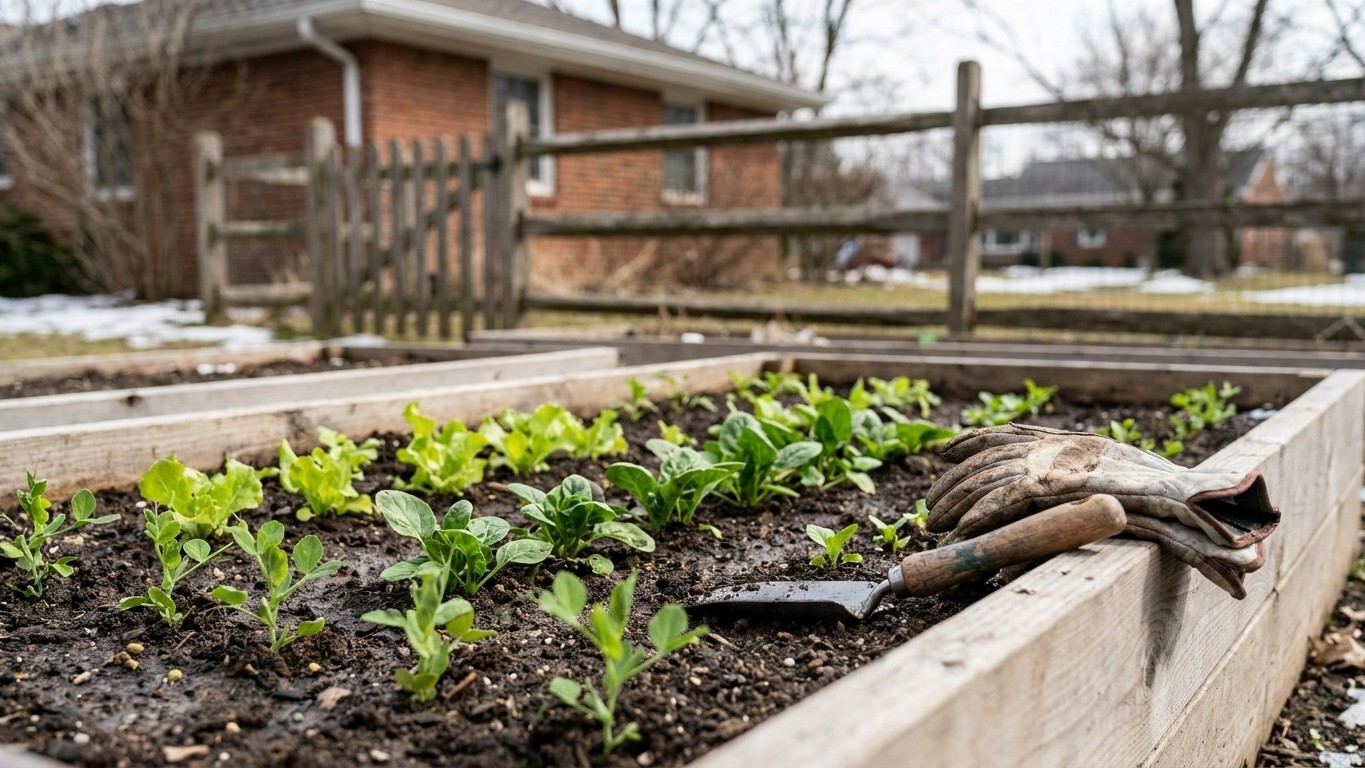

Across most of Wyoming, March is not a planting month for the open garden. The state’s last spring frost falls between May 7 and May 18, and at elevation that window can run even later, so soil is still cold, often frozen a few inches down, and sometimes buried in snow. What March actually delivers is indoor seed starting, dormant-season orchard work, and the planning that decides whether May goes smoothly or badly.
What goes in the ground in March

Nothing goes into open Wyoming soil this month with any real confidence, and that is worth saying plainly rather than dressing up with exceptions. With the last spring frost landing between May 7 and May 18 depending on location, March sits roughly eight to eleven weeks ahead of safe outdoor planting for anything tender, and even cold-hardy crops face soil that is likely still frozen at depth or waterlogged with snowmelt runoff. Working that ground now, wet or half-frozen, compacts it in ways that cost yield all season.
That does not mean the garden is closed. In the lower-elevation pockets, the Bighorn Basin, parts of Goshen County, spots below roughly 5,000 feet where soil thaws earlier, gardeners with workable ground late in the month can get garlic cloves and shallot sets into the ground if they missed the fall planting window, though fall remains the stronger method for both. Bare-root fruit trees, brambles, and grapevines can go in as soon as the ground can be worked and before buds swell, which for many parts of the state means late March at the earliest and often April.
What actually works this month
Cold frames and low tunnels earn their keep in March. A frame set over ground that thawed early can host spinach, mâche, and radish seed weeks before open soil would tolerate them, because the covered soil warms faster and holds that heat overnight. Dormant divisions of rhubarb crowns can go into a cold frame or a sheltered bed against a south-facing wall. Forcing rhubarb or chicory indoors, in a dark, cool space, gives a harvest of tender stalks or chicons while the outdoor garden is still asleep. None of this replaces open-ground planting. It fills the gap until the ground actually cooperates.
What to start under cover
Seed starting in March works backward from the frost window, not forward from the calendar page. With the last frost falling May 7 to May 18, count back the weeks each crop needs before it goes outside, and the arithmetic points to March as the busiest indoor-sowing month of the year here.
Onions and leeks need ten to twelve weeks under lights before transplanting, which puts their sowing date squarely in early to mid-March for a May move outdoors. Peppers, slow and finicky, want eight to ten weeks indoors, so starting them now, especially early in the month, lines up with that same transplant window. Tomatoes need six to eight weeks and can start a couple of weeks behind the peppers without losing ground. Cole crops meant for transplant, broccoli, cabbage, kale started for early setting out, run six weeks and fit comfortably into a mid-to-late March start.
Two mistakes undo this math. Start too early, and tomatoes or peppers turn rootbound and leggy on a windowsill weeks before the soil or air is ready to receive them, a plant that never fully recovers once it hits the garden. Start too late, especially with onions and leeks, and the transplants go out undersized, giving Wyoming’s short, often abrupt growing season too little head start to produce a real bulb or stalk before fall frost arrives between September 24 and October 5. A bright, cool spot or supplemental grow lights matter more here than in milder states, because Wyoming’s high-elevation sun is intense but daylength in March is still short, and weak light is the single biggest cause of leggy starts.
What is ready to pick
Outdoors, March offers little to nothing across most of Wyoming, and any list pretending otherwise would be misleading. What keeps a household fed this month comes from what was put up earlier, not from fresh growth.
Kale and leeks that overwintered under snow cover, in the milder valleys where gardeners tried it, can sometimes be dug or cut once the ground softens enough to reach them, and both improve in flavor after hard cold. Given the state’s zone range of 3a to 6a, this is a gamble that pays off more reliably in the warmer pockets than at higher, colder sites. A cold frame planted in late winter can already be yielding spinach or mâche leaves by late March in a sheltered, south-facing spot. Indoors, sprouts and microgreens fill the fresh-vegetable gap in days rather than weeks, needing only a jar or a tray and a windowsill.
March is also the month to walk the root cellar or basement storage shelves with a critical eye. Squash with soft spots, potatoes sending out pale sprouts, onions gone soft at the neck: all of these are signs the stored harvest is starting to turn, and pulling the questionable ones now, before they spread rot to neighboring produce, saves the rest of the stash for the weeks still ahead before anything fresh comes out of the garden.
The jobs that matter this month

March in Wyoming is a working month even though almost nothing is planted outdoors, and the jobs done now decide how the rest of the season unfolds.
Dormant pruning of fruit trees and berry canes should happen before buds swell, and at Wyoming’s elevations that window often stretches later into March than gardeners in milder states expect. Cutting now, while the plant is still fully dormant, reduces stress and disease risk compared to pruning after growth starts. Seed ordering belongs on this month’s list too: popular short-season varieties bred for high-elevation, cool-summer climates sell out, and a gardener waiting until April is choosing from what is left rather than what fits best.
Soil testing pays off now, ahead of the spring rush, giving results back in time to amend before planting. Turning the compost pile, even a half-frozen one, speeds the thaw and keeps decomposition moving once temperatures allow it. Tools deserve attention here too: a dull hoe or a rusted pruner costs real time once the season opens, and sharpening and cleaning them now, rather than mid-spring, means they are ready the moment the ground is. Wyoming’s wind is hard on garden infrastructure over winter, so checking fencing, raised bed frames, and trellis posts for frost heave or wind damage before they are needed again is worth the walk around the yard. Planning the coming season’s crop rotation, on paper, while there is still time to reorder seed if the plan changes, rounds out the list.
What not to do in March
The most common March mistake in Wyoming is trusting a warm afternoon. A stretch of chinook wind can push air temperatures into the 50s or 60s even while the soil a few inches down is still near freezing, and gardeners who direct-sow warm-season seed on the strength of that warm air end up with seed that rots in cold, damp ground rather than germinating.
Uncovering hardy plants too early after one of those warm spells is the second trap. A cold frame or row cover opened because the afternoon felt like spring, then hit by the hard freeze that follows a chinook, can undo weeks of protected growth in a single night. Keep the covers on until the freeze risk has genuinely passed, not until one warm afternoon suggests it has.
Feeding nitrogen too early is the third mistake worth naming. Applying a nitrogen-heavy fertilizer to dormant fruit trees or perennial beds in March, before real growth has resumed, pushes soft, premature growth that a late freeze, still likely given the May frost window, can kill outright. Hold nitrogen applications until buds are actively swelling and the freeze risk has genuinely dropped. Working wet soil is the fourth: snowmelt leaves many Wyoming garden beds saturated well into March, and digging or tilling that ground compacts it into clumps that take a full season to break down again. Wait for it to crumble in your hand, not just look dry on the surface.
Checking this against your own county
A statewide March calendar is a starting point, not a set of instructions for a specific backyard. Wyoming’s elevation swings from under 3,700 feet in parts of the Bighorn Basin to well over 7,000 feet in Laramie and the mountain valleys, and that difference alone can shift planting windows by three to four weeks in either direction. The state’s hardiness range of 3a to 6a covers real, sometimes extreme, variation from one county to the next, and a frost date measured at one reference station will not match conditions on a north-facing slope or a low frost pocket a few miles away.
The University of Wyoming Extension, at uwyo.edu/uwe, publishes county-level guidance and local planting calendars built for these differences. Checking local soil temperature and recent frost history there, before trusting any statewide date, is the single best way to plan for one specific piece of ground.
Gardeners who plant by the Moon can check the March 2027 moon planting calendar, a tradition rather than a proven method.
Common questions
Can I plant grass seed in Wyoming in March?
Most of the state is still too cold for reliable lawn seed germination in March, since soil temperatures generally need to reach the mid-50s Fahrenheit consistently, something that typically does not happen until closer to the last frost window of May 7 to May 18. Late April or May seeding is more reliable across most elevations.
Is it too early to start tomatoes indoors in March in Wyoming?
Not for most of the state. Tomatoes need six to eight weeks indoors before transplanting, and with the last frost falling between May 7 and May 18, a start in mid-to-late March lines up well. Starting much earlier than that risks leggy, rootbound plants before the ground is ready.
What vegetables survive Wyoming winters in the ground?
Overwintered kale, leeks, and sometimes spinach can survive under snow cover in the milder valley locations, particularly where the hardiness zone leans closer to 5a or 6a rather than the colder 3a pockets. Survival is not guaranteed and depends heavily on snow cover acting as insulation.
When should I prune fruit trees in Wyoming?
Late winter into March, while trees remain fully dormant and before buds begin to swell, is the standard window. At higher elevations, that dormant period often extends later into March than it would in lower, milder parts of the state, so checking bud swell locally matters more than following a fixed date.