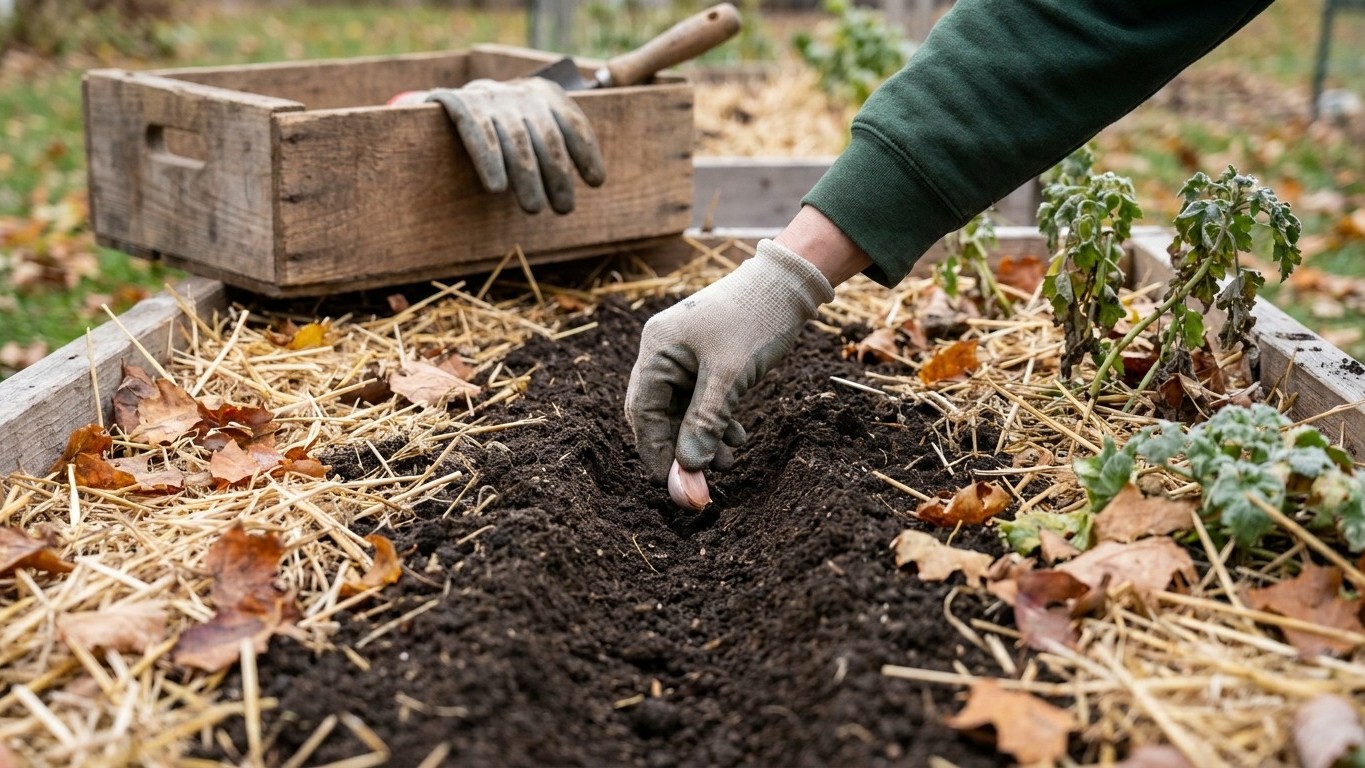

November closes the outdoor planting season across nearly all of Wyoming. The state’s first fall frost typically arrives between September 24 and October 5, so by the time November opens, most gardens have already been through several hard freezes. Garlic and shallots are the only crops still going into open ground, and only where soil remains workable. Everything else moves under cover, into cold frames, or onto the planning table for spring.
What goes in the ground in November

The decision this month has nothing to do with the calendar and everything to do with whether a shovel can still break the soil. Wyoming’s first fall frost window (September 24 to October 5, per NOAA NCEI 1991-2020 Climate Normals) has already passed by the time November starts, which means the ground in most counties is either frozen solid or freezing overnight and thawing briefly by afternoon. That freeze-thaw cycle is the real gatekeeper, not the date on the wall.
Where soil is still workable, usually in the first week or two of the month in lower-elevation valleys, garlic and shallots can still go in. Both need roughly six weeks of root growth before hard freeze locks the ground, and even a shortened window still lets cloves establish enough to overwinter. Plant them 2 inches deep, mulch heavily with straw right away, and don’t wait for a “better” week that may not come.
Bare-root fruit trees, canes, and dormant shrubs can also go in while the ground is still diggable, provided the nursery stock is genuinely dormant, not just discounted. Heel them into a trench with loose soil or mulch if planting has to wait past a hard freeze.
Cold frames and low tunnels stretch the season for hardy greens that were already established before frost, spinach, mâche, and claytonia in particular, but starting new seed under them this late is a long shot at this elevation range. Forcing crops indoors is the more reliable move: pot up rhubarb crowns or chicory (witloof) roots, keep them cold and dark for several weeks, then bring them into gentle warmth to force pale, tender growth through winter.
Say it plainly: outside of garlic, shallots, bare-root dormant stock, and forcing projects, nothing new goes into open Wyoming ground in November. Padding that list with anything else sets a gardener up to lose seed and time.
What to start under cover
Counting backward from Wyoming’s last spring frost window (May 7 to May 18) is the only honest way to schedule indoor starts, and in November that arithmetic works against most spring crops. Onions and leeks, the slowest starters, need 10 to 12 weeks under lights before transplant, which lands their sowing date in February or early March, not November. Start them now and the seedlings will be leggy, rootbound, and stressed long before the ground even thaws.
That’s the first failure mode: starting too early. Cool basement light and short days stretch seedlings toward the nearest window, weakening stems before they ever see real sun. The second failure mode runs the opposite direction, waiting so long that fast crops like lettuce or brassicas miss their transplant window entirely once the short spring arrives.
What actually belongs under cover in November is different from the spring lineup. Cold-hardy perennial and wildflower seeds that require moist cold stratification can be sown into pots and left outdoors or in an unheated garage, letting Wyoming’s natural winter do the stratifying work over the coming months. Slow perennial herbs, like rosemary or lavender started from seed, can go under grow lights now precisely because their germination and growth cycle is measured in months, not weeks, so a November start still lands them at transplant size closer to the frost-free window.
Microgreens and windowsill herbs (basil, chives, cilantro) are the other honest answer: sown indoors on a rolling two-to-three-week cycle purely for kitchen use, with no frost date arithmetic involved at all.
What is ready to pick
Little to nothing comes out of open Wyoming ground in November, and that’s worth saying directly instead of stretching a short list. Any brassica or root crop still in the garden should already be harvested or heavily protected. Zone 3a-6a winters (USDA Plant Hardiness Zone Map, 2023) bring extreme minimum temperatures that outmatch straw mulch alone for most greens left uncovered.
Kale and leeks are the exceptions worth banking on. Both can survive under a foot of snow, which acts as insulation rather than a threat, and both sweeten with cold exposure. Dig leeks with a fork rather than pulling, since frozen soil grips the roots hard, and knock snow aside gently rather than exposing the whole bed to open air.
Cold frames still producing spinach, mâche, or claytonia can be harvested outer-leaf-first through the month, as long as the frame is vented on sunny days to avoid cooking the greens on an unexpectedly warm afternoon. Indoors, sprouts and microgreens fill the gap: a jar of sprouting lentils or a tray of pea shoots is ready in 5 to 10 days regardless of what’s happening outside.
This is also the month to check stored squash, potatoes, and onions rather than assume they’re holding fine. Squash with a soft spot near the stem, potatoes throwing early sprouts, or onions gone soft at the neck need to be pulled and used immediately, before they take neighboring produce down with them. A five-minute check of the root cellar or pantry shelf now saves a much bigger loss in January.
The jobs that matter this month

November carries real deadlines even without a seed going into the ground, and skipping them costs the next season, not this one.
Dormant pruning tops the list for fruit trees and cane berries. Once leaves have dropped and sap has slowed, cuts heal cleaner and disease spreads less than during active growth. Remove dead, crossing, or diseased wood first, then shape for airflow; a tree pruned now enters spring ready to put energy into fruit rather than repair.
Seed ordering belongs on this month’s list too, and earlier beats later. Popular varieties, especially short-season types bred for high-elevation gardens, sell out by midwinter, and a gardener who orders in November has first pick instead of a substitute list.
Soil testing and amending pays off precisely because amendments like lime or compost need months to integrate before spring planting. Pull a sample now, send it to a lab, and work in whatever it recommends while the ground is still workable.
Turning the compost pile keeps decomposition moving even as temperatures drop, and it’s far easier to fork through now than to chip at a frozen block in January. Cleaning and sharpening tools, oiling pruners, and putting hoses and irrigation lines away before a hard freeze cracks them protects gear that would otherwise need replacing.
Round out the month by repairing raised beds and fencing while the ground still allows post-setting, and by mapping next season’s crop rotation on paper. None of this is filler. It’s the work that makes March less of a scramble.
What not to do in November
The most common mistake is trusting a warm afternoon over the soil itself. A 55-degree day in early November can feel like an invitation to tuck in one more round of greens or bulbs, but air temperature and soil temperature move on different clocks, and soil several inches down often stays near freezing regardless of what the thermometer says at noon.
Uncovering cold frames or removing mulch after a mild stretch is the same error in reverse. Wyoming’s freeze-thaw pattern means a warm spell is rarely the start of a trend, and plants exposed too early lose the insulation they need for the next cold snap, which usually arrives within days.
Feeding nitrogen this late works against the plant, not for it. Nitrogen pushes soft new growth right when perennials, trees, and shrubs need to be hardening off and going dormant. That new growth gets caught by the next freeze and dies back, wasting energy the plant needed to survive winter. Hold off until active spring growth resumes.
Finally, don’t assume stored produce takes care of itself once it’s off the vine. Squash, potatoes, and onions left unchecked in a warm or humid corner rot faster than expected, and a single soft potato in a bin can spread that rot to everything around it within a couple of weeks.
Checking this against your own county
A state-wide November guide is a starting point, not an instruction sheet, and Wyoming is a hard state to average. Elevation swings of several thousand feet between valley towns and mountain-adjacent communities shift frost timing by weeks in either direction, and the state’s hardiness zones span 3a to 6a (USDA Plant Hardiness Zone Map, 2023), a range wide enough that a plant thriving in one county may not survive the winter two counties over.
Before acting on any date in this article, check it against local conditions through the University of Wyoming Extension, which tracks county-level frost data and planting guidance built for the state’s elevation extremes.
Common questions
Can I still plant garlic in Wyoming in November?
Yes, as long as the soil is still workable, typically only in the first week or two of the month at lower elevations. Once the ground locks into a hard freeze, garlic cloves won’t establish roots before winter sets in fully.
Will kale survive a Wyoming winter without any protection?
It often survives under snow cover, which insulates rather than harms it, but exposed kale in open, wind-scoured beds is far less reliable, especially in the colder end of the state’s zone 3a-6a range.
Is it too late to start seeds indoors for spring in November?
For most vegetables, yes, it’s too early rather than too late. Counting back from the May 7 to May 18 last-frost window, most transplants shouldn’t start until February or March; a November start usually means leggy, stressed seedlings by transplant time.
What’s the single most important November job if I only have one weekend?
Check stored produce for rot and mulch any garlic or shallots already in the ground. Both tasks have real deadlines: stored crops that turn will spread, and unmulched garlic loses its head start before the hardest freezes arrive.
Gardeners who plant by the Moon can check the November 2026 moon planting calendar, a tradition rather than a proven method.
Related guides
Elsewhere? See what to plant in November in every state and province.