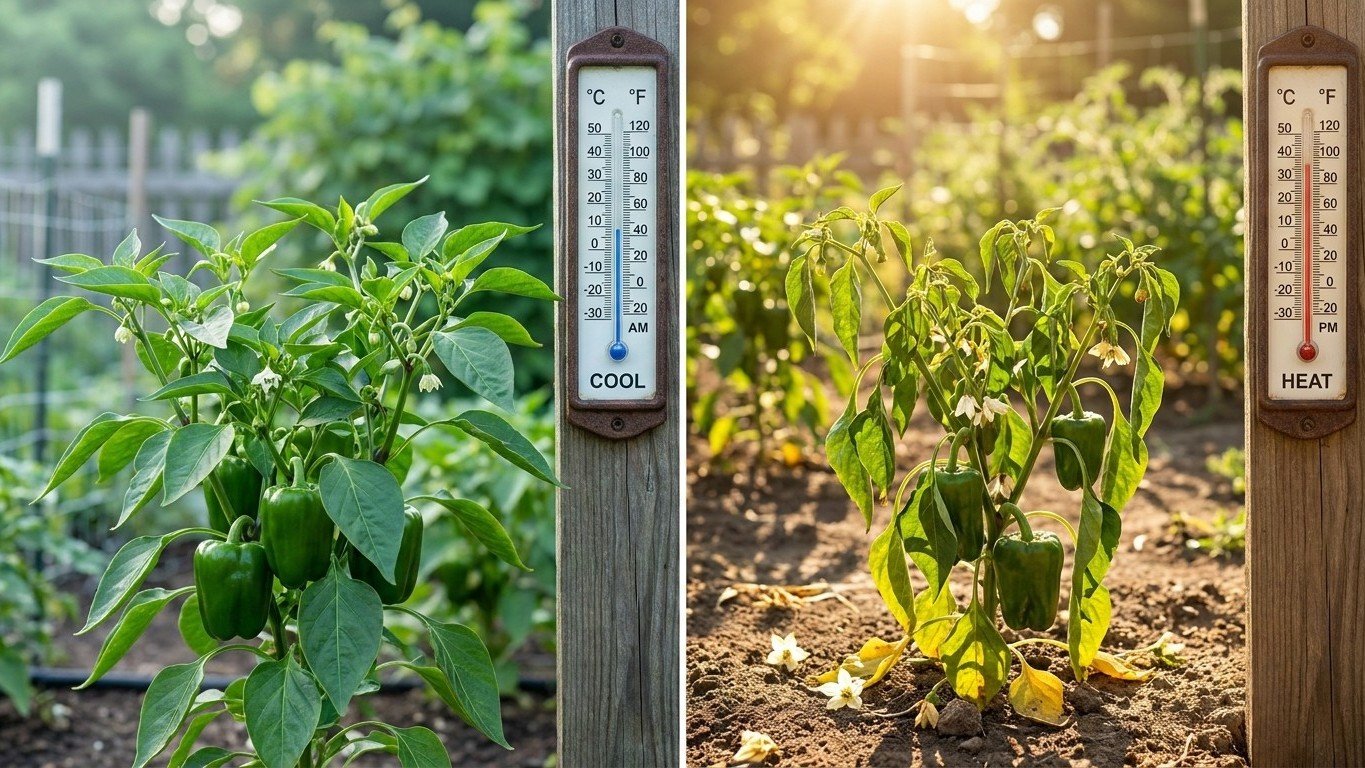

Pepper fruit set collapses at two separate points on the thermometer: nights below 55 F and days above 90 F. Utah State University Extension names both thresholds in the same breath, because gardeners who brace only for summer heat often lose their crop to a run of cool nights instead. Knowing which threshold is stalking your garden this season changes everything from Starting Pepper Seed and Transplanting Peppers to when you pick.
The short answer
According to Utah State University Extension’s guide, Peppers in the Garden, fruit set fails when nighttime temperatures drop below 55 F or when daytime temperatures climb above 90 F. Either end of that range stops the plant from setting fruit, and the blossoms simply drop instead of turning into peppers. That’s the whole mechanism in one sentence, but the practical part is figuring out which threshold applies to your yard on any given week.
Most gardeners assume the danger is heat. It’s the more visible failure: a July heatwave, wilted leaves, blossoms littering the soil under the plant. But a stretch of unusually cool nights, the kind that shows up in early June or again in September, does the same damage without any drama. The plant looks fine. It just quietly stops producing. Understanding Why Peppers Drop Their Flowers helps explain why the risk varies by cultivar too, since some Pepper Varieties tolerate temperature swings better than others, a nuance worth weighing against Pepper Types the Extension Names — and What It Does Not Say, and separate from calcium-related issues like Blossom-End Rot on Peppers, which can mimic fruiting problems but stems from a different cause entirely.
Here’s where the record gets thin. This site tracks the number of days above 90 F for individual territories, which tells you how often the hot-end threshold gets crossed where you live. It does not carry summer overnight lows for those same places. That’s not a gap you can paper over by guessing. A location’s latitude, or even its coldest winter month, tells you nothing reliable about how cool its July and August nights run, since elevation, humidity, and local terrain shift nighttime temperatures far more than latitude does. If the cold end of this range matters where you garden, the only honest answer is to watch your own thermometer through the growing season, ideally with a min-max reading placed near the pepper bed itself, not on a porch or under an eave where microclimates skew the number.
What you can plan around with more confidence is the heat side, since local day counts above 90 F are documented and consistent year to year for a given territory. If your area logs a long stretch of 90-plus days each summer, expect blossom drop during those weeks regardless of how well you follow best practices for Watering Peppers or fertilize. Shade cloth and afternoon shade from taller companion plants reduce the effect, but they don’t erase the threshold, and exposed fruit can still suffer from Sunscald on Peppers once leaf cover thins out during a heat spell. The plant’s biology doesn’t negotiate, which is also why timing matters so much when it comes to Harvesting Peppers before a heat spike wipes out the remaining blossoms.
What actually decides it
Fruit set is only the first failure point. Three more mechanisms determine whether a pepper plant that did set fruit actually delivers a usable harvest, and they’re easy to tangle together if you don’t separate them.
Cold nights stall pollen viability
Below 55 F at night, pepper pollen doesn’t function well enough to fertilize the flower. The blossom opens, looks normal, and then drops within a day or two because nothing happened inside it. This is a pollination failure, not a plant-health problem, which is why fertilizing harder or watering more doesn’t fix it. The only fix is time and warmer nights.
Heat above 90 F aborts blossoms directly
Daytime heat above 90 F works through a different channel. The plant redirects energy toward survival, heat stress interferes with flower development, and existing blossoms abort rather than complete fertilization. This is a separate mechanism from the cold-night failure even though the visible result looks similar: dropped flowers, no fruit.
Blossom-end rot has four distinct causes
Once fruit does set, a sunken, leathery patch on the blossom end can still ruin it. Utah State University Extension lists four separate causes: poor water management, excessive nitrogen, root pruning, and drought stress. Only one of those four is about water volume. Excess nitrogen pushes the plant into rapid leafy growth at the expense of calcium uptake in the fruit. Root pruning, whether from careless cultivation or transplant shock, damages the very system that moves calcium to the fruit. Drought stress is its own trigger, independent of your regular watering schedule if a single dry spell hits during fruit development. Treating this as a single “water more” problem misses three of the four causes.
Sunscald depends on leaf cover, not the fruit itself
Sunscald happens when fruits are exposed to direct sunlight during hot, dry weather. The fruit itself isn’t defective, it’s simply unprotected. Foliage is the shield here: a plant that’s been over-pruned, or one that’s lost leaves to disease or wind damage, exposes its fruit to the same sun that a fully leafed plant would shrug off.
How to do it
- Count backward 8-10 weeks from your intended transplant date and start seeds indoors on that day, since Utah State University Extension allows 8-10 weeks to grow transplants of usable size.
- If you’re sowing directly into the garden instead of transplanting, wait until 2 weeks before your last expected frost date to put seed in the ground.
- Hold transplants indoors or under cover until the soil reaches 60 F and all danger of frost has passed. Both conditions have to be true, not just one.
- Space plants 18 inches apart within the row, with 18-24 inches between rows, to give roots room and keep air moving through the foliage.
- Wait until soil temperature climbs above 75 F before laying organic mulch. Mulching too early traps cool, damp soil around the roots and slows the plant down instead of helping it.
- Water 1-2 inches per week, applied deep and infrequent rather than in light daily doses. Drip irrigation is the method Utah State University Extension recommends, since it keeps foliage dry and delivers water at root level.
- Watch for flowering, then count 35-45 days from that point to reach full color, since this maturity window runs from flowering, not from the sowing or transplant date.
- Harvest and, if you’re not using the peppers right away, store them 1 to 2 weeks at 50-55 F. Longer refrigeration than that causes chilling injury to the fruit.
What goes wrong
- Blossoms drop with no visible cause. Check your nighttime temperatures before assuming a disease or pest problem. Below 55 F at night is a known cause of fruit-set failure, and since local overnight lows aren’t tracked here for every territory, a thermometer in the garden bed is the only reliable way to confirm it.
- Flowers vanish during a heatwave. Days above 90 F stop fruit set directly. There’s no watering or feeding fix for this one; shade cloth during the hottest afternoon hours reduces the stress, but the underlying threshold still applies.
- Fruit develops a sunken, dark patch on the bottom end. This is blossom-end rot, and it traces back to one or more of four causes: poor water management, excessive nitrogen, root pruning, or drought stress. Fixing it means checking all four, not just adding water. Ease off high-nitrogen fertilizer, avoid disturbing roots during cultivation, and keep soil moisture even through fruit development rather than letting it swing between soaked and dry.
- Pale, papery patches show up on exposed fruit. That’s sunscald, caused by direct sun exposure during hot, dry weather. Since leaf cover is what protects the fruit, avoid heavy pruning during the hottest stretch of the season and let the plant keep its natural canopy intact.
- Peppers go soft or develop pitting in the refrigerator. That’s chilling injury from prolonged cold storage. Peppers hold for 1 to 2 weeks at 50-55 F; storing them colder or longer than that damages the fruit rather than preserving it.
- Mulch applied early leaves the bed slow to warm. Organic mulch should wait until soil is above 75 F. Put down too soon, it insulates cool, damp soil right when the plant needs warmth to establish.
If you follow the almanac, here is when to plant peppers by the moon. It is a tradition, not a proven method.
Common questions
What temperature kills pepper blossoms?
Fruit set fails at both ends of the range: nights below 55 F and days above 90 F, according to Utah State University Extension. Either threshold on its own is enough to cause blossom drop.
How long does it take peppers to ripen after flowering?
Utah State University Extension puts full color development at 35-45 days after flowering, not from the sowing or transplant date. Track the flowering date on individual plants if you want an accurate harvest window.
When should I transplant peppers outside?
Wait until soil temperature reaches 60 F and frost danger has fully passed. Both conditions need to be met; soil warmth alone isn’t enough if a late frost is still possible.
Can I mulch peppers right after planting?
No. Hold off on organic mulch until soil temperature is above 75 F. Applied earlier, mulch keeps the soil cooler and damper than the plant wants during establishment.