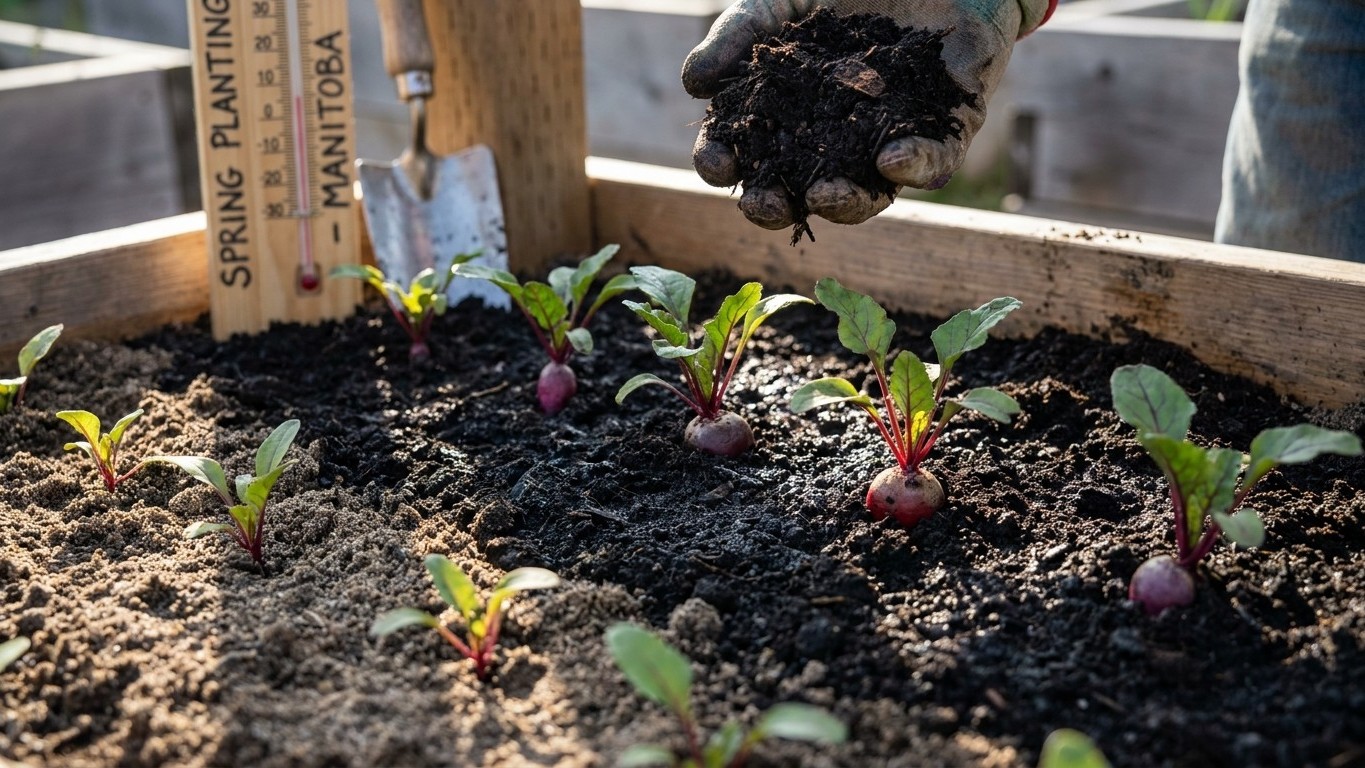

Manitoba’s ground runs alkaline and moisture-heavy in ways that push against what a beet actually wants: deep, well-drained, sandy soil loosened with a modest hand of compost. Add a last frost date that averages May 23 but slides later half the time, and the six weeks after seeding become the real test. Here’s what that means for a Manitoba garden bed, and where beets typically fail.
The short answer
The most common soil across Manitoba’s mapped agricultural land is a Chernozem, the dark, organic-rich grassland soil the prairies are known for, covering 41 percent of the surveyed area (Gleysolic soils come second). Median surface pH runs about 7.6, which is alkaline. Texture leans loam to silt: 45 percent sand, 24 percent clay, 31 percent silt, with organic matter around 5.5 percent. Drainage is classed as imperfectly drained.
Set that against what a beet actually asks for. Utah State University Extension describes the ideal bed as deep, sandy and well-drained, enriched with no more than 1 inch of composted organic matter per 100 square feet. Manitoba’s typical profile matches part of that description and works against the rest of it. The organic matter is already generous, so a gardener adding compost on top of Chernozem soil should stay well under that 1-inch ceiling rather than treat it as a target to hit. The clay-silt fraction and the imperfectly drained rating are the bigger friction point: water sits in this kind of ground longer than a beet root prefers, particularly right after snowmelt when the bed is saturated and cold.
Heat is the other half of the Utah State guidance. Once temperatures climb past 85 F while the soil is also dry, beet roots turn woody rather than tender. Manitoba summers do produce stretches of heat, but the actual count of days each year that a reference station like Winnipeg passes 90 F isn’t published in the data behind this page, so it won’t be guessed at here. What can be said with confidence is the mechanism: any hot, dry spell layered onto Manitoba’s alkaline, moisture-retentive Chernozem calls for closer watering, not just a general sense that “it gets hot in July.”
None of this is a diagnosis for one particular yard. Manitoba’s agricultural zone spans hundreds of individual soil series, and a garden sitting on river-bottom silt, reclaimed muskeg, or fill brought in during a home build can behave nothing like this median. Treat the Chernozem profile as the province’s starting tendency, and the beet’s own preferences as the target, then close the gap with a soil test rather than an assumption, using a closer look at Beet Soil in Manitoba to guide the adjustments.
The six weeks that decide it here
Beets are sown directly in the ground, never transplanted, and Utah State University Extension’s guidance on the crop centers on the first six weeks after that seeding, which is why nailing down When to Sow Beets in Manitoba matters: water stress in this window is what triggers premature flowering, or bolting, before the root has had a chance to size up. Sowing 2 to 3 weeks ahead of the last frost is the standard timing, and in Manitoba that last frost averages May 23 at the Winnipeg Richardson International Airport station, based on the 1981-2010 climate normals from Environment and Climate Change Canada.
That average date is a midpoint, not a guarantee. In one year out of two, frost actually arrives after May 23, sometimes well after. A gardener who sows 2 to 3 weeks before the average date and then gets a late frost is not necessarily in trouble (beet seedlings tolerate a light frost reasonably well), but the calendar math for the six-week bolting window should be built around the later possibility, not the average one. Push the six weeks out mentally to early May through late June rather than assuming the earliest possible sowing date every season.
What does a Manitoba spring do inside that window? It tends to swing rather than settle. The province’s imperfectly drained Chernozem soil holds meltwater into early spring, so beds can start the season waterlogged and cold, then dry out fast once prairie sun and wind take over in May and June. That swing matters more for beets than a steady climate would. A bed that goes from soggy to parched in the space of two or three weeks delivers exactly the kind of water stress that Utah State University Extension flags as the trigger for early bolting, and it can happen inside that critical six-week stretch without a single day of extreme heat involved. Bolting from thirst in May is a separate problem from woodiness caused by July heat, and treating them as the same issue, both solved by “keep it watered,” misses the fact that one strikes cool young plants and the other strikes roots that are already sizing up.
What goes wrong here
- Waterlogged seedbeds after snowmelt. Manitoba’s imperfectly drained Chernozem holds spring moisture longer than a beet seed wants for germination, and cold, soggy soil invites damping off in young seedlings. Raise the row a few inches above grade and work in the composted organic matter (staying under the 1-inch-per-100-square-foot ceiling) to open up the clay-silt fraction before sowing.
- Early bolting when spring swings dry. If the same bed that was wet in April turns dusty by late May, the plants are moving through their first six weeks under real water stress, exactly the window Utah State University Extension names as the bolting trigger. A steady watering schedule through that stretch, rather than watering only when the surface looks dry, closes most of this gap.
- Woody roots from summer heat. Once air temperatures push past 85 F, any accompanying dry spell turns beet flesh fibrous and tough. This is a separate failure from spring bolting and shows up later in the season, on roots that already survived the early stress. Deep, less frequent watering and a layer of mulch over the row keep the soil from swinging hot and dry at once.
- Crusting on the clay-loam fraction. With 24 percent clay in the typical Manitoba profile, a hard rain on bare soil can seal the surface before small beet seed clusters push through. Keep the top inch loose with light raking or a thin mulch layer rather than leaving a bare, compacted surface after sowing.
- Compost pushing an already-alkaline soil further alkaline. Median pH sits at 7.6 across the province’s mapped surface, already on the alkaline side. Heavy, repeated composting on top of that median can nudge pH higher still, so the 1-inch-per-100-square-foot ceiling from Utah State University Extension is worth respecting rather than treating as a minimum.
Checking this against your own county
Manitoba doesn’t divide its farmland into counties the way many U.S. states do, but the same local check applies: take the province-wide Chernozem profile as a starting point, then confirm your own soil’s texture, drainage and pH before planning a bed. Manitoba Agriculture, the provincial extension service, publishes region-specific soil and crop guidance and is the right first call for anyone gardening outside the Winnipeg area, where local drainage or frost timing may run noticeably behind the Richardson Airport normals. Find current programs and contacts at gov.mb.ca/agriculture.
A soil test through that same office, or a private lab, will give an actual pH and texture reading for a specific yard rather than the province-wide median used here. That’s the only way to know whether a given bed needs more drainage work, less compost, or simply a watering schedule tuned to the local swing between wet spring and dry early summer.
Common questions
What pH should Manitoba gardeners expect for beets?
The province’s mapped agricultural soil runs a median surface pH of about 7.6, alkaline. That’s a starting figure for the region, not a reading for any one garden, so a local soil test remains the only way to know an actual number.
How long do beets take to mature after sowing in Manitoba?
Beets are sown directly in the ground and generally reach maturity roughly 60 to 80 days from that seeding, depending on the variety grown, according to Utah State University Extension. That count starts at seeding, never at a transplant date, since beets aren’t transplanted.
Is it safe to sow beets before May 23 in Manitoba?
May 23 is only the average last frost date at the Winnipeg Richardson International Airport station, based on 1981-2010 climate normals. Frost falls later than that in roughly half of all years, so sowing 2 to 3 weeks ahead of the average date means accepting some frost risk on young seedlings rather than a guaranteed frost-free start.
Why did my beet roots turn woody instead of tender?
Woodiness comes from heat above 85 F combined with dry soil, a different failure from early bolting caused by water stress in the first six weeks after seeding. Consistent deep watering during any hot, dry stretch later in the season is the fix Utah State University Extension points to for this specific problem.