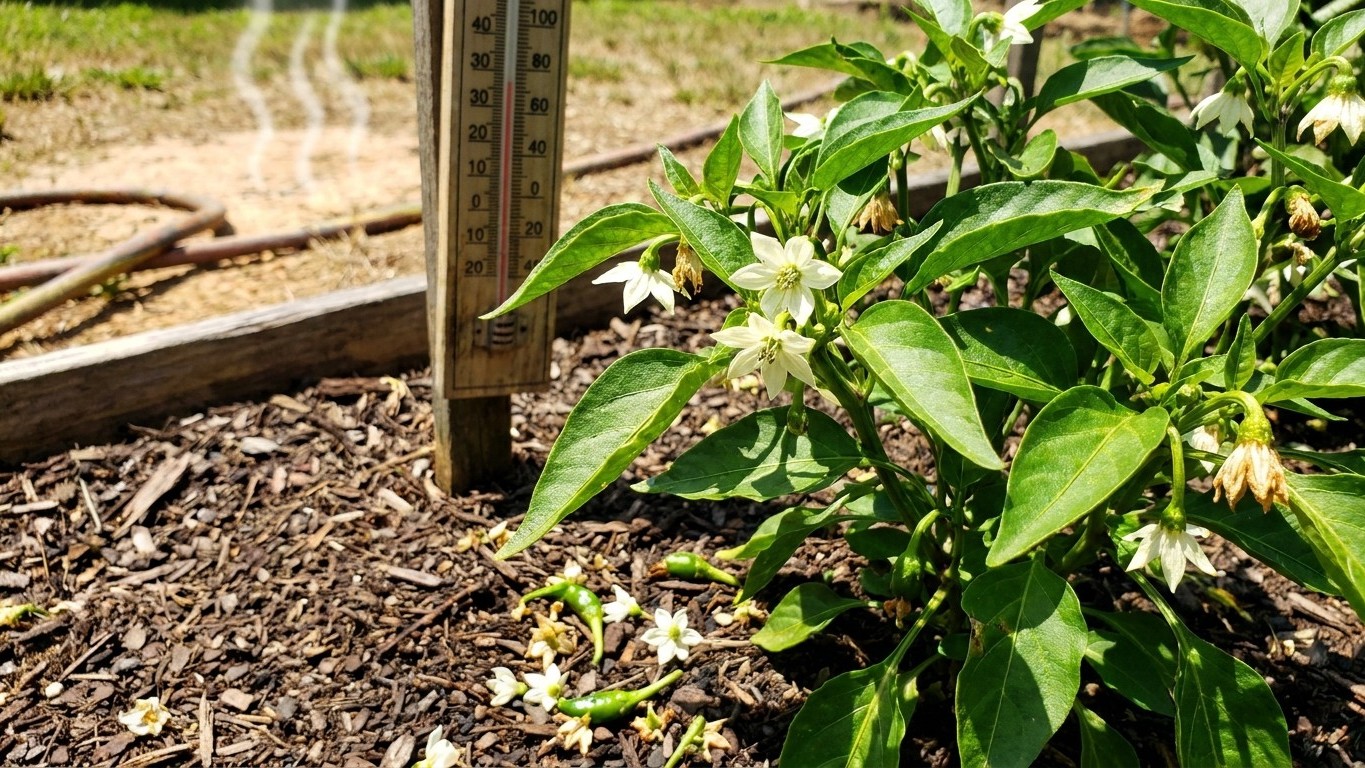

Peppers drop their flowers or never set fruit in Rhode Island mostly because of temperature swings, not soil or watering mistakes. The state’s summer heat spikes and its cool coastal nights both interfere with pollination, and a transplant started too early or too late compounds the problem. Get the timing and the temperature window right, and fruit set usually follows.
The short answer
Providence, the reference station for Rhode Island climate data, averages 9.4 days a year at or above 90 F, according to NOAA NCEI Climate Normals for 1991-2020. That’s not a brutal number compared to inland states, but it’s enough to matter. Pepper flowers can abort when daytime highs climb into the 90s during bloom, especially if that heat arrives in a stretch rather than a single afternoon. The plant keeps growing leaves and stems, but the blossoms that would have become peppers simply fall off before pollination finishes. A gardener in Woonsocket or South Kingstown who sees a string of 90-plus days in July should expect some blossom loss during that window, even with otherwise healthy plants.
The other side of the equation matters just as much, and it’s the one growers overlook. Pepper fruit set also fails when nights drop below 55 F, a threshold cited by Utah State University Extension. Cool nights slow pollen viability and can stall fruit development even when daytime conditions look ideal. Rhode Island’s coastal geography, its bays, and the Atlantic influence all shape how cool a given yard gets after sunset, and that variation happens at a very local level, sometimes yard to yard depending on elevation, tree cover, and distance from water.
This is the part that needs a caution flag: this site does not carry summer night minima for Rhode Island or any other state. Nobody publishes a single number for “how cold does it get at night in July” that applies evenly across a state this size, and guessing from latitude alone is not reliable, since a valley three miles from the coast can run several degrees cooler than a spot in town on the same night. The only accurate move is to track your own overnight lows with a simple outdoor thermometer near the pepper bed during the flowering weeks. If you’re seeing repeated nights under 55 F while blossoms are opening, that’s your answer, and no statewide average will substitute for that reading.
So the short answer has two halves. Nine and a half days a year of 90-plus heat is a real but manageable hazard, one that a gardener can plan around by timing transplants and watching the forecast. The cool-night half is invisible from state-level data and has to be checked at home.
When to start seed here
Working backward from Rhode Island’s frost and soil data gives a seed-starting date that actually fits local conditions, rather than a generic package instruction. Here’s the arithmetic, step by step, using Providence’s reference figures.
- Start with the last spring frost window. NOAA NCEI’s 1991-2020 normals put Providence’s 32 F freeze probability in the 30 to 70 percent band between April 7 and April 17. That’s the airport station reading, and it’s the starting point for the calculation, not the final word for every yard.
- Adjust for your actual property. Suburban and rural gardens in Rhode Island typically see their last frost land later than the airport figure, often by one to two weeks, and more if the garden sits at elevation or in a low-lying spot that collects cold air. A gardener in a valley pocket in northern Rhode Island should plan on a later safe date than someone on a warm, sheltered lot closer to the coast.
- Confirm soil temperature before transplanting. Utah State University Extension is specific on this: pepper transplants go in the ground only after frost has passed and once soil temperature reaches 60 F. Frost passing and soil warming don’t always happen on the same day. Cold, wet spring soil can lag behind air temperature by a week or more, so check the soil with a probe thermometer rather than assuming the calendar alone tells you it’s ready.
- Count back 8 to 10 weeks for indoor seed starting. That same Utah State University Extension guidance calls for starting pepper seed indoors 8 to 10 weeks before that transplant date. If your adjusted, frost-safe, soil-ready transplant date lands in the first half of May, counting back 8 to 10 weeks puts seed-starting indoors somewhere in late February to early March.
- Redo the math for your own county. Because the airport figure is a reference point and not a guarantee, the safest approach is to track your own last frost over a couple of seasons, note when your soil actually warms to 60 F with a thermometer, then subtract the 8 to 10 week window from that real date rather than the state average.
This sequence matters because starting seed too early just means leggy, stressed transplants sitting indoors waiting for soil that isn’t ready, while starting too late shortens the whole season and pushes flowering into the hottest stretch of summer, right when that 9.4-day heat count starts working against fruit set.
What goes wrong here
- Blossom drop during a hot spell. When daytime highs push into the 90s during flowering, blossoms can abort before pollination completes. Providence’s 9.4 average days a year at or above 90 F means this is an occasional risk rather than a constant one, but it tends to cluster in July. The remedy is timing bloom to avoid the hottest stretch where possible, and giving plants light afternoon shade with row cover or shade cloth during a forecasted heat run.
- Blossom drop from a cool night. Nights under 55 F have the same effect from the other direction, stalling pollen viability. Since summer night minima aren’t tracked here at the state level, the fix starts with a thermometer at the garden bed during flowering weeks. If cool nights are a recurring pattern in your yard, choose a warmer microclimate, near a south-facing wall or fence that holds heat, and delay transplanting a week or two until nights consistently clear that mark.
- Sunscald on exposed fruit. Strong summer sun can scorch pepper skins, especially on fruit left exposed after pruning removed too much foliage. The remedy is leaving enough leaf cover to shade developing peppers, and avoiding heavy pruning during the hottest weeks of the season.
- Blossom-end rot on developing fruit. This shows up as a dark, sunken patch on the fruit’s bottom end and traces back to inconsistent watering that disrupts calcium uptake, not a soil calcium shortage in most cases. The remedy is even, regular watering, mulching to hold soil moisture steady, and avoiding the swing between bone-dry soil and a sudden heavy soak.
Common questions
How many days a year does Rhode Island see 90 F heat that can hurt pepper fruit set?
Providence, the state’s reference climate station, averages 9.4 days a year at or above 90 F, based on NOAA NCEI Climate Normals for 1991-2020. That’s the benchmark for how often hot-end blossom drop becomes a realistic risk during the flowering weeks.
Can I tell how cold my nights get by looking at a state weather map?
No. Summer overnight lows vary too much yard to yard, based on elevation, tree cover, and distance from water, to be estimated from a state map or from latitude. This site does not publish summer night minima, so the only reliable method is placing a thermometer near the pepper bed and checking it during the flowering period.
When should I transplant peppers outdoors in Rhode Island?
Wait until after your local last frost and until soil temperature reaches 60 F, per Utah State University Extension guidance. Providence’s reference last-frost window runs April 7 to April 17, but suburban and rural gardens often see frost end one to two weeks later, so check your own county rather than relying on the airport figure alone.
What causes the dark spot on the bottom of a pepper?
That’s blossom-end rot, and it usually comes from uneven watering rather than a lack of calcium in the soil. Keeping moisture consistent with regular watering and mulch is the practical fix.