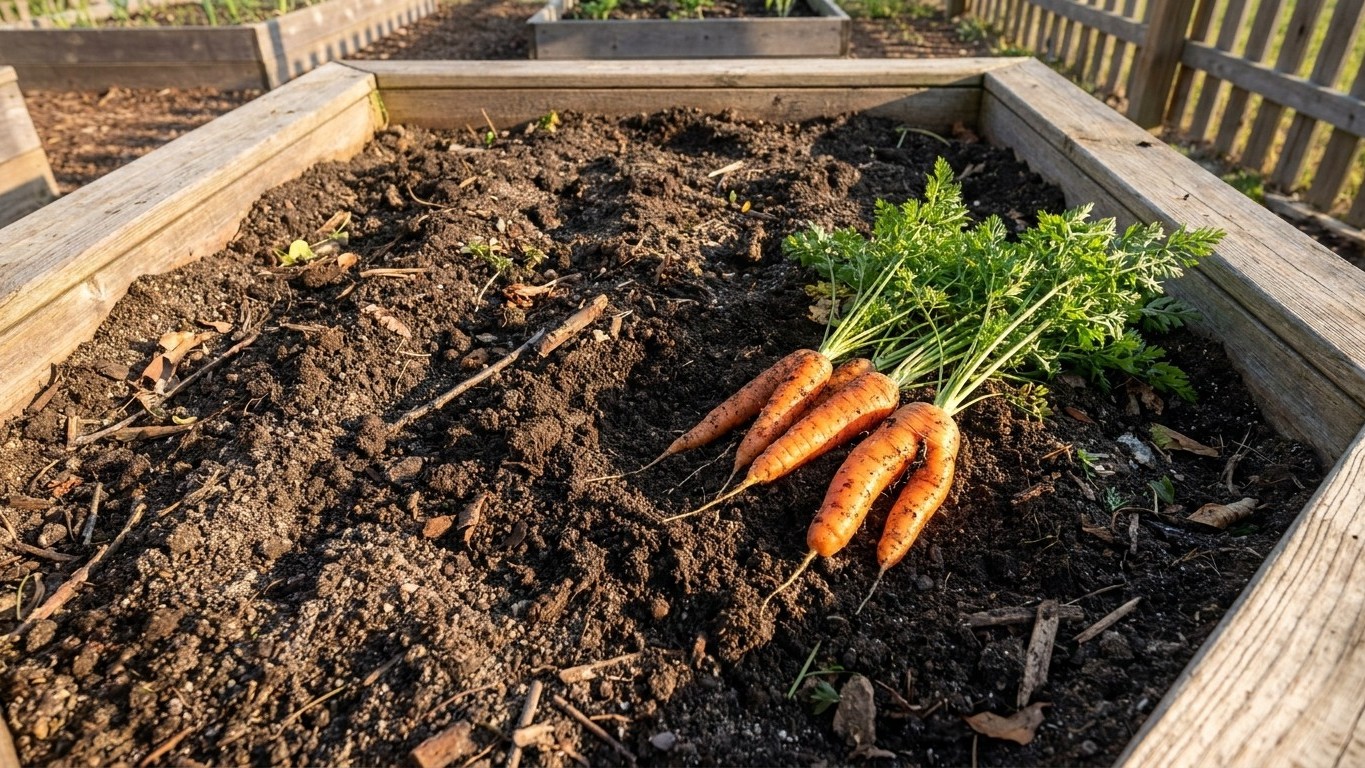

Rhode Island’s representative topsoil, the Narragansett series, is a well-drained silt loam: 34 percent sand, 60 percent silt, only 6 percent clay, with about 4.0 percent organic matter and a surface pH near 5.3. That low clay number matters for the question of Will Carrots Fork in Rhode Island Soil?, since it’s clay and rock that twist a taproot into a fork. Compost still helps, and a raised bed removes the guesswork entirely.
The short answer
The Narragansett series is classified as an Inceptisol, which is soil science shorthand for a young soil. It hasn’t had the thousands of years needed to develop the strong, sharply banded layers you’d find in older soil orders. What USDA’s Soil Data Access records for the surface horizon of its major components is a silt loam: 34 percent sand, 60 percent silt, and just 6 percent clay, sitting on top of organic matter around 4.0 percent. Surface pH runs about 5.3, which is strongly acid.
For a carrot, the number that matters most here is that 6 percent clay figure. Utah State University Extension is blunt about the mechanism behind forked roots: heavy or rocky soil is what twists a taproot sideways or splits it into two legs. A silt loam with 6 percent clay is nowhere near the dense, sticky clay that causes the worst forking. Combined with good drainage and a respectable 4.0 percent organic matter, this representative soil starts from a reasonably favorable place for a straight root, at least on paper.
That doesn’t mean skip the prep work. Compost worked into the top foot of soil loosens any compaction and feeds the organic matter that’s already there. Double digging, turning the soil in two layers to break up anything hard beneath the surface, is cheap insurance against a hardpan you can’t see from above. If your yard has been graded, filled, or compacted by construction equipment at any point, a raised bed sidesteps the question altogether by giving the root a full 10 to 12 inches of loose, uniform growing medium with no history to worry about. Once your soil is prepped, timing the planting itself matters too, so see When to Sow Carrots in Rhode Island for the dates that fit this climate.
None of this is a diagnosis of your particular garden. Rhode Island, like every state, is mapped across hundreds of distinct soil series, and the Narragansett series is simply the one USDA lists as representative for the state as a whole under its State Soils program. Your own yard could sit on something sandier, rockier, or wetter. The strongly acid pH of 5.3 is a fact about this mapped series, not a number to assume applies to your beds without a test. Treat everything above as a starting point for what the region’s ground tends to do, not a verdict on the dirt under your own feet.
The test that settles it in your own garden
State-level soil data can only tell you what’s typical. Your own garden bed answers the question directly, and it takes about twenty minutes with a shovel.
- Dig a hole at least a foot deep. Use a spade or a soil probe wherever you plan to sow carrots. Look at the sides of the hole as you go, not just the bottom.
- Check the depth of loose soil before you hit something hard. A hardpan, a layer of compacted clay, or a shelf of buried construction fill within that first foot is exactly what forces a taproot to bend or fork. If you hit resistance at six inches instead of twelve, that’s your answer on whether a raised bed makes sense.
- Pull out rocks and note how many you find. Carrots don’t need a rock-free bed, but a taproot growing straight down into a stone will simply go around it, and around often means forked.
- Feel the texture between your fingers. Wet a small handful and try to roll it into a ribbon. Soil that ribbons long and smooth like clay behaves very differently from soil that falls apart quickly, which points toward more sand or silt.
- Watch how water moves through it. Fill the hole with water and see how long it takes to drain. Water that sits for hours signals poor drainage, a condition carrots handle badly regardless of what any regional average says.
Do this in more than one spot if your yard has any slope or if part of it was disturbed by past landscaping. Two beds ten feet apart can behave completely differently once you’ve had a house, a driveway, or an old shed on the property.
When to sow here
Carrots go into the ground as seed, direct-sown where they’ll grow, since transplanting disturbs the taproot before it’s even started. Every date below counts from that seeding day, never from a transplant, because there isn’t one.
- Start with your local last spring frost window. At the reference weather station used for Rhode Island’s 1991-2020 climate normals, the last spring freeze falls somewhere between April 7 and April 17, based on standard freeze-probability data. Suburban and rural gardens away from that station often see their own last frost run one to two weeks later, and more if you’re at any real elevation, so treat this range as a reference point rather than a guarantee for your yard.
- Sow 2 to 3 weeks before that date, not after. Counting back three weeks from April 7 lands around March 17; counting back two weeks from April 17 lands around April 3. That gives a rough sowing window somewhere in the second half of March into the first days of April, shifting later if your own site historically frosts later than the reference station.
- Check soil temperature before trusting the calendar. Carrot seed needs soil at a minimum of 40 F to germinate at all, and germination is strongest between 55 and 65 F. A cold snap can push your actual sowing date back regardless of what the calendar window suggests, so a simple soil thermometer beats guessing.
- Expect a slow start in cool soil. Carrot seed is famously unhurried even in ideal conditions, and soil sitting near that 40 F floor will germinate noticeably slower than soil already into the 55 to 65 F range.
What goes wrong here
- Forked roots in compacted or rocky ground. Even where the mapped soil runs light on clay, individual yards with fill, rubble, or a hardpan a few inches down will still fork a taproot. The fix is the same everywhere: work compost in deep, double dig before sowing, or switch to a raised bed with loose soil a full foot deep.
- Poor germination during a hot stretch. Carrot seed germinates best between 55 and 65 F. A late-spring heat spike pushes soil temperature well above that window, and germination rates drop noticeably. Sowing at the earlier end of the recommended window, and keeping the seedbed consistently moist with light mulch or frequent watering, keeps soil temperature closer to the range seed actually wants.
- Splitting from uneven watering. Carrots that dry out and then get soaked, whether from a skipped week of watering followed by a heavy rain or from an inconsistent hose schedule, tend to split along the root as it swells unevenly. Regular, even moisture from sowing through harvest is the only real prevention, and it matters more on light, fast-draining soil that swings between wet and dry quickly.
- Strongly acid soil going unaddressed. The state’s representative surface pH of 5.3 is firmly on the acid side. Whether that number matches your own bed is impossible to know without testing, and guessing at a fix without a test result risks over- or under-correcting.
Checking this against your own county
Everything above describes what a single representative soil series and a single reference weather station look like on paper. Your county, and often your specific neighborhood, can differ from both in ways that matter for a root vegetable that punishes guesswork.
University of Rhode Island Cooperative Extension is the land-grant service for the state and the right place to take both questions: a soil test that returns your actual pH and nutrient levels, and localized frost-date guidance based on records closer to your own address than a single airport station. Reach them at web.uri.edu/coopext. A five-dollar soil test answers in writing what a shovel and a guess never quite settle.
Common questions
Do I need to add lime because Rhode Island’s soil is acidic?
The representative surface pH for the state’s mapped Narragansett series is about 5.3, which is strongly acid, but that figure describes a mapped soil series, not your bed. A soil test through your local extension office gives you your own number before you add anything.
Can I sow carrots directly from a seed packet without starting them indoors?
Yes, and it’s the only method that works well for carrots. The taproot resents disturbance, so carrots are always direct-sown where they’ll mature, with the 70 to 100 days to harvest counted from that seeding date rather than from any transplant.
Why did my carrots come up sparse this year?
Soil temperature is the usual suspect. Carrot seed germinates poorly below 40 F and best between 55 and 65 F, so a cold snap right after sowing, or a sudden heat spike, can both thin out a stand that looked fine on the seed packet.
Is a raised bed really necessary if my soil isn’t heavy clay?
Not necessarily. The state’s representative soil runs only 6 percent clay, which is on the lighter side, but individual yards vary enormously. The dig-and-feel test earlier in this article, done in your own bed, is a better guide than any regional average for deciding whether a raised bed is worth the lumber.