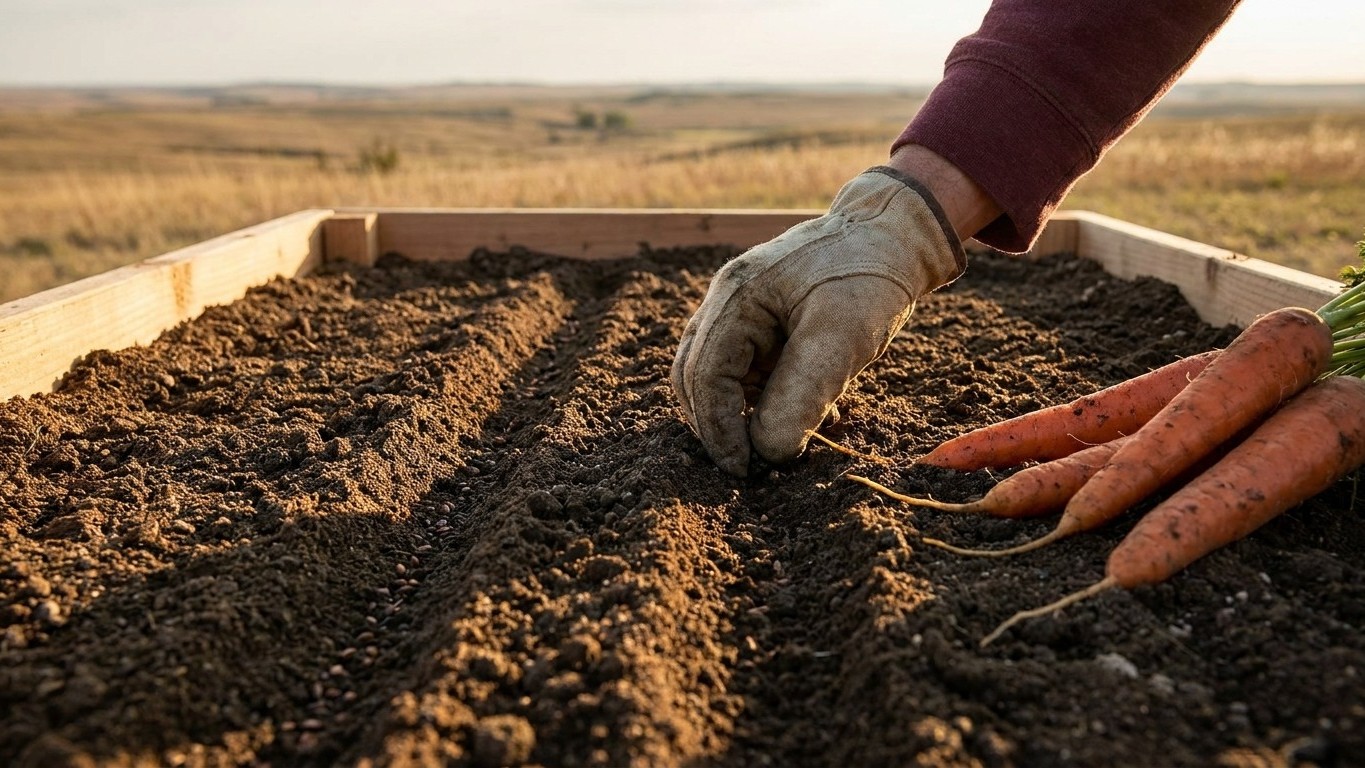

South Dakota’s state soil, the Houdek series, is a well-drained loam with a fairly even split of sand and silt and only a moderate clay load. That mix rarely forces a carrot root to split into two forks, but it describes a statewide average, not your backyard. Whether your carrots grow straight or fork depends on the depth, stones and drainage of the specific bed you plant, and that’s worth checking before seed goes in the ground.
The short answer
South Dakota’s official state soil is the Houdek series, a Mollisol, the deep, dark prairie soil that built the Corn Belt and got named the state soil by law in 1990. Sampled at the surface horizon across 90 mapped components, it runs about 38 percent sand, 22 percent clay and 40 percent silt, with organic matter around 3.0 percent and a surface pH near neutral at roughly 6.7. Drainage class is listed as well drained.
That texture matters because carrots have one clear preference: deep, sandy, well-drained soil loaded with organic matter, according to Utah State University Extension. Heavy or rocky soil is what makes a carrot root fork, splitting around an obstruction instead of growing straight down. On paper, Houdek’s blend, roughly two parts sand and silt for every one part clay, leans toward the loose, easy-draining texture carrots want, rather than the dense, sticky clay that stops a taproot cold.
So a bed that resembles the Houdek series is a reasonably good starting point for carrots without heroic intervention, though the real question of Will Carrots Fork in South Dakota Soil? still comes down to what’s in your specific bed. If your soil runs heavier than that, closer to a clay loam or straight clay, the same Extension guidance applies: work in plenty of compost and double dig the bed, breaking up and loosening the soil to a depth well beyond where the root will grow, or skip the fight altogether and build a raised bed filled with a loose, sandy mix. A raised bed sidesteps the whole forking problem because you control the texture from the start instead of trying to rework what’s already there, and getting the timing right matters just as much as texture, so check When to Sow Carrots in South Dakota before you plant.
Here’s the catch worth sitting with: Houdek is the soil that represents South Dakota on a map and in a law, not the soil in every yard across the state. South Dakota spans hundreds of mapped soil series, and river bottoms, hill country, and any lot a builder has scraped, graded or filled can carry a completely different texture, drainage pattern and pH than the Houdek profile. Treat these numbers as a regional tendency, a hint about whether the ground around you is more likely to hold water and pack tight or drain fast and stay loose, not as a diagnosis of the bed you’re about to plant. The next step is a look at your own dirt, not the state’s.
The test that settles it in your own garden
State-level soil data can’t tell you what’s twelve inches down in your own plot. A short, low-tech check does that in under an hour, and it costs nothing but a shovel and some patience.
- Dig a test hole. Go down at least 12 inches where you plan to sow carrots. Note how easy or hard the digging is; soil that fights you the whole way down is a warning sign for a taproot crop.
- Check the depth and look for obstacles. Carrots need clear, unbroken depth to grow straight. Look for rocks, chunks of construction debris, old roots, or a compacted layer (a hardpan) that stops the shovel or changes the soil’s color and density abruptly.
- Feel the texture. Take a handful of moist soil from the hole and squeeze it. Soil that forms a hard, sticky ball and holds its shape leans toward clay. Soil that barely holds together and falls apart when you poke it leans toward sand. Something in between, a ribbon that holds briefly then breaks, points toward the loam and silt mix that carrots tolerate best.
- Watch how water drains. Fill the hole with water and see how it behaves. Water that sits for a long stretch signals poor drainage and a higher risk of splitting or rot. Water that disappears quickly, on the other hand, means you’ll need to stay on top of consistent watering once seeds are in the ground.
None of these steps requires a lab, and none of them requires guessing at numbers nobody has measured for your specific yard. They tell you, directly and locally, whether you’re closer to the Houdek profile or working with something the state average never accounted for.
When to sow here
Carrots are sown directly in the ground; there’s no transplanting step to shift the calendar around. Every date below counts from the seed going into the soil, not from any later stage.
- Start with the local frost window. At the reference weather station used by NOAA’s 1991-2020 Climate Normals for this area, the last spring frost falls between April 29 and May 9. That’s a station reading, and suburban and rural gardens often see their own last frost later than the airport does, sometimes by one to two weeks, more if the garden sits at higher elevation.
- Check the soil temperature before anything else. Carrot seed needs soil at a minimum of 40 degrees Fahrenheit to have any real chance of sprouting. A thermometer pushed a few inches into the bed on a calm morning tells you more than the calendar does.
- Count backward two to three weeks from your last frost date. Using the April 29 to May 9 window as a reference, that puts a typical outdoor sowing target somewhere in the second half of April, provided the soil has already warmed past that 40-degree floor. If your own last frost tends to run later than the station date, push this window back to match.
- Aim for the germination sweet spot. Seeds sprout best when soil sits between 55 and 65 degrees Fahrenheit. Sowing a little early, while soil is still climbing toward that range, is normal and expected; sowing into soil that’s already baked past 65 through a stretch of hot weather is where trouble starts.
The arithmetic is simple once you have your own frost date: two to three weeks before that date, check that the soil has cleared 40 degrees, then sow, knowing germination will pick up speed as the ground warms into the mid-50s to mid-60s.
What goes wrong here
- Forking in heavy ground. Where soil runs closer to clay than the Houdek loam, a carrot’s taproot hits resistance and splits around it, or wraps into odd shapes. The fix is the same one Utah State University Extension gives for any heavy soil: work in generous compost and double dig the bed to loosen it well below root depth, or grow carrots in a raised bed filled with a looser, sandier mix instead of fighting the native ground.
- Poor germination during a hot spell. Seeds sprout best between 55 and 65 degrees Fahrenheit, and a sudden run of warm days can push soil temperature well past that range before seedlings ever break the surface. Sowing on the earlier side of your window, and keeping the bed shaded or mulched during an unexpected heat spike, keeps soil temperature closer to that sweet spot.
- Splitting from uneven watering. A root that grows fast during a wet stretch and then stalls during a dry one tends to split along its length as it swells unevenly. Consistent watering on a set schedule, rather than heavy soaking followed by neglect, keeps the root growing at a steady rate.
- Stones and old debris deflecting the root. Even in loam soil, a buried rock, a chunk of old sod, or construction fill left behind by a previous owner can send a taproot sideways or forking. Clearing the top 12 inches of the bed by hand before sowing removes most of that risk before it starts.
Checking this against your own county
Everything above is a starting point built from a state-level soil series and a single weather station’s frost data. Neither one is a substitute for what’s happening on your own property, in your own county, this season. South Dakota State University Extension, the state’s land-grant extension service, tracks local frost timing, soil conditions and crop performance at the county level and is the right place to confirm your own planting window before you commit seed to the ground.
A quick call or visit to their local office can also flag anything unusual about your area’s soil, whether that’s a known pocket of heavy clay, unusually rocky ground, or a microclimate that runs colder or warmer than the regional average. That local check is the difference between planting on a statewide guess and planting on something closer to a measurement of your own dirt.
Common questions
Can I grow carrots in clay soil in South Dakota?
Yes, but expect forking unless you amend it. Working generous compost into the bed and double digging to loosen the soil well below root depth helps, and a raised bed filled with a looser mix avoids the problem entirely.
What’s the best time to sow carrot seeds in South Dakota?
Count back two to three weeks from your local last spring frost date, and confirm soil has warmed to at least 40 degrees Fahrenheit before sowing. The reference frost window for one South Dakota station runs April 29 to May 9, though your own yard may run later.
Why do my carrots split instead of forking?
Splitting usually comes from uneven watering, a fast growth spurt followed by a dry stretch, rather than from an obstacle in the soil. Forking, by contrast, is the root growing around something solid, like a rock or a hardpan layer.
Does the Houdek state soil mean my garden won’t need amending?
No. Houdek describes a representative surface soil mapped across the state, not the ground in any particular yard. Dig your own test hole, check the texture and drainage, and treat the state figures as a regional tendency rather than a measurement of your bed.