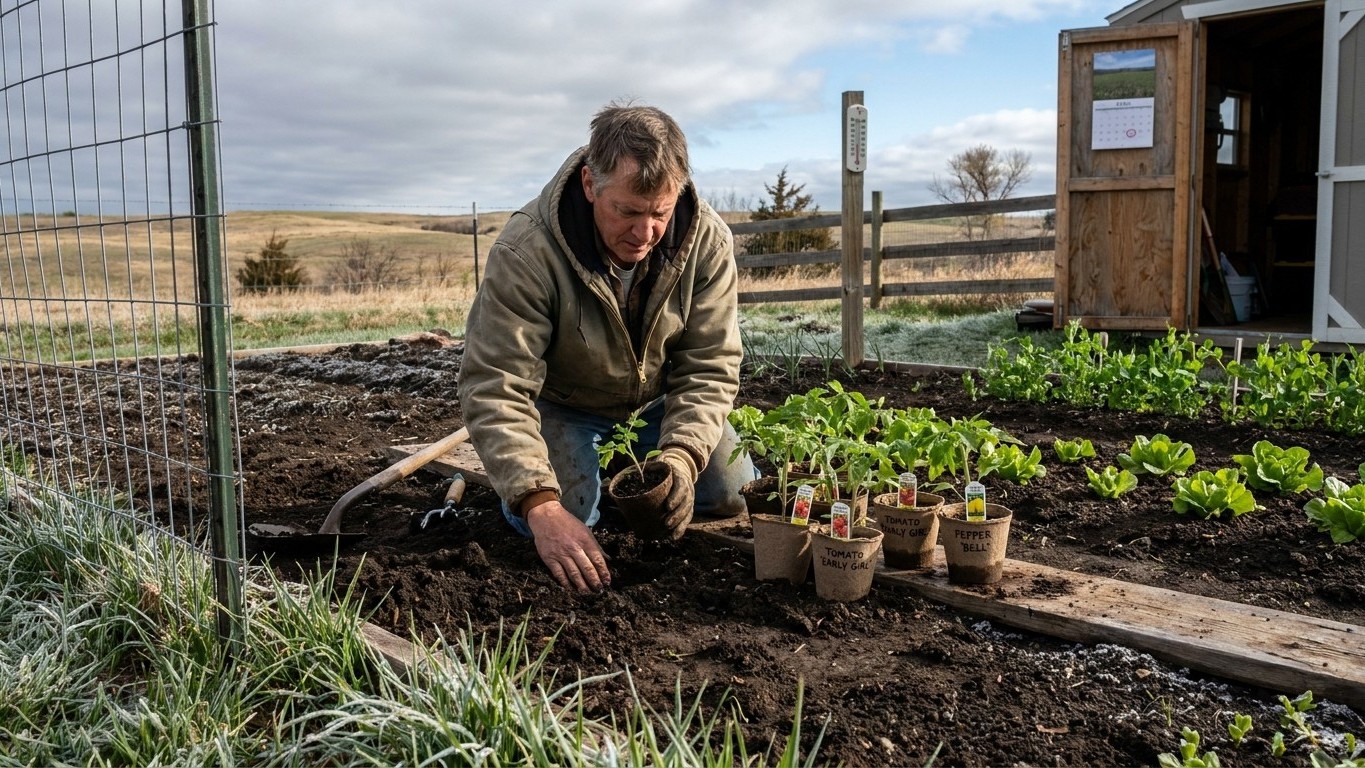

South Dakota gardeners work with one of the tighter frost-free windows in the country, and the difference between the eastern and western edges of the state can run two zones wide. Here’s what the season here actually allows, and where the state-level averages stop being useful for your own yard.
How long your season really is

Three numbers set the boundaries of what you can grow in South Dakota, and they belong together before anything else. The USDA places the state across hardiness zones 3b to 5b, the average last spring frost near Sioux Falls falls between April 29 and May 9, and the average first fall frost arrives between September 24 and October 4 – a window that also shapes When to Carve a Pumpkin in South Dakota if you’re growing them for Halloween.
| Measure | Value |
|---|---|
| USDA Hardiness Zone | 3b to 5b |
| Average last spring frost | April 29 to May 9 |
| Average first fall frost | September 24 to October 4 |
Do the subtraction and you get a frost-free window of roughly 140 to 160 days, depending on which end of each range your particular year lands on. That’s the one figure that actually decides what you can attempt. A 90-day sweet corn variety fits easily, as detailed in Growing Sweet Corn in South Dakota. A 100-day winter squash still has room, and a quick, cold-hardy root crop like parsnips fits comfortably too – see Growing Parsnips in South Dakota for how that timeline plays out, and the same margin makes room for other fast-maturing staples, as covered in Growing Carrots in South Dakota, Growing Beets in South Dakota, and Growing Potatoes in South Dakota, while a hardy perennial that shrugs off the state’s early frosts is covered in Growing Asparagus in South Dakota. But a long-season melon or a heat-loving pepper that needs 90 days just to reach transplant size, plus another 75 to fruit, is running the calendar with almost no margin for a cool June or an early September cold snap – see Growing Peppers in South Dakota for how to make that timing work.
The word “average” deserves more weight than most garden calendars give it. NOAA builds these dates from a 30-70% freeze probability band across the 1991-2020 record, which means they’re the midpoint of three decades of actual frosts, not a promise. By definition, roughly half of all years bring a frost later than that spring date or earlier than that fall date. Treating May 9 as a hard planting deadline, or September 24 as the day you’re guaranteed to still have tomatoes, sets up a gardener for a bad surprise about every other year.
There’s also a gap built into these numbers that matters more in South Dakota than in flatter, more uniform states. The dates above come from an airport weather station near Sioux Falls, in the eastern part of the state. Suburban yards, rural gardens, and anywhere with more elevation or less pavement to hold heat typically see the last spring frost later and the first fall frost earlier than the reference station, often by one to two weeks. Add the fact that the western part of the state sits in a colder zone altogether, and the honest takeaway is that this table is a starting point, not a schedule for your specific plot.
What the summer does to a garden here
Heat isn’t automatically good news for a garden, and South Dakota gets enough of it to matter. Sioux Falls averages 13.8 days a year at 90F or above, and that’s the number that drives water demand and pushes some crops out of the picture entirely for a stretch of the season.
Tomatoes stop setting fruit reliably once daytime highs push consistently above roughly 90F, even though the plant keeps growing and flowering. Lettuce, spinach, and other cool-season greens bolt to seed and turn bitter under the same conditions. That means the growing year here isn’t one long uninterrupted stretch from last frost to first frost. It behaves more like two productive shoulder seasons, a cooler run through late May and June, then another through September, with a stretch in the hottest part of July and into August where cool-season crops simply won’t perform and heat-loving ones are the only thing worth tending.
Winter cold matters just as much for anything meant to survive between seasons. The coldest month at the Sioux Falls reference station averages a daily minimum of 8.5F, which is the figure that decides whether a perennial, a fruit bush, or a garlic bed planted in fall actually makes it to spring. That’s a different question from the record low anyone remembers from a bad winter; it’s the typical overnight floor during the coldest weeks, and it’s cold enough that anything rated for a warmer zone than the local one is a genuine risk, not a stretch.
Put those two figures together and the practical takeaway is straightforward: plan for a garden that peaks twice, not once, and choose perennials and overwintering crops rated for cold that regularly drops into single digits, not just a zone number pulled from a seed packet.
What tends to go wrong in South Dakota
SDSU Extension’s home garden pages return to the same handful of insects again and again, and knowing when each one shows up saves more grief than knowing every possible name.
- Flea beetles, asparagus beetles, and wireworms — earliest to appear, often as soon as seedlings and emerging asparagus spears are in the ground in spring; flea beetles riddle young leaves with small holes, asparagus beetles chew the spears directly, and wireworms work underground against roots and tubers of new transplants.
- Colorado potato beetle, striped cucumber beetle, and spotted cucumber beetle — arrive as potato, squash, and cucumber plants establish in late spring, feeding on foliage and, in the case of cucumber beetles, spreading bacterial wilt as they go.
- Squash bug, squash vine borer, and blister beetles — show up in early-to-mid summer on squash and pumpkin vines and on beans and tomatoes; squash bugs and vine borers cause vines to wilt and collapse seemingly overnight, blister beetles feed in visible clusters.
- Imported cabbageworm, cabbage looper, and diamondback moth caterpillar — active on cabbage-family crops through most of the summer, chewing ragged holes in leaves and heads.
- Grasshoppers — build through late summer and turn genuinely damaging in dry years, when they’ll strip leaves off nearly anything in reach.
This isn’t every insect a South Dakota gardener could meet, and pressure from any one of them varies across the state. It’s the shortlist the state’s own extension service flags most often for home gardens, worth checking your plants against before assuming a problem is something worse.
Where to check before you plant
Everything above is a state-level average, and South Dakota spans enough latitude and elevation change that a single planting calendar can’t fit it well. The hardiness zone alone runs from 3b to 5b across the state, a real difference in what survives winter, and the frost dates come from one station near Sioux Falls that may run a week or two ahead of a garden further west or at higher elevation.
That’s exactly the gap SDSU Extension is built to close. As South Dakota’s land-grant university extension service, it publishes region-specific planting guidance, pest identification pages, and soil test resources that go well beyond a statewide average.
A planting date built for the state capital, or for any single reference city, can be three weeks wrong at either edge of the state. Before committing a season’s work to a calendar pulled from an average, a call or visit to the county extension office is the fastest way to find out how much that average actually applies to the ground you’re planting in.