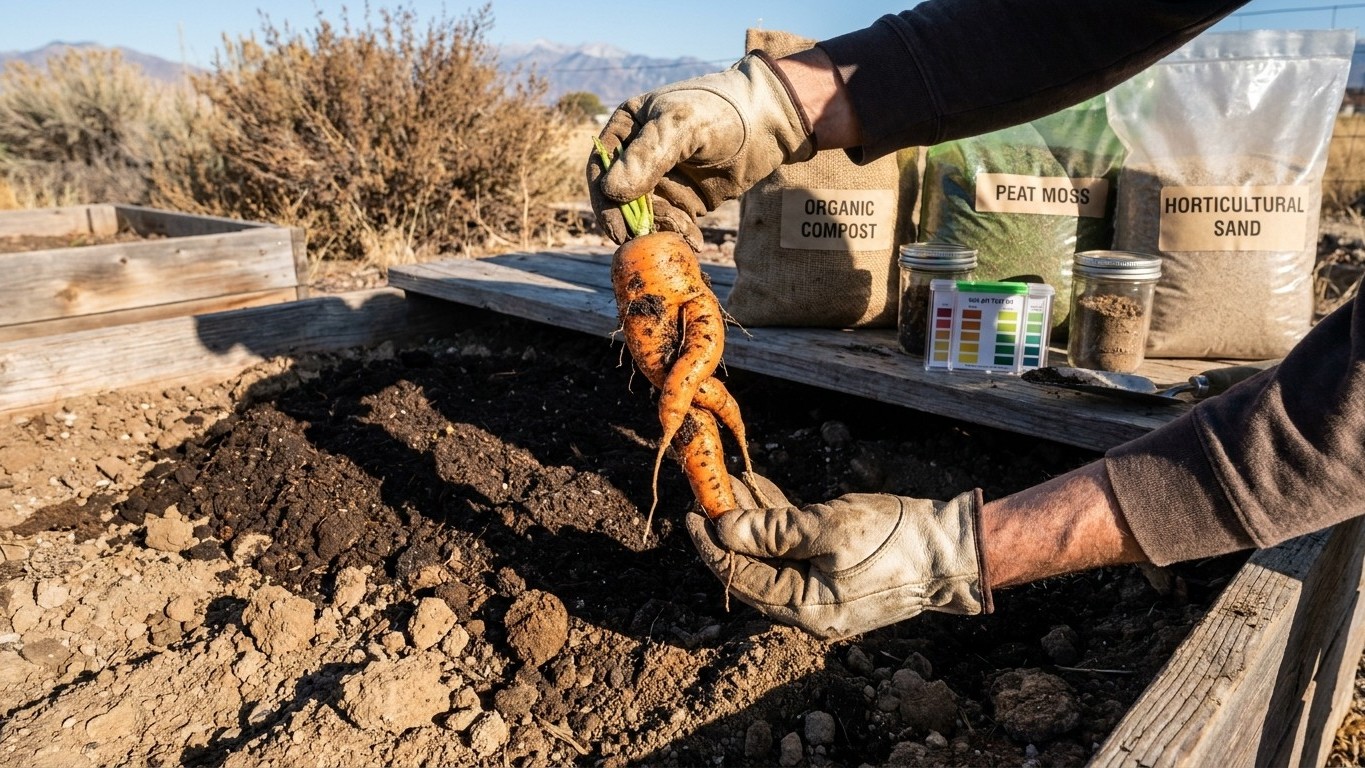

Utah’s representative topsoil runs sandy and alkaline, which sounds like decent news for a root crop that hates heavy ground. But the state’s official soil series is a benchmark, not a guarantee, and plenty of Utah backyards sit on clay that will bend a carrot into a corkscrew. The fix, when that happens, is compost and depth, not a different seed packet.
The short answer
The soil USDA lists as representative of Utah is called the Mivida series, an Aridisol, the kind of dry-climate soil that forms where rainfall is scarce and evaporation runs high. It tends toward alkaline and often carries salts near the surface. The measured surface pH sits around 8.1. Texture-wise it’s sandy: 72 percent sand, 9 percent clay, and 19 percent silt, with organic matter around 1.5 percent. Drainage class is well drained.
For a carrot, that texture is mostly good news. Carrots want deep, sandy, well-drained ground rich in organic matter, according to Utah State University Extension. Sandy soil lets a taproot push straight down without hitting resistance, and good drainage keeps the root from sitting in water it doesn’t want. The low organic matter figure, though, is the catch. At around 1.5 percent, the native surface horizon doesn’t carry much of the loose, crumbly material that keeps sandy soil from packing down between waterings, and it won’t feed a root crop the way a well-composted bed does.
The bigger catch is that Mivida is one soil series among hundreds mapped across Utah. It’s the series USDA singles out to represent the state under its State Soils program, not a survey of every yard from Logan to St. George. River bottoms run heavier and siltier. Foothill soils carry more rock. Any lot where a builder scraped, graded, or backfilled during construction can have a texture that has nothing to do with the natural series mapped underneath it. Treat the Mivida numbers as a starting point for what the region’s ground tends to do, not a diagnosis of the dirt outside your back door.
So will carrots fork in Utah soil? It depends which Utah ground you’re standing on. If a soil test or a simple dig shows sand dominating and few rocks, a carrot should run straight with a light hand of compost worked in before sowing, timed according to When to Sow Carrots in Utah. If what you find instead is heavy clay, or a soil compacted from construction fill, the roots will hit resistance, split around it, and grow forked. Utah State University Extension’s answer for heavy or rocky soil is plenty of compost combined with double digging, loosening and amending the bed a full spade deep rather than just scratching the surface. Where the ground refuses to cooperate even after that, a raised bed filled with a sandy, compost-rich mix sidesteps the problem completely.
The test that settles it in your own garden
State soil data can only tell you what’s typical for the region. Your own raised bed, your own side yard, your own decade-old vegetable patch, none of that shows up on a soil survey map with any precision. The only way to know what a carrot will meet underground is to look.
- Dig a test hole at least a foot deep where you plan to sow. Carrots need clear, unobstructed depth to grow straight, so this is the step that matters most.
- Check for rocks and debris as you dig. Anything solid in the top foot, from gravel to buried construction scraps, is a likely fork point for a growing root.
- Feel the texture by rubbing a handful of moist soil between your fingers. Gritty and loose suggests sand. Sticky, smooth, and slow to fall apart suggests clay. Silky but not sticky usually means silt.
- Squeeze a handful into a ball and see what happens. Soil that holds a tight shape and resists crumbling leans clay. Soil that won’t hold together at all leans sand.
- Watch how water drains. Fill the test hole with water, let it soak in once, then fill it again and time how long it takes to disappear. Water that lingers for hours points to a drainage problem a carrot bed will need to solve before sowing.
None of this replaces a lab soil test, and this page won’t guess at numbers no source here has measured for your specific yard. What the dig-and-feel test gives you is enough to decide, in plain terms, whether you’re working with something close to the sandy, well-drained Mivida profile, or with heavier ground that calls for compost, double digging, or a raised bed before a single seed goes in.
When to sow here
Carrots are sown directly in the ground. There’s no transplanting step to plan around, no seedling tray to harden off, so every date here counts from the day seed goes into soil, not from any later planting-out.
- Start with the frost window. NOAA’s 1991-2020 climate normals put the last spring freeze at a station in the Salt Lake area between April 12 and April 29, based on 32°F freeze probabilities. That’s a range, not a single date, and it reflects one valley station. Salt Lake sits in a comparatively mild valley; most of Utah runs higher in elevation and colder, while the southern part of the state runs warmer, so this window will shift earlier or later depending on where in the state a garden sits.
- Count backward two to three weeks. Carrot seed goes into the ground before that last frost date, not after it. Counting back three weeks from the early end of the window, April 12, lands around the third week of March. Counting back two weeks from the late end, April 29, lands around the middle of April. That stretch, roughly mid-March through mid-April depending on local elevation and the specific frost date for a given spot, is the sowing window this arithmetic produces.
- Check soil temperature before sowing, not just the calendar. Carrot seed needs the soil to have warmed to at least 40°F to germinate at all, so a cold snap that keeps ground temperatures below that mark should push sowing back regardless of what the date says.
- Aim for the germination sweet spot. Carrot seed germinates best when soil sits between 55°F and 65°F. Sowing right at the edge of the frost window, rather than the earliest possible day, often lands closer to that range and gives more even, reliable sprouting.
Because the frost data here comes from a single valley station, a garden up a canyon or out on a high bench should expect its own last frost to land later than April 29, and should shift the whole sowing window later to match.
What goes wrong here
- Forking in heavy ground. Where clay content runs higher than the sandy Mivida benchmark, or where the bed sits over compacted fill, a taproot meets resistance and splits into two or more legs. The remedy is compost worked in generously plus double digging to loosen the profile a full spade deep, or a raised bed filled with looser, sandier soil if the native ground won’t cooperate.
- Poor germination during a hot spell. Carrot seed germinates best between 55°F and 65°F. A warm stretch that pushes soil temperature well above that range can slow sprouting or leave gaps in the row. Watching soil temperature rather than the calendar, and sowing a little earlier within the recommended window when a heat spike is forecast, helps avoid the problem.
- Splitting from uneven watering. Carrots that dry out and then get soaked, a common pattern in a dry, high-evaporation climate like the one that shapes Utah’s Aridisol soils, tend to split as the root swells suddenly after a lag. Steady, even moisture through the growing season, rather than infrequent deep soaking, keeps the root growing at a consistent rate.
- Stunted roots in low-organic-matter soil. The Mivida series carries only about 1.5 percent organic matter at the surface, thin fuel for a root crop that benefits from richer ground. Working compost into the bed before sowing, rather than relying on the native soil alone, gives carrots the depth of loose, nutrient-carrying soil they need to size up properly.
Checking this against your own county
Everything above starts from a single representative soil series and a single frost-recording station, not from a survey of every county in Utah. Local conditions, elevation, and microclimate can shift both the numbers and the advice that follows from them.
Utah State University Extension is the authority to check next, and it publishes exactly this kind of local guidance at extension.usu.edu. A county office there can point to a more precise local frost record, confirm whether a particular area’s soil leans closer to sand or to clay, and adjust sowing dates for gardens sitting well above or below the valley floor.
Common questions
Do carrots grow well in Utah’s alkaline soil?
Utah State University Extension’s guidance focuses on texture and drainage rather than a specific pH target for carrots, and no source here publishes an ideal pH figure for the crop. What’s clear is that the state’s representative soil, with a surface pH around 8.1, is alkaline, and that the sandy texture behind that number is the more important factor for straight, unforked roots.
Can I sow carrots earlier than the recommended window in a warm Utah spring?
Only if the soil itself has warmed to at least 40°F, the minimum threshold for germination. A mild spell in the air doesn’t always mean the ground has caught up, so checking soil temperature directly is a more reliable guide than an early warm stretch on the calendar.
Does a raised bed solve forking on its own?
A raised bed helps mainly because it lets a gardener control the soil mix directly, filling it with the loose, sandy, compost-rich texture carrots need instead of relying on whatever the native ground provides. On its own, height doesn’t fix forking; the soil inside the bed does.
Why does my carrot seed germinate unevenly even when I sow at the right time?
Uneven germination often traces back to soil temperature drifting outside the 55°F to 65°F range where carrot seed sprouts best, or to inconsistent moisture across the row while seeds are germinating. Both are worth checking before assuming the seed or the timing was at fault.