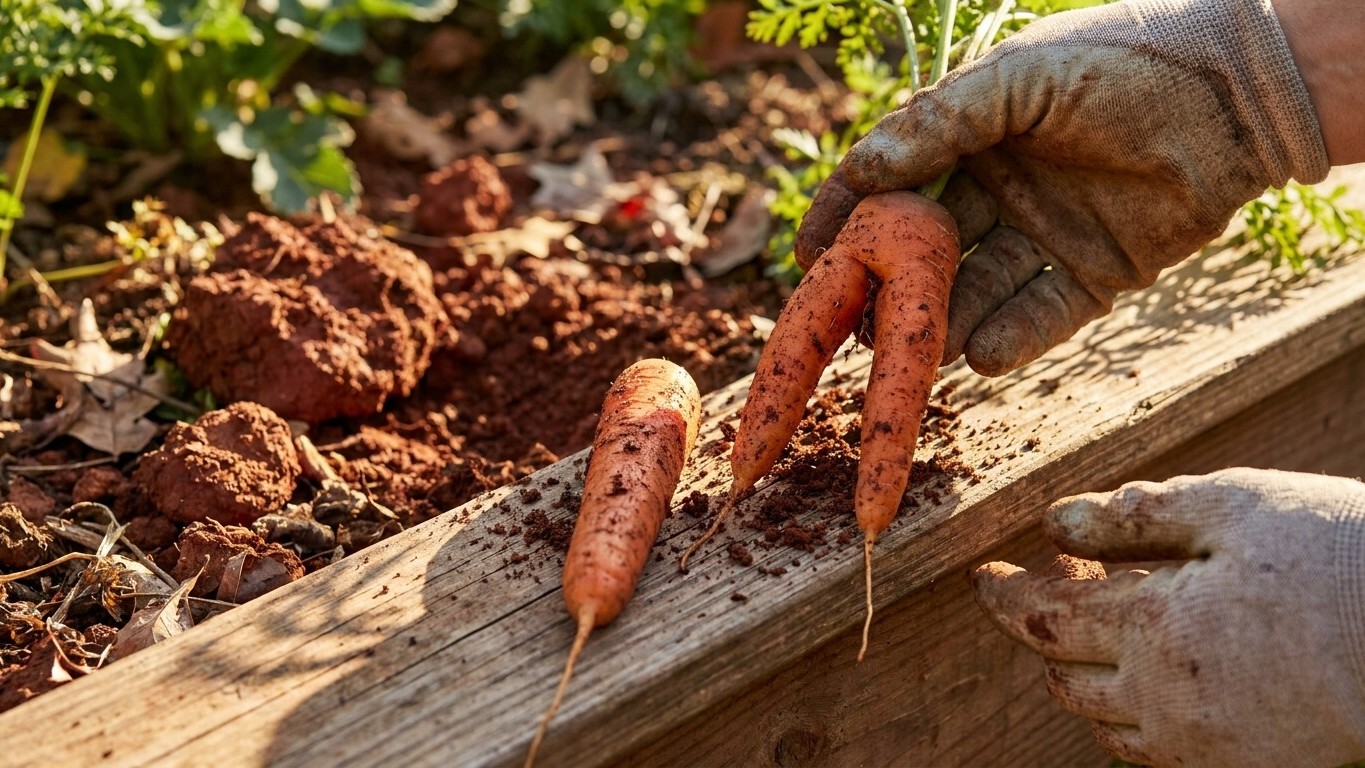

New Mexico’s representative soil, the Penistaja series, is sandy and well drained with only 15 percent clay. That texture favors a straight carrot, not a forked one. But that’s a state average, not a diagnosis of your raised bed or backyard plot. Whether your own carrots fork comes down to the clay, rocks and compaction in the specific patch of dirt you’re planting, and there’s a way to check that before you ever drop a seed.
The short answer
The soil USDA lists as representative of New Mexico is the Penistaja series, an Aridisol, the kind of dry-climate soil common across the state that tends toward alkaline and sometimes carries salts. The surface horizon runs about 69 percent sand, 15 percent clay and 16 percent silt, with a pH near 7.5 and organic matter around 1.4 percent. It’s classified well drained. Those numbers come from USDA NRCS Soil Data Access, averaged across 47 mapped components of the series.
For a carrot, that texture is mostly good news. Utah State University Extension is blunt about what causes forking: heavy or rocky soil. A root pushing through 15 percent clay with 69 percent sand has room to grow straight down without hitting a wall of compacted ground. Sandy, well-drained dirt is exactly the profile carrots want, according to that same USU guidance, which calls for deep, sandy, well-drained soil rich in organic matter.
The catch is that last part. Organic matter in the Penistaja series sits at roughly 1.4 percent, which is thin. USU’s advice for heavy or rocky ground, plenty of compost and double digging, still applies here, just for a different reason. Sandy, low-organic-matter soil drains fast and holds little nutrition on its own, so a carrot bed built on this kind of ground still benefits from the same fix: work in compost before you sow, and loosen the soil a full spade deep so roots don’t stall against a dense or dry layer a few inches down. A raised bed filled with a lighter, richer mix is an easy way to sidestep the native ground altogether if you’d rather not amend in place.
None of this means every carrot patch in New Mexico is safe from forking. A state this size holds hundreds of soil series, not one. Penistaja is what USDA’s State Soils program names as representative, but river bottoms tend to run heavier and siltier, hill country can be shallow and rocky, and any lot where a builder scraped or filled the ground will behave like nothing on a soil survey map. Treat these numbers as a starting point for what the region’s dirt tends to do, sandy, alkaline, well drained, low in organic matter, and then find out what your actual bed is doing before you plant.
The test that settles it in your own garden
A soil survey tells you about the county. It doesn’t tell you about the twelve square feet where you’re planning to sow carrots. That takes a few minutes with a shovel, not a lab.
- Dig a hole at least a foot deep where you plan to sow. Carrots need that much clear depth to grow straight; if you hit a hardpan, dense clay layer or a shelf of rock before you get there, that’s your forking risk right in front of you.
- Look at what comes out on the shovel. Count visible stones and note whether the soil breaks apart in clumps or comes out as one solid, sticky mass. Solid clumps that resist breaking apart by hand point toward compaction a carrot root will struggle to push through.
- Run the ribbon test. Squeeze a moist handful of soil between your thumb and fingers and try to push out a ribbon. Sandy soil won’t hold a ribbon at all and falls apart immediately. Clay-heavy soil forms a long, smooth ribbon that holds its shape. Something in between, a short ribbon that breaks easily, is closer to the loam carrots prefer.
- Check drainage. Dig a hole about a foot deep and wide, fill it with water, and let it drain completely. Fill it a second time and time how long it takes to drain. Water still sitting after several hours signals poor drainage, the kind of waterlogged ground that leads to the uneven moisture that splits and forks roots. Water gone quickly, within an hour or so, tells you the ground drains freely, closer to what a sandy soil like Penistaja would do.
Run this test in more than one spot if your yard has any slope, old construction fill, or a section that always seems to puddle after rain. Soil can change completely within a few feet, especially on a lot that’s been graded or built on.
What goes wrong here
New Mexico’s climate and its typical soil chemistry create a specific set of carrot problems, most of them fixable once you know what’s causing them.
- Forking in heavy or compacted pockets. Even where the broader soil survey shows a sandy, well-drained series, individual yards can have compacted fill, old construction debris, or a clay lens the survey doesn’t capture. Utah State University Extension’s fix is straightforward: work in plenty of compost and double dig the bed a full spade depth before sowing, or skip the native ground entirely with a raised bed filled with loose, amended soil.
- Poor germination during a hot, dry stretch. Sandy soil with low organic matter, the profile the Penistaja series shows at about 1.4 percent, dries out fast at the surface. Carrot seed sits shallow and needs consistent moisture to sprout; a crusted, dry top inch during a hot spell can leave much of a row ungerminated. Keeping the seedbed lightly and evenly moist until seedlings are up, rather than watering deeply on a schedule, does more good here than any single irrigation change.
- Splitting from uneven watering. Roots that grow through a dry spell and then get soaked, or the reverse, tend to crack along the length of the root. This is a watering-schedule problem more than a soil problem, though it shows up faster in fast-draining sandy ground that swings between dry and wet more sharply than a heavier soil would. A steady, even watering routine through the growing season matters more in this kind of soil than in a soil that holds moisture longer on its own.
- Alkaline surface chemistry slowing early growth. The Penistaja series runs around pH 7.5 at the surface, alkaline, and Aridisols in this dry-climate category often carry salts. Neither of those is something a home gardener fixes overnight, but working compost into the bed before sowing, the same step that helps with texture, also helps buffer some of that alkalinity over time.
Common questions
Do I need a soil test before planting carrots in New Mexico?
A lab test isn’t required to grow carrots, but the hands-on checks in the test above, depth, texture, and drainage, will tell you nearly everything you need to know about whether your specific bed is likely to fork a root, without waiting on results from anywhere.
Is the Penistaja series the exact soil in my backyard?
Probably not exactly. It’s the series USDA’s State Soils program lists as representative of New Mexico as a whole, drawn from averaged data across 47 mapped components. Your own yard, especially near a river, on a hillside, or on any lot that’s been graded, can differ completely.
What’s the actual fix if my soil is too heavy for carrots?
Utah State University Extension recommends working in plenty of compost and double digging the bed before sowing. If the native ground is too rocky or compacted to make that practical, building a raised bed filled with a lighter, amended soil sidesteps the problem entirely.
Since carrots are sown directly, does soil depth matter more than for transplanted vegetables?
Yes. Carrots are sown in place and never transplanted, so there’s no seedling grown elsewhere with an established root to fall back on. The seed germinates and the root grows straight down through whatever soil is actually there, which is exactly why checking depth and texture in your own bed matters more than it would for a crop you start in trays and move later.