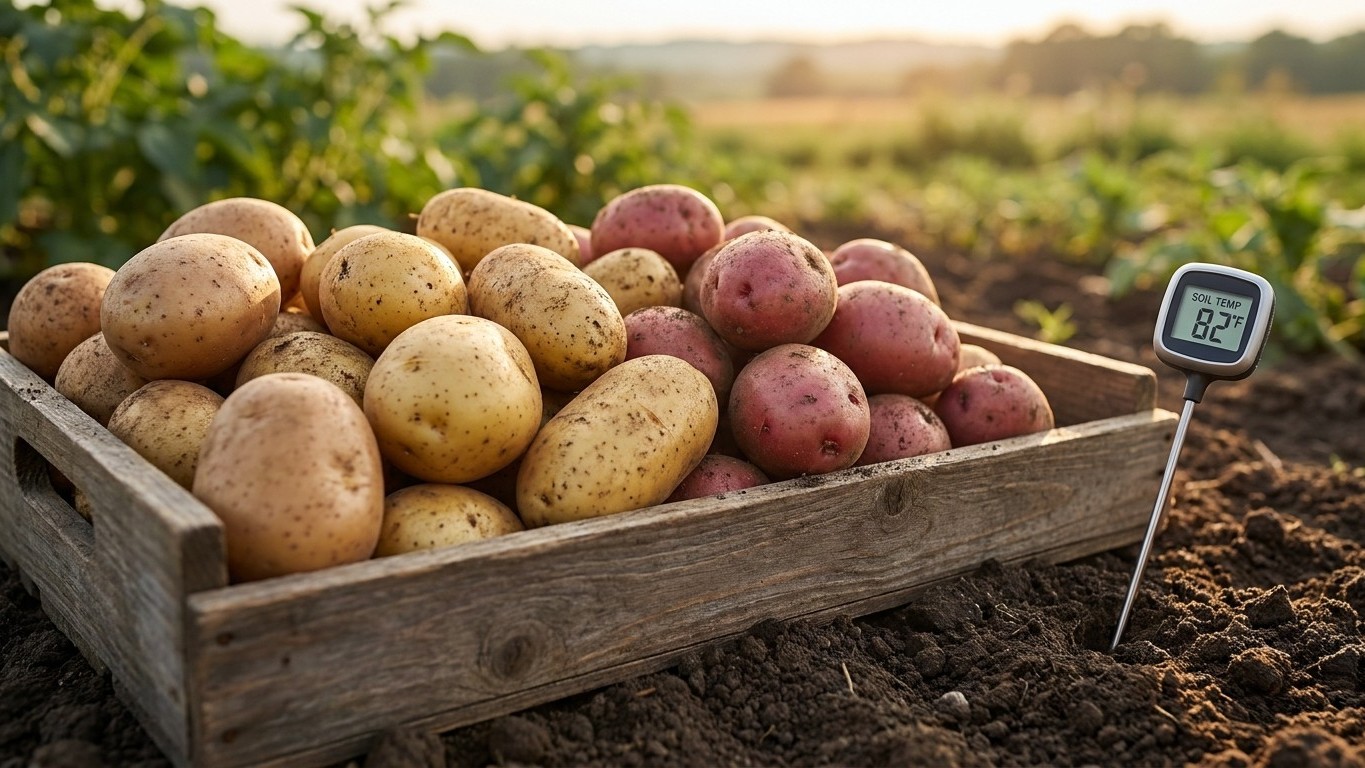

Wisconsin gardeners get the best results by matching a potato’s season class, early, mid-season, or late, to the state’s frost window rather than chasing a specific brand name. The window that matters most: soil hits planting temperature of 50 F some 14 to 21 days before the last spring frost, according to Utah State University Extension and the University of Maine Cooperative Extension. That timing decision, more than the variety label on the seed bag, determines whether tubers size up before summer heat shuts them down.
The short answer
Near Madison, the last spring frost falls between April 16 and April 29, based on NOAA NCEI’s 1991-2020 Climate Normals for station USW00014839. That’s a two-week band, not a single date, and it’s the number Wisconsin gardeners should anchor a planting calendar to rather than a folk saying about lilacs or dandelions.
Work backward from that window and the season-class question answers itself. Utah State Extension and the University of Maine Cooperative Extension both describe potatoes as a crop planted once soil temperature reaches 50 F, which lands 14 to 21 days ahead of the last frost date. For the Madison area, that means soil prep and planting typically fall in late March to early April, well before the frost window closes. Gardeners farther north in Wisconsin, where the growing season starts later and ends sooner, need to shift that whole calculation later, though this page doesn’t carry a station-specific frost date for those areas.
Season class is the second half of the answer, and it’s the part gardeners skip. Early-season types finish their bulking before the hottest stretch of summer arrives, which matters because Utah State Extension identifies soil temperatures above 90 F as the point where tuber set and fill stop entirely, watering does neither, and there’s no recovering that lost sizing window later in the season. Mid-season and late-season types need a longer stretch of cool-to-moderate soil to reach the same result, which is a bigger gamble in a state where summer soil temperatures can climb past that ceiling for stretches of days.
None of this means one named variety is objectively “better” for Wisconsin. It means the gardener’s job is to pick a season class that lets the crop dodge the heat ceiling, then choose a variety within that class for the use it’s suited to, baking, boiling, or general table use, categories that both source institutions describe without ever attaching a maturity-day countdown to them. Neither Utah State Extension nor the University of Maine publishes a days-to-maturity figure for named cultivars, so treating any specific number you see elsewhere as gospel is a mistake worth avoiding from the start.
What actually decides it
Two mechanisms run the whole decision, and once a gardener understands them, the reasoning transfers to any Wisconsin county, not just the one with a weather station.
Soil temperature triggers planting, not the calendar
Potatoes go in the ground when soil reaches 50 F, full stop, according to both source institutions. That’s a soil thermometer reading, not a date circled on a wall calendar. In a cold, wet spring, 50 F soil might arrive later than the “14 to 21 days before last frost” math suggests; in an early warm spell, it might arrive sooner. The frost window from NOAA NCEI (April 16 to April 29 near Madison) is the backstop, the date range planning should orbit around, but the soil thermometer is the actual trigger. A gardener working from calendar dates alone, ignoring soil temperature, risks planting into cold, wet ground where seed pieces rot before they sprout.
The 90 F ceiling is what makes season class matter
This is the mechanism most home gardeners never hear explained. Once soil temperature climbs above 90 F, tuber set and fill stop, according to Utah State Extension, and irrigation does not reverse that shutdown. It’s a heat ceiling, not a drought problem, so the usual fix, watering more, does nothing. The practical consequence: in any location where soil regularly crosses 90 F for stretches during summer, the safer bet is a variety that completes its bulking before that heat arrives, which is what “early-season” means functionally. A late-season type planted in the same spot is betting that this particular summer stays cool enough, long enough, for the tubers to keep sizing through the hot months, a bet that doesn’t always pay off. This page doesn’t carry a Wisconsin-specific count of 90 F soil-temperature days, so treat the mechanism as the transferable lesson: check how often your own soil crosses that ceiling before committing to a long-season type, rather than assuming Wisconsin’s reputation as a cool-summer state protects every location equally. Southern Wisconsin’s summers run measurably hotter at the soil surface than the state’s northern counties, and a sunny, south-facing garden bed will cross 90 F sooner than a shaded or well-mulched one even in the same yard.
How to do it
- Buy certified seed potatoes rather than grocery-store tubers or saved pieces from last year’s crop; uncertified seed carries virus that grocery potatoes are never screened for, and that virus load builds silently year over year until yields collapse.
- Choose a season class, early, mid-season, or late, based on how reliably your specific planting site avoids soil temperatures above 90 F during summer, using the mechanism above rather than a variety’s marketing name.
- Check soil temperature directly with a soil thermometer starting in early spring rather than relying on the calendar alone.
- Plant once soil reaches 50 F, which for the Madison area (last frost April 16 to April 29, per NOAA NCEI) typically falls 14 to 21 days ahead of that frost window.
- Cut certified seed pieces to a workable size, let cut surfaces callus for a day or two in a cool, airy spot, then plant with eyes facing up.
- Hill soil over the developing plants as they grow, which protects shallow tubers from sun exposure and helps buffer soil temperature swings.
- Watch soil temperature through the season; if it’s trending toward or above 90 F, know that added water will not restart tuber sizing once it’s stopped, and factor that into whether a second, later-season type is worth planting the same year.
- Harvest early-season types once tops begin dying back, before the hottest weeks of summer put stalled tubers at risk of quality loss in the ground.
What goes wrong
- Planting from grocery-store potatoes. These aren’t certified seed and often carry virus that never shows up as visible symptoms the first year, only as declining yield later. Buy certified seed potatoes instead, every season, rather than saving pieces from a previous harvest.
- Planting by calendar date instead of soil temperature. A gardener who plants on a fixed date regardless of conditions risks cold, wet soil that rots seed pieces before sprouting. Check soil temperature directly and wait for 50 F rather than trusting a fixed date.
- Assuming more water fixes stalled tuber growth. Once soil crosses above 90 F, tuber set and fill stop, and irrigation doesn’t restart that process, per Utah State Extension. The fix is choosing an earlier season class next time, or shading and mulching the bed to buffer soil temperature, not increasing watering after the fact.
- Choosing a late-season type in a hot, sunny bed. A long-season variety planted where soil regularly crosses the 90 F ceiling is gambling on a cool summer that may not arrive. Match season class to how hot that specific bed actually runs, not to the state’s general reputation for mild summers.
- Treating a variety’s name as a guarantee of texture or use. Neither Utah State Extension nor the University of Maine Cooperative Extension labels varieties “waxy” or “floury.” What’s published is intended use, baking, boiling, or general table use, so check that instead of relying on informal texture labels from other sources.
- Ignoring that one frost date doesn’t cover the whole state. The April 16 to April 29 window applies to the Madison-area station (NOAA NCEI, USW00014839). Gardeners elsewhere in Wisconsin, especially farther north or away from Lake Michigan’s moderating effect on the lakeshore, need their own local frost data rather than applying this figure statewide.
Common questions
Can I plant potatoes before the last frost date in Wisconsin?
Yes, and the sources suggest it’s usually necessary. Planting is triggered by soil reaching 50 F, which Utah State Extension and the University of Maine Cooperative Extension both note falls 14 to 21 days before the last frost date, meaning most of the planting window happens while frost risk is still present in the air, not after it’s gone. Potato foliage that emerges before the frost risk fully passes can be damaged by a late freeze, but the tubers themselves, still underground, are generally unaffected.
Does Wisconsin get hot enough to stop tuber growth?
It can, depending on the specific site. The mechanism from Utah State Extension is that soil above 90 F halts tuber set and fill regardless of watering. This page doesn’t carry a count of how many days Wisconsin soil crosses that mark in a typical summer, but sunny, south-facing beds in the southern part of the state are more likely to hit it than shaded beds or northern locations.
Why does certified seed matter so much for potatoes specifically?
Potatoes are propagated from tubers, not seeds from fruit, so any virus present in a parent tuber passes directly into every plant grown from a piece of it. Certified seed programs test for that virus load; grocery-store potatoes and home-saved tubers are not tested, and virus symptoms often don’t show clearly until yield has already dropped.
Is there a single best potato variety for all of Wisconsin?
No, and neither source used here suggests one exists. The right choice depends on the season class that fits how hot a specific garden bed runs and what the harvest is meant for, baking, boiling, or general use, categories both Utah State Extension and the University of Maine Cooperative Extension publish without attaching a fixed maturity countdown to any named cultivar.