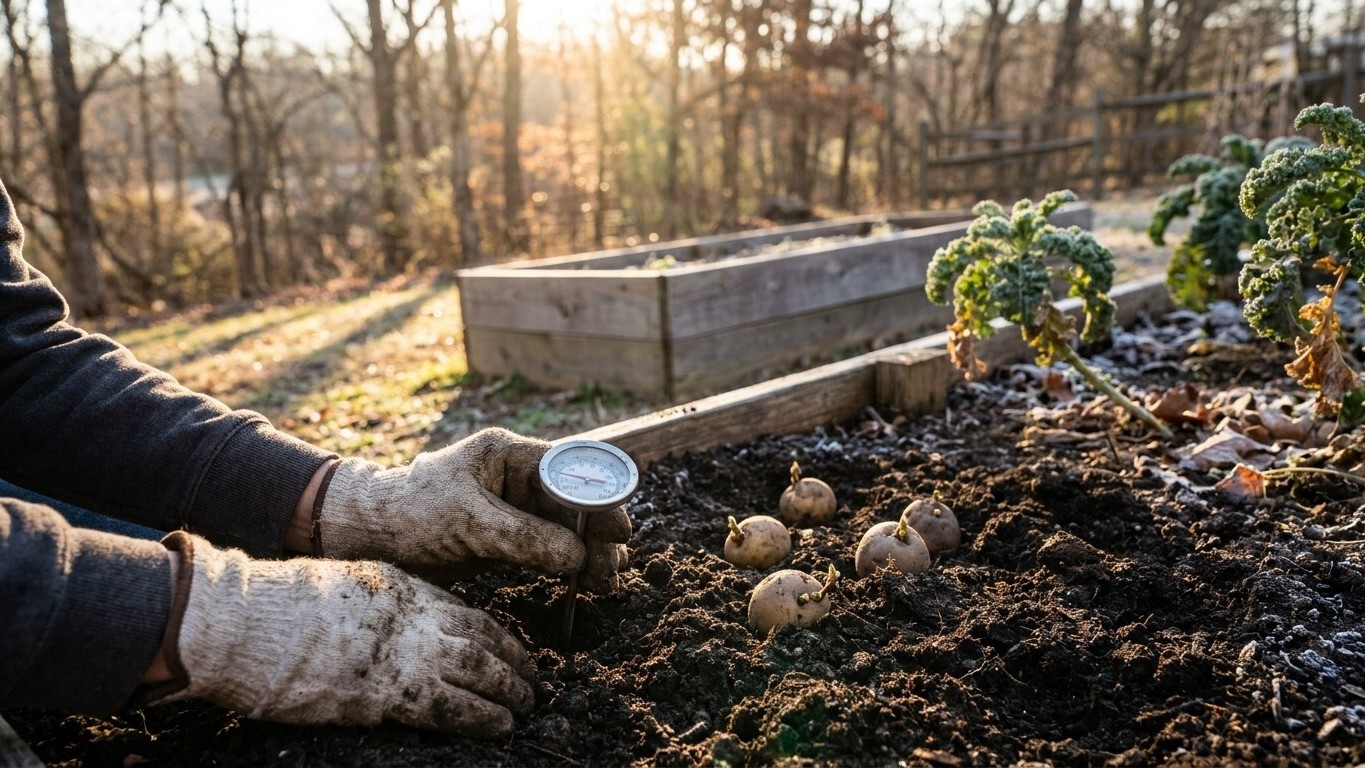

Potatoes go into Wisconsin soil weeks before the last frost, not after it. The trigger is soil temperature, not the calendar: once soil hits 50°F, seed potatoes can go in even though air frost is still likely. Counting back from the last frost date, per NOAA NCEI Climate Normals, puts that window in late March to mid-April across southern and central Wisconsin, later as you move north.
The short answer
For the Madison area, NOAA NCEI’s 1991-2020 Climate Normals (station USW00014839) put the last spring freeze, the date with a 30 to 70 percent chance of 32°F, between April 16 and April 29. That’s the anchor point. From there you count backward, because potatoes aren’t planted after the frost risk passes, they’re planted before it, timed to when the soil itself warms enough to sprout.
Utah State University Extension and the University of Maine Cooperative Extension both describe the same rule: seed potatoes go in the ground once soil temperature reaches 50°F, and that point typically arrives 14 to 21 days before the last frost date. Apply that math to the Madison window and the planting date lands somewhere between late March and mid-April, well ahead of the point where frost is no longer a risk.
That gap between “safe to plant” and “safe from frost” surprises a lot of gardeners who are used to tomatoes and peppers, where the rule is wait until frost danger has passed. Potatoes work backward from that logic. The foliage that eventually emerges can take some cold; the seed piece underground, insulated by several inches of soil, is not sitting in the same air temperature the thermometer on your porch reports.
The number that matters is not a single date but a range, and it moves with two things: how far north or south you garden in Wisconsin, and how close your soil is to open water. The Lake Michigan shoreline holds heat differently than inland counties, which changes when frost risk actually drops in fall, though for spring planting the relevant fact stays the same everywhere in the state: watch the soil, not just the sky.
What actually decides it
Two separate thresholds run this whole decision, and neither one is the frost date printed on a seed packet.
The 50°F soil trigger
Seed potatoes are a tuber, not a seed in the botanical sense, and they don’t germinate the way a bean does. They sprout from stored energy in the tuber itself, and that process starts when soil temperature, not air temperature, crosses roughly 50°F. Air can swing 20 degrees in an afternoon; soil several inches down changes slowly, which is why Utah State and Maine Extension both frame the planting trigger in soil terms. A thermometer pushed four inches into the row tells you more than any frost-date chart. In a wet, low-lying garden, soil can lag two weeks behind a well-drained slope planted the same week, even under identical air temperatures.
The 90°F heat ceiling
The other end of the season is just as fixed, and it’s the mechanism most gardeners never hear about until a harvest disappoints them. Once soil temperature climbs above 90°F, tuber set and tuber fill both shut down. This isn’t a moisture problem, so watering more doesn’t reverse it, the plant simply stops sizing tubers while the soil stays that hot. That single fact is why planting date matters more in Wisconsin than most people assume: a crop planted late enough that its tuber-bulking window lands during the hottest stretch of summer is fighting a ceiling that irrigation can’t lift.
This is the reasoning a gardener in a county this page never names still needs. If your local frost-free season historically runs long and hot, the answer isn’t to plant later hoping for a longer window, it’s to plant earlier and treat the crop as a spring dig, finished before peak heat arrives. If your soil rarely sees 90°F, the calculation is more forgiving, and a full-season variety has room to bulk through summer without hitting that ceiling.
| Season class (per Extension sources) | How it fits the heat ceiling |
|---|---|
| Early | Finishes bulking before peak summer heat; suited to gardens where 90°F soil is common |
| Mid-season | Needs a moderate stretch of cooler soil through its bulking period |
| Late | Bulks into cooler fall soil; best where summer heat is limited |
How to do it
- Pull the last-frost data for the station nearest your garden, or use the Madison-area range of April 16 to April 29 as your reference if you’re in that part of the state.
- Count back 14 to 21 days from that date to estimate the calendar window when soil is likely to reach 50°F.
- Confirm with a soil thermometer at planting depth rather than trusting the estimate alone, since slope, drainage, and mulch all shift the actual number.
- Buy certified seed potatoes rather than grocery-store tubers or last year’s saved stock; uncertified seed carries virus that spreads silently through a planting and shows up as weak yields, not obvious disease.
- Cut larger seed potatoes into pieces with at least one eye each, and let cut surfaces callus for a day or two before planting if conditions are damp.
- Choose a season class based on your local heat pattern: early season class where summer soil regularly runs hot, mid-season or late where it doesn’t.
- Plant seed pieces at the recommended depth once soil has reached 50°F, and be ready to hill soil over emerging foliage if a late frost threatens after sprouts appear above ground.
What goes wrong
- Planting by the calendar instead of the soil. A date that worked one year can be two weeks off the next if spring runs cold or wet. Check soil temperature directly rather than trusting a fixed date.
- Using uncertified seed. Grocery potatoes and saved home stock often carry viruses that don’t kill the plant outright but quietly cut yield. Buy certified seed potatoes from a known source every time.
- Planting a late-season class in a hot-summer garden. If soil regularly climbs past 90°F during bulking, tuber growth stalls and no amount of watering restarts it. Match season class to your local heat pattern, favoring early varieties where summers run hot.
- Frost damage to emerged foliage. Sprouts that break the surface before the last frost passes can get nipped. Hill extra soil over young growth or cover rows on nights when frost is forecast; the underground tuber usually survives even if top growth is set back.
- Rot from planting into cold, waterlogged soil. Rushing the date before soil has actually warmed and drained invites seed piece rot before sprouting even starts. Wait for the soil, not the eagerness.
Common questions
Is April 16 to April 29 the last frost date for all of Wisconsin?
No. That range applies to the Madison area, based on NOAA NCEI’s 1991-2020 Climate Normals for station USW00014839. Frost dates shift earlier or later depending on how far north you are and how close you are to Lake Michigan, which moderates temperature along the shoreline.
Can I plant potatoes before all frost risk has passed?
Yes, and that’s the normal approach. Seed potatoes go in once soil reaches 50°F, which Extension sources place 14 to 21 days before the last frost date, precisely because the tuber underground isn’t exposed to the air frost that would damage above-ground foliage.
What happens if I plant too late in a hot part of the state?
Soil above 90°F stops tuber set and tuber fill outright, and it isn’t a watering problem, so irrigation won’t fix it. Where hot soil is common, an early season class planted as soon as soil hits 50°F avoids the ceiling instead of running into it mid-summer.
Does saved seed from last year’s harvest work as well as certified seed?
Not reliably. Uncertified seed, including grocery potatoes and home-saved tubers, can carry virus that doesn’t show obvious symptoms but reduces yield. Certified seed potatoes are tested specifically to avoid that risk.