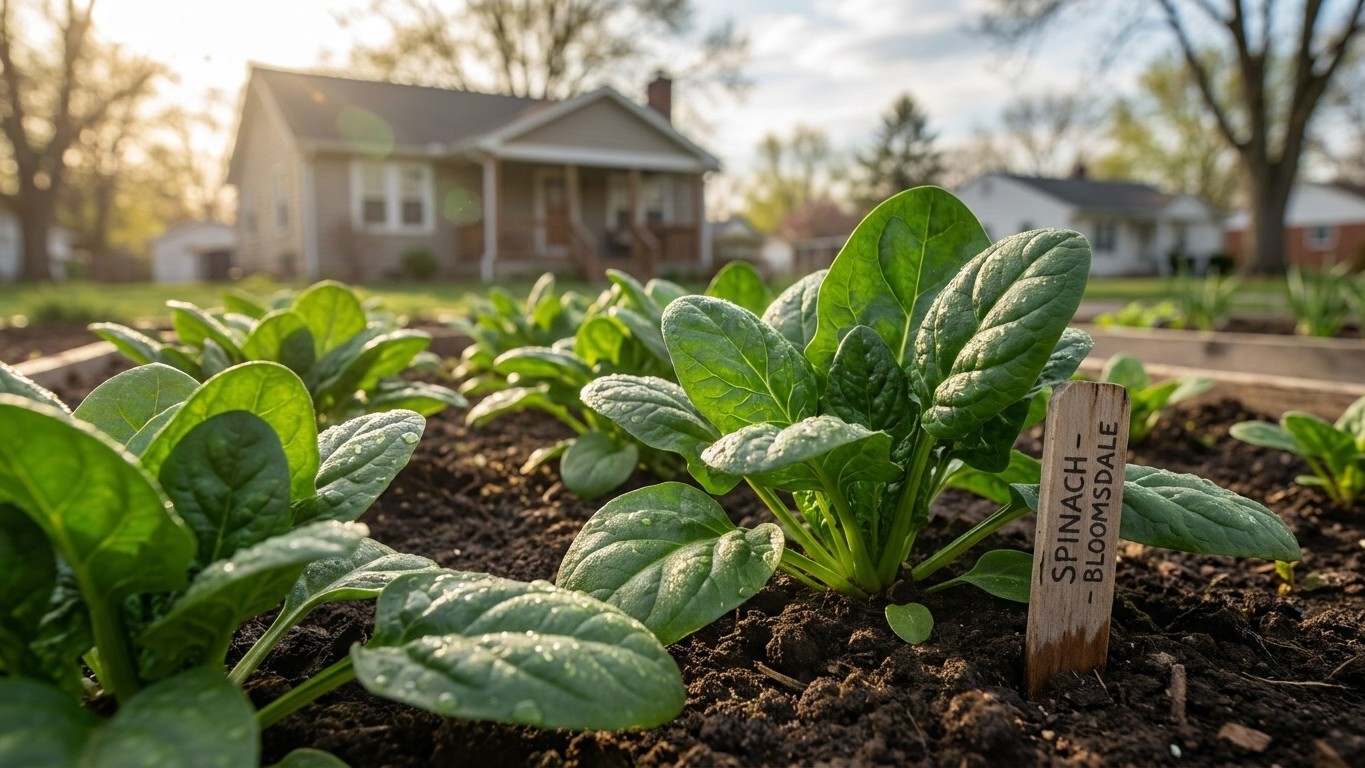

Spinach in Manitoba bolts because of long summer days, not because of heat. On the longest day of the year, Winnipeg gets 16 hours and 8 minutes of daylight, well past the point where spinach starts throwing up a flower stalk. That leaves a narrow spring window and a fall crop that has to be timed around soil temperature instead of frost.
The short answer
Winnipeg’s longest day runs 16 hours and 8 minutes of daylight, one of the longest stretches anywhere spinach gets grown in North America. That number matters more than any thermometer reading here, because spinach flowers in response to long days as much as it does to warmth. A gardener moving to Manitoba from a milder, shorter-summer state might assume the cooler climate buys extra weeks of leaf production. It does not. Day length pushes the plant toward bolting on its own schedule, and Manitoba’s summer days are about as long as they get.
Where Manitoba actually has an advantage is heat. The reference station at Winnipeg averages 0.0 days a year above 90 F. That is not a typo. Compare that to spinach’s own ceiling: growth quality drops once temperatures climb past 75 F, and the same threshold is where the leaves start turning bitter. In a region with real summer heat, both day length and heat gang up on the crop at once. In Manitoba, the heat side of that equation barely shows up in the climate record.
So the limiting factor here is day length, almost by itself. Will Spinach Bolt Early in Manitoba? Spinach sown in early spring will grow well in cool, short-heat conditions, then bolt as the calendar pushes toward the solstice and daylight stretches past what the plant can tolerate before flowering. Heat is a secondary concern, useful mostly for understanding why the plant turns bitter if a stretch of warm afternoons happens to coincide with those long days. A gardener who understands that distinction stops blaming a random hot week for bolting that was already baked in by June daylight.
This also means shade cloth or timing tricks that work against heat will do little against day length. Nothing shortens the sun’s schedule. The only real lever available is choosing when the crop is in the ground, which is exactly what the spring and fall windows below are built around, including When to Sow Autumn Spinach in Manitoba.
How long the spring window really is
- Frost date as the anchor. Environment and Climate Change Canada lists the average last spring frost at Winnipeg Richardson International Airport as May 23, based on the 1981-2010 climate normals. That is a mean, not a guarantee: in roughly half of all years, frost arrives after that date, so treat it as the midpoint of a window rather than a line you can sow right up against with confidence.
- Sowing two to three weeks early. Utah State University Extension notes spinach seed tolerates cold soil well enough to go in the ground two to three weeks before the last frost. Applied to the May 23 mean, that puts sowing somewhere between roughly May 2 and May 9 for most Manitoba gardens near the Winnipeg reference climate.
- Growth under lengthening days. From early May onward, daylight keeps expanding toward that 16 hour, 8 minute peak at the solstice. Spinach sown in early May grows through a stretch of moderate day length at first, then runs into the steepest part of the daylight curve as June approaches.
- Bolting arriving by the solstice. Because long days alone trigger flowering, and Manitoba’s days are already well past any threshold that would hold spinach in a leafy stage, the spring harvest window effectively closes around the time daylight peaks in late June. That gives a usable spring stretch of roughly six to seven weeks from sowing to the point where bolting becomes the dominant concern.
- Local variation still applies. Districts north of Winnipeg or at higher elevation typically see later last-frost dates, which shifts sowing later but does not change when the solstice arrives. That compresses the usable window even further the farther a garden sits from the reference station.
The autumn crop, and when the soil lets you sow
Fall spinach in Manitoba gets planned around two separate obstacles, and they sit on opposite ends of the calendar. One blocks germination in late summer. The other ends the season outright once autumn arrives.
Soil too warm to germinate
Utah State University Extension is specific on this point: spinach seed germination drops once soil temperature climbs above 80 F. That is the reason fall sowing cannot simply happen “whenever it cools off outside.” Manitoba’s mild summer heat load, that 0.0 days-a-year average above 90 F, means soil temperatures likely stay under that 80 F ceiling for longer stretches than in hotter regions, but there is no published soil-temperature figure for Manitoba here, so the practical approach is to wait until the hottest part of summer has clearly passed before trusting a late-summer sowing.
The frost that ends the season
Environment and Climate Change Canada’s normals put the average first fall frost at Winnipeg Richardson International Airport at September 22. Same caution as spring: this is a mean date, not a safe cutoff, and in about half of all years frost shows up later than that. Because spinach tolerates cold reasonably well, gardeners often harvest right up to or just past that first light frost rather than treating it as a hard stop.
Utah State University Extension’s guidance for a fall crop is to sow 50 to 75 days before the date you actually want to harvest. That figure is the only one published for fall timing here; no separate days-to-maturity number exists for spinach in this source. Counting back from September 22 as a realistic target harvest date puts sowing somewhere between roughly July 9 (75 days back) and August 3 (50 days back). That window sits comfortably after the peak of summer, which also lines up with waiting for soil to cool below that 80 F germination threshold.
Four spinach varieties commonly discussed for garden use are Bloomsdale, Melody, Teton, and Olympia. No maturity data, disease resistance, or performance figures for any of these are published in the source used here, so treat the names only as a starting point for further research, not as a ranking.
Checking this against your own county
Winnipeg’s frost dates and daylight numbers describe one reference station, not the whole province. A garden in the Interlake region, the Parkland, or farther north can run weeks behind Winnipeg on both spring warmup and fall cooling, which shifts every date discussed above in the same direction, later in spring, earlier in fall.
Manitoba Agriculture is the provincial body to check for local frost data, soil condition reports, and vegetable-growing guidance specific to a given district. Anyone gardening outside the Winnipeg area should treat the dates in this article as a starting estimate, then adjust based on what the provincial extension service publishes for their own region.
Common questions
Does a cool Manitoba summer mean spinach can be grown all season?
No. Bolting is triggered by long days as much as by heat, and Manitoba’s summer days are long enough on their own to push spinach toward flowering regardless of how mild the temperatures stay.
Why does spinach seed fail to germinate in midsummer?
Utah State University Extension reports germination drops once soil temperature rises above 80 F. That is a soil-warmth problem, not a cold problem, which is why fall sowing has to wait rather than start right after the spring crop bolts.
Is May 23 a safe date to assume frost is over?
No. It is the mean last-frost date from Environment and Climate Change Canada’s climate normals for the Winnipeg Richardson International Airport station. In roughly half of all years, frost occurs after that date.
Which spinach variety bolts slowest in Manitoba?
No published data compares Bloomsdale, Melody, Teton, or Olympia on bolt resistance in this source. Anyone choosing between them should check current seed-supplier descriptions and provincial trial data rather than assume performance from the name alone.