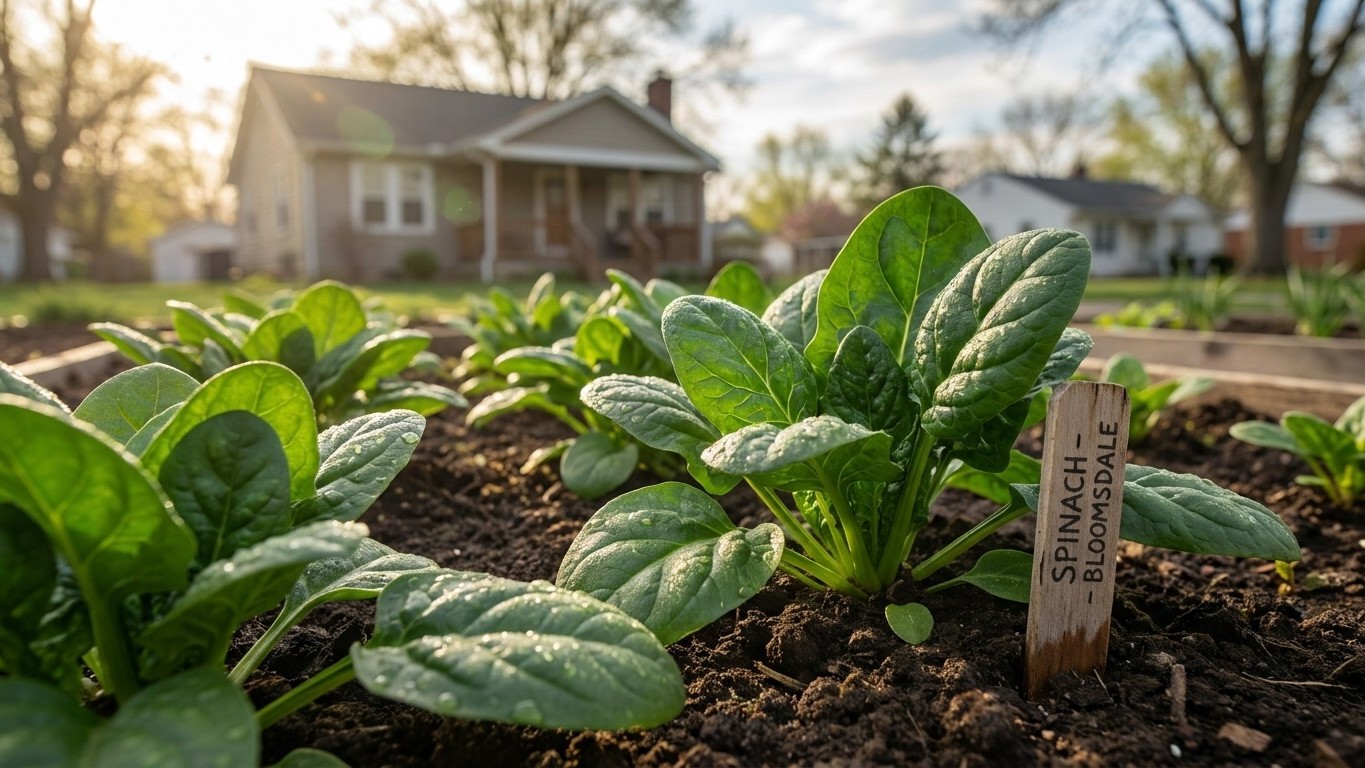

Will Spinach Bolt Early in North Dakota? Spinach in North Dakota bolts fast once the calendar turns toward the summer solstice, because the long daylight hours that build up through May and June push the plant straight into flowering. The real constraint here isn’t heat alone (though it matters), it’s day length. That means the growing window is short on both ends, and timing the sowing date matters more than picking a “heat-tolerant” variety.
The short answer
At the reference city, the longest day of the year brings 15 hours and 41 minutes of daylight. That’s a lot of light, and for spinach, light is the trigger that matters most. Spinach bolts under long days and warm temperatures together, and it grows best where air temperatures stay below 75 F. A cool North Dakota summer doesn’t change the day-length side of that equation at all. Even if a July happens to run mild, the plant is still tracking the clock, not just the thermometer, and 15 hours and 41 minutes of light near the solstice is more than enough to flip spinach into reproductive mode.
So which one is the actual limit here, day length or heat? Both play a role, but they act on different parts of the calendar. In spring, day length does most of the damage: as North Dakota’s days stretch out through May toward that mid-June peak, spinach planted too late gets caught by the lengthening light before it ever produces a full-size leaf harvest. Heat adds a second layer, but it’s a smaller factor in this state than it would be somewhere like Kansas or Oklahoma. The reference station logs an average of just 11.7 days a year at 90 F or above, so North Dakota isn’t fighting brutal, prolonged heat waves. The problem is that the state sits far enough north that its summer daylight hours are unusually long, and that alone is enough to end the spinach season on schedule regardless of how mild the temperatures feel.
This is worth sitting with for a second, because it runs against instinct. Gardeners often assume a cooler summer buys them more time with a leafy green like spinach. Here it doesn’t, at least not on the day-length side. What a cooler summer does buy is a slightly wider comfort zone before that 75 F ceiling gets crossed on a hot afternoon, which matters for flavor since heat stress also brings on bitterness. But the clock keeps ticking toward the solstice no matter what the thermometer says, and that’s the piece of the puzzle most first-time growers miss. Plan around the calendar first, and treat any mild stretch of weather as a bonus, not a reason to delay sowing.
How long the spring window really is
Working out North Dakota’s usable spring window means stacking the frost data against the day-length trigger, step by step. The same logic applies in reverse when planning When to Sow Autumn Spinach in North Dakota, since shortening days in fall create a mirrored set of constraints.
- The reference city’s last spring frost falls between May 4 and May 15, based on NOAA NCEI Climate Normals for 1991-2020.
- Spinach seed can go in the ground 2 to 3 weeks before that last frost date, which puts a realistic sowing window somewhere between mid-April and the very start of May.
- Once seedlings are up, growth stays productive as long as temperatures don’t push past that 75 F ceiling for long stretches, and North Dakota’s spring air temperatures are rarely the limiting factor this early in the season.
- Day length keeps climbing through May, and by the time the state approaches its June daylight peak of 15 hours and 41 minutes, spinach sown in April has typically already produced its harvestable leaves and is heading toward bolting.
- That leaves a spring harvest window of roughly six to eight weeks from a mid-to-late April sowing before the lengthening days push the crop to flower.
Six to eight weeks isn’t a long run, but it’s a workable one if the sowing date is treated as fixed rather than flexible. Waiting even ten days past the ideal window to plant doesn’t just shrink the harvest, it stacks the plant’s maturity right against the point where day length alone forces bolting. Gardeners who sow in early April, ahead of the last-frost range, and accept some risk of a light frost on tender seedlings, generally get the fullest harvest before the plant turns.
The autumn crop, and when the soil lets you sow
A fall spinach planting in North Dakota is a separate calculation entirely, and it hinges on two obstacles that have nothing to do with each other: soil that’s still too warm to germinate seed reliably, and a frost that arrives before the crop matures.
Soil still too warm for good germination
Spinach seed germinates poorly once soil temperature climbs above 80 F, according to Utah State University Extension. That threshold, not the air temperature, is what actually blocks an early-August sowing in a lot of gardens. North Dakota’s relatively modest heat load (that 11.7-day average above 90 F air temperature) means soil generally cools below 80 F sooner than it would in a hotter state, but “sooner” here still usually lands in early-to-mid August rather than July. Sowing into soil that’s still holding summer heat is one of the most common reasons a fall spinach crop comes up thin and patchy.
Working backward from the first fall frost
The first fall frost at the reference station arrives between September 25 and October 5. The source doesn’t publish a specific days-to-maturity figure for spinach, but it does say to plant 50 to 75 days before the date you want to harvest. Counting back from the earlier end of that frost range, September 25, a 50-day fall crop needs to go in the ground by roughly August 6, and a 75-day crop needs sowing closer to July 12. Given that soil often isn’t reliably below 80 F until early-to-mid August, most North Dakota gardens are working with the shorter end of that 50-to-75-day range for a fall planting, not the longer one. That’s a tight but workable window, and it argues for sowing as early in August as the soil allows rather than waiting.
Four spinach varieties commonly come up in extension guidance: Bloomsdale, Melody, Teton, and Olympia. The source used for this page doesn’t publish maturity data, disease notes, or bolt-resistance ratings for any of them, so no variety-specific claims are made here.
Checking this against your own county
Every date in this article comes from a single airport weather station, and NOAA NCEI itself notes that suburban and rural gardens typically see their last spring frost later and their first fall frost earlier than the airport figures, sometimes by one to two weeks, more at higher elevation. That’s not a small margin when the spring window is already only six to eight weeks long. Before locking in a sowing date, check current conditions and local frost history through NDSU Extension, which can point to county-level data closer to an actual garden than a single reference station ever will.
Common questions
Does a longer, cooler North Dakota summer delay spinach bolting?
No. Bolting is triggered by long daylight hours as well as warmth, and the reference city’s 15 hours and 41 minutes of light on the longest day is enough on its own to push spinach toward flowering, regardless of how mild the temperatures stay.
Can spinach be sown in North Dakota before the last frost date?
Yes. Spinach seed typically goes in 2 to 3 weeks ahead of the last spring frost, which at the reference city falls between May 4 and May 15, putting the sowing window in mid-to-late April.
Why does an August sowing sometimes fail to come up?
Soil temperature above 80 F reduces spinach germination. If soil hasn’t cooled below that mark yet, seed can sit and rot or germinate unevenly rather than failing from cold.
How many weeks of fall growing does North Dakota realistically get?
Working from a first fall frost of September 25 to October 5 and the source’s 50-to-75-day planting guidance, most gardens land closer to the 50-day end, since soil often isn’t consistently cool enough to sow until early-to-mid August.