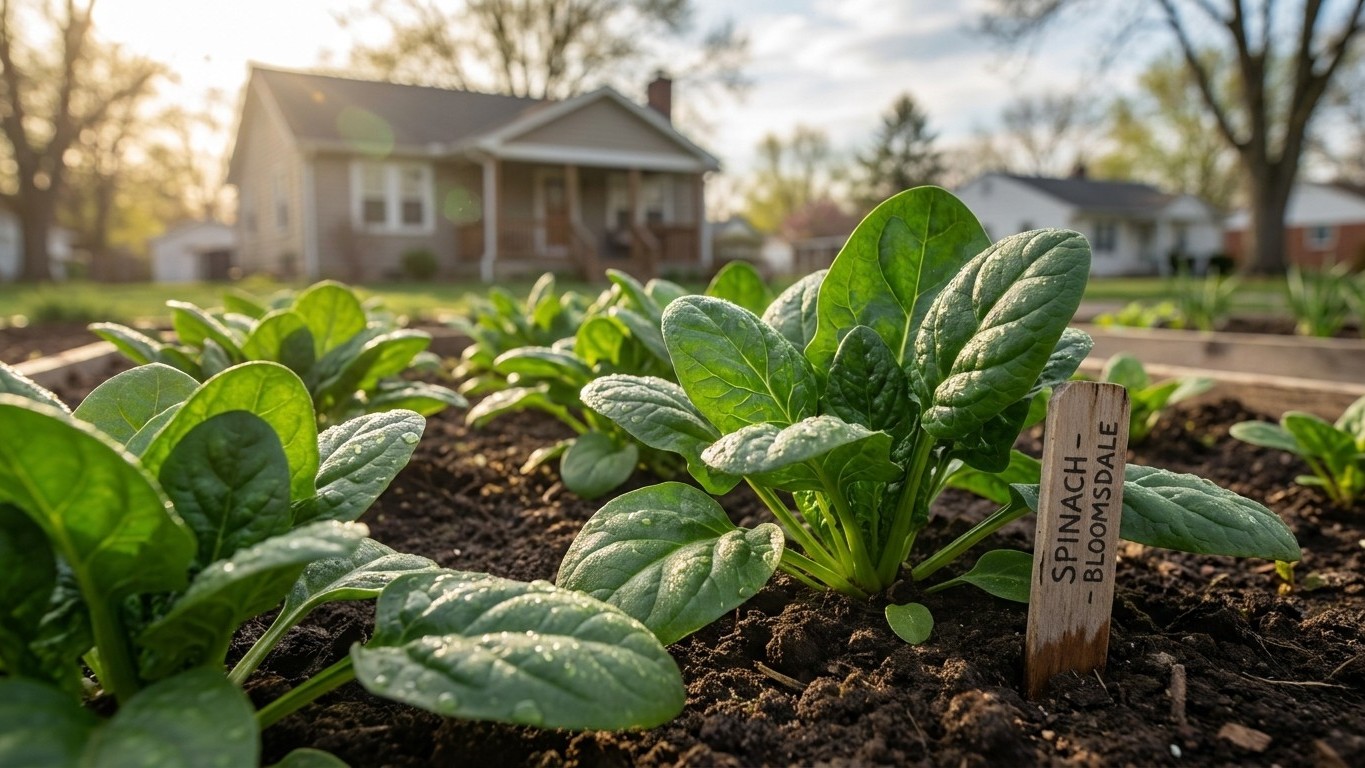

In coastal and Southern California, spinach doesn’t fail because of an early frost, since there isn’t one most years. It bolts because the days grow long enough, and in some regions warm enough, to flip the plant into flowering mode long before a Midwestern or Northeastern garden would see the same thing. With almost 14 hours and 16 minutes of daylight on the year’s longest day, the trigger here is the calendar itself, not the thermometer alone.
The short answer
On the year’s longest day, the reference city here logs 14 hours and 16 minutes of daylight from sunrise to sunset, calculated from its latitude using the standard solar-declination formula for the June solstice. That number matters more than most gardeners realize, because spinach doesn’t wait for heat to make up its mind about flowering. Long days push it toward bolting on their own, and 14 hours 16 minutes is well past whatever line a spinach plant needs to cross before it starts sending up a flower stalk instead of leaves.
That’s the opposite of what a cool summer usually buys a gardener elsewhere. In places with real winters, a mild June can stretch the harvest by a week or two because the plant reads the calm temperatures and stays in leaf-production mode. That trick doesn’t hold here. The days get long enough to trigger bolting whether or not the thermometer cooperates, so a cool June along the coast still ends the spinach patch on schedule, not later.
Heat is the second half of the mechanism, and at the coastal and southern reference station it’s a surprisingly small contributor. The average year sees only 2.4 days that reach 90°F or hotter, a number low enough that it barely registers as “hot” by national standards. That’s a very different climate from the Central Valley or the inland deserts, where 90°F afternoons stack up for weeks and heat alone would be enough to force bolting even without the day-length trigger doing anything.
For the coastal and southern parts of the state, day length is doing almost all of the work. The plant bolts because the calendar tips past its tolerance, not because the air turns punishing. Inland, in the Central Valley, the Sierra foothills, and the desert valleys, heat piles on top of that same day-length trigger, and the window closes even faster, sometimes weeks earlier than along the coast. California isn’t one climate for this question. It’s several, layered over the same day-length math.
That distinction is why a blanket answer for “California” falls apart quickly. A garden in Eureka or Santa Barbara is working with a different heat load than one in Fresno or Bakersfield, even though both are reading the same lengthening days in early summer. The day-length trigger is fixed by latitude, but the heat that compounds it is entirely local, which is the reason growers anywhere in the state should treat their own county’s data as the tie-breaker rather than a single statewide date. For more on the question of Will Spinach Bolt Early in California?, and for a practical timeline built around these same factors, see When to Sow Autumn Spinach in California.
How long the spring window really is
The standard rule of thumb for spinach is to sow two to three weeks before the last expected frost, then squeeze in as much growth as possible before temperatures push past the 75°F ceiling, the point where the plant slows down and starts turning bitter. That rule assumes a frost date exists to count backward from. Along the coast and through Southern California, it doesn’t. The 30-year record at the reference station shows zero days at or below 32°F, and NOAA lists the frost-free season there as a full 365 days.
- Throw out the frost countdown first. With no reliable last-frost date, the “two to three weeks before” rule has nothing to attach to. Sowing timing has to be set by soil workability and by how fast the days are lengthening, not by a frost deadline that isn’t coming.
- Count from the other end instead. The season doesn’t end when frost arrives; it ends when day length crosses the bolting trigger and, in warmer inland pockets, when afternoons start regularly beating that 75°F ceiling. That’s the deadline that actually governs a California spring spinach crop.
- Recognize the trade-off. Removing the frost constraint should, in theory, open up the calendar, and it does on the front end since sowing can start earlier than in a frost-bound state. But it closes just as early on the back end, because the day-length trigger doesn’t care whether frost ever happened. The window gains time at the start and loses roughly the same amount at the finish.
- Watch the heat load, not just the calendar. Near the coast, where 90°F days are rare, at only 2.4 per year at the reference station, the ceiling gets crossed mostly by day length. Inland, where hot afternoons arrive weeks earlier in spring, the 75°F ceiling is crossed sooner, and the usable window shrinks further.
- Treat the spring window as a moving target. Without a fixed frost date or a published local soil-temperature schedule, the honest way to size the window is by watching both signals directly, daylight climbing toward the solstice and afternoon highs climbing toward 75°F, rather than counting days from a date on a calendar.
That’s a longer explanation than a frost-bound gardener needs, but it’s the accurate one. The spring crop here isn’t measured in a fixed number of weeks so much as in how fast the two triggers, daylight and heat, converge in any given year.
The autumn crop, and when the soil lets you sow
Fall spinach runs into trouble at the opposite end of the thermometer from spring spinach. Instead of waiting for the ground to warm up enough to sprout, gardeners here have to wait for it to cool down. Utah State University Extension puts the germination problem plainly: spinach seed germination drops off once soil temperature climbs above 80°F, which in most of California means a late-summer sowing is a gamble no matter how mild the air feels in the shade.
Soil too warm to germinate
Late-summer soil in California, especially away from the immediate coast, routinely sits well above that 80°F line, even after the air has started to feel like fall. Seed dropped into ground that hot will germinate unevenly at best, often not at all. The practical fix is to wait, checking soil temperature directly rather than trusting a date on a calendar, and to sow once it has dropped back down near or below that threshold.
The frost that ends the season, or doesn’t
In most of the country, a fall spinach crop runs on borrowed time until the first frost shuts it down. Coastal and Southern California don’t share that problem. The 30-year climate record at the reference station shows no measurable freeze in an average year, and the frost-free season is listed at the full 365 days. That means the fall crop isn’t cut short by cold. It can, in theory, keep going right through what would be winter anywhere else, limited only by shortening daylight and whatever water and soil conditions the grower is managing.
Utah State University Extension’s guidance for timing a fall crop is to sow 50 to 75 days before the date you want to harvest, and no more specific maturity figure is published for spinach by that source, nor should one be borrowed from another vegetable. Applied here, that means picking a realistic harvest target for whenever the soil has cooled below that 80°F mark, then working backward 50 to 75 days from there to find the sowing date. Because there’s no frost deadline forcing an early finish, that harvest target can sit well into the cooler months without the crop running out of season the way it would in a place where the ground actually freezes.
Checking this against your own county
Everything above comes from a single reference station representing coastal and Southern California conditions, and the state doesn’t hold still long enough for one station to speak for all of it. Move north into the Central Valley, up into the Sierra foothills, or into the high desert, and the frost-free, mild-heat picture described here stops applying. Those regions freeze most winters and log far more than 2.4 days above 90°F each year.
The most reliable way to adjust these numbers for a specific address is through University of California Agriculture and Natural Resources (UC ANR), at ucanr.edu, which links out to county-level Cooperative Extension offices covering local soil temperature trends, frost history, and planting calendars county by county. A gardener in Fresno County and one in Santa Cruz County are working with genuinely different bolting timelines, even though both are technically “California,” and the county extension office is the resource built to draw that line accurately.
Common questions
Which spinach varieties hold up best in California’s climate?
Bloomsdale, Melody, Teton, and Olympia are among the named spinach varieties gardeners commonly ask about for warm-day, long-daylight regions. Utah State University Extension, the source used throughout this page, doesn’t publish comparative bolt-resistance data or days-to-maturity figures for any of them, so no variety-by-variety performance claim can be made here without inventing numbers that don’t exist in the record.
Can spinach be grown through summer in California?
Not reliably. Summer days near the solstice run around 14 hours and 16 minutes at the reference city, well past the point where day length alone pushes spinach toward flowering, and inland heat adds to that pressure. A summer sowing anywhere in the state is working against the plant’s own biology, not against the local weather.
Does frost matter for spinach in California?
Along the coast and through Southern California, no. The 30-year record shows no measurable freeze in an average year at the reference station. Move into the Central Valley, the Sierra foothills, or higher desert elevations, and frost becomes a real factor again, one this page’s coastal and southern data doesn’t cover.
What temperature makes spinach turn bitter?
Utah State University Extension puts the growth ceiling at 75°F, and that same number marks where flavor starts to suffer. It isn’t a calendar date. It’s a temperature threshold that can arrive early in a hot spring or late in a mild one, which is exactly why watching the thermometer matters more than watching the month.