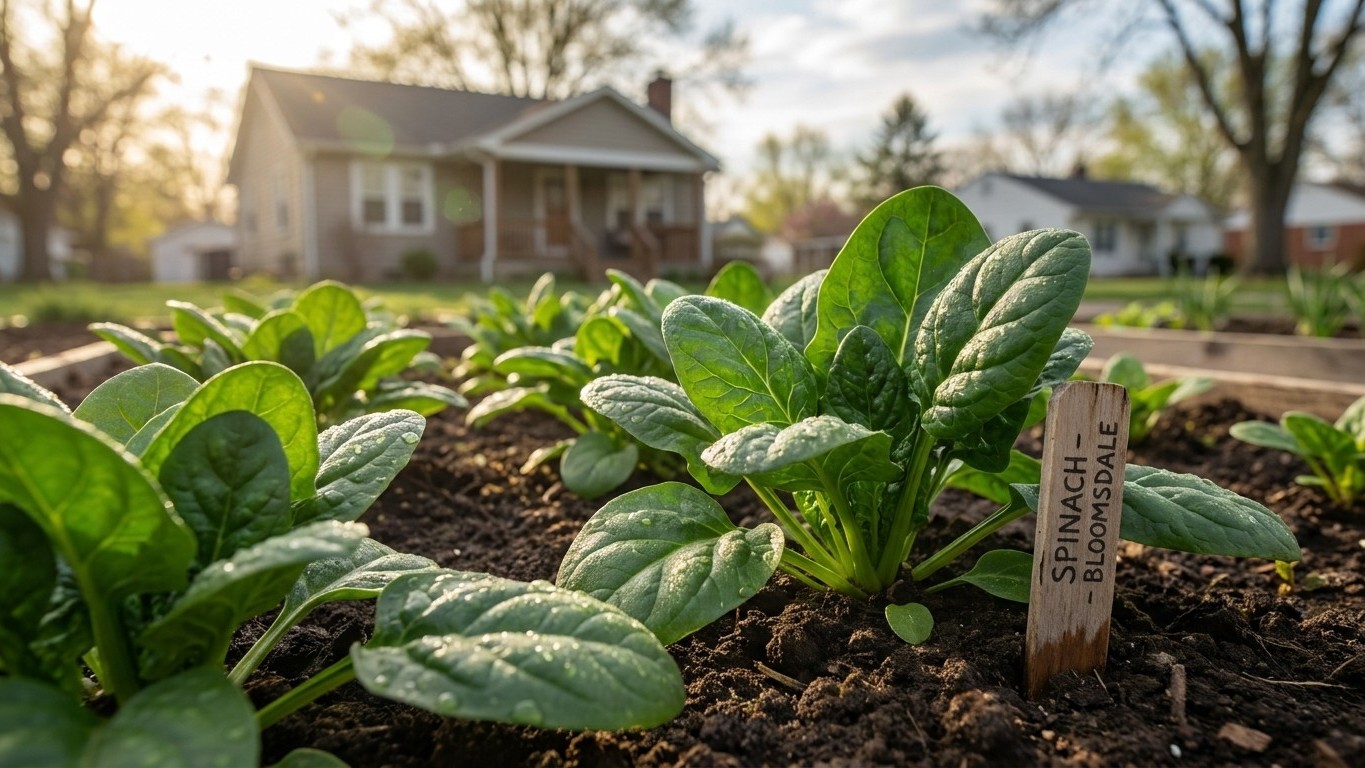

Salt Lake City’s summer sun stretches to 14 hours and 56 minutes on the longest day of the year, and that long light alone is enough to send spinach into flower. Add in more than 52 days a year that reach 90 F, and Utah gardeners are working against two triggers at once, not one. That’s why spinach here is a spring-and-fall crop only, sown roughly three weeks before the last frost and again in late summer for an autumn harvest before the first freeze shuts things down (see When to Sow Autumn Spinach in Utah for exact timing).
The short answer
Start with the number that matters most: 14 hours and 56 minutes of daylight on the summer solstice at the Salt Lake City reference station. That’s long enough, on its own, to push spinach toward flowering. Spinach bolts under long days and warm temperatures together, and it grows best where temperatures stay under 75 F. Once the days stretch past a certain length, the plant’s internal clock starts pushing toward seed production, regardless of how the thermometer reads that particular week.
That matters for how Utah gardeners think about summer. A cooler-than-usual June doesn’t buy extra growing time, because the day length keeps climbing whether or not the mercury cooperates. Will Spinach Bolt Early in Utah? The mechanism that ends the spring spinach crop here is not one thing but two working in the same direction: the days get long enough to trigger flowering, and at the same time the region logs more than 52 days a year at 90 F or above, which pushes soil and air temperatures well past that 75 F growth ceiling. Either factor alone would shorten the season. Together, they close it fast.
This is worth separating clearly from how day length works on other crops grown in Utah gardens, because the same number cuts the opposite way depending on the plant. Long days build a bulb onion. Long days destroy a spinach crop. There’s no way around that contradiction other than to remember which crop is standing in front of you before you make any planting decision based on day length.
So the honest framing for Utah is this: neither day length nor heat gets to claim sole responsibility here. Both apply. The 14-hours-56-minutes ceiling arrives at almost exactly the same point in the calendar as the run-up to Utah’s hottest stretch, so the two pressures land on top of each other rather than one following the other by weeks. That overlap is what makes the spinach-growing window in Utah feel short compared to leafy greens that tolerate more heat, and it’s why timing the sowing date matters more here than in a milder, shorter-summer climate.
How long the spring window really is
- Start with the frost date. The last spring frost in the Salt Lake City area falls between April 12 and April 29, based on NOAA’s 1991-2020 climate normals for that station.
- Move the sowing date earlier. Utah State University Extension recommends sowing spinach 2 to 3 weeks before that last frost date, which puts seed in the ground somewhere between late March and mid-April, depending on how the season is running.
- Track the growth ceiling. Spinach grows well only while temperatures stay under 75 F. As spring advances toward Utah’s warm season, and as daylight climbs toward that 14-hour-56-minute peak, the plant comes under increasing pressure to bolt rather than keep producing leaves.
- Recognize the closing point isn’t a fixed date. Because bolting is triggered by the combination of day length and heat rather than a single calendar day, the exact week the spring crop turns bitter and runs to seed will shift year to year with how quickly the region warms.
- Add up the usable stretch. Sown in late March or early April and pushed out by rising heat and lengthening days sometime before the peak of early summer, Utah’s spring spinach window generally runs somewhere in the range of six to eight weeks of good growing conditions before quality drops.
Utah State University Extension lists four spinach varieties commonly grown in home gardens: Bloomsdale, Melody, Teton, and Olympia. The source doesn’t publish days-to-maturity or bolt-resistance figures for any of the four, so there’s no data-backed way to say one holds longer against Utah’s long summer days than another. Gardeners choosing between them are working from the same general day-length and heat guidance that applies to spinach as a crop, not from variety-specific numbers.
The autumn crop, and when the soil lets you sow
Fall spinach in Utah faces a different obstacle than spring spinach does. Instead of racing lengthening days and rising heat, the autumn crop has to wait out soil that’s still too warm to sprout, then get harvested before the season’s first hard freeze.
Soil still too warm to germinate
Spinach seed germination drops off once soil temperatures climb above 80 F. In Utah’s valley, late summer soil routinely holds onto that heat well after the air starts to feel like fall is coming, since 52.1 average days a year above 90 F leaves plenty of stored warmth in the ground through much of August. Practically, that means an autumn sowing attempted too early risks poor or spotty germination, not because of any lingering spring bolting pressure, but because the seed simply won’t sprout reliably in soil that hot.
Counting back from the first frost
Utah State University Extension’s guidance for a fall crop is to sow 50 to 75 days before the date you want to harvest, since no days-to-maturity figure is published for spinach by that source. The first fall frost at the Salt Lake City reference station arrives between October 18 and October 29. Aiming to harvest around the earlier end of that window, before frost risk climbs, puts the sowing date somewhere between late July and late August, counting back 50 to 75 days from mid-October. That window lines up closely with the point when soil finally starts cooling off from summer’s peak, which is exactly why late summer sowing for a fall crop tends to work better than an early-August attempt made while the ground is still holding onto 90-degree-day heat.
Checking this against your own county
Every number above comes from a single reference station near Salt Lake City, and Utah’s terrain makes that a poor stand-in for the whole state. Salt Lake sits in a comparatively mild valley. Most of Utah’s growing regions sit higher and colder, with frost dates that arrive earlier in fall and linger later in spring, while southern Utah runs warmer and can push both the heat ceiling and the bolting risk earlier in the calendar.
Before locking in a sowing date, check local conditions through Utah State University Extension, the land-grant extension service for the state. County-level frost dates, soil temperature guidance, and current-season advisories will reflect elevation and local microclimate in a way that a single statewide reference point can’t.
Common questions
Does shade slow down spinach bolting in Utah?
Shade can reduce direct heat load on the plant, which helps keep soil and leaf temperatures under that 75 F ceiling a little longer. It doesn’t change day length, though, and day length alone is enough to trigger flowering once it gets long enough, so shade helps with one half of the problem but not the other.
Can spinach survive frost in the fall?
Spinach tolerates cool weather well and is grown specifically to mature before Utah’s first fall frost, which falls between October 18 and October 29 at the Salt Lake City reference station. The autumn sowing schedule is built around harvesting ahead of that date, not around surviving a freeze afterward.
Why does spring soil work but late-summer soil doesn’t for sowing spinach?
Germination drops once soil temperatures climb above 80 F. Spring soil, still cool from winter, sits well under that mark when spinach is sown 2 to 3 weeks before the last frost. Late-summer soil, still holding heat from a summer with more than 52 days above 90 F, often sits above that threshold until later in August.
Is there a spinach variety that resists bolting better in Utah’s long summer days?
Utah State University Extension names four home-garden varieties (Bloomsdale, Melody, Teton, Olympia) but publishes no bolt-resistance or days-to-maturity data comparing them. There’s no sourced basis for recommending one over another on that point.