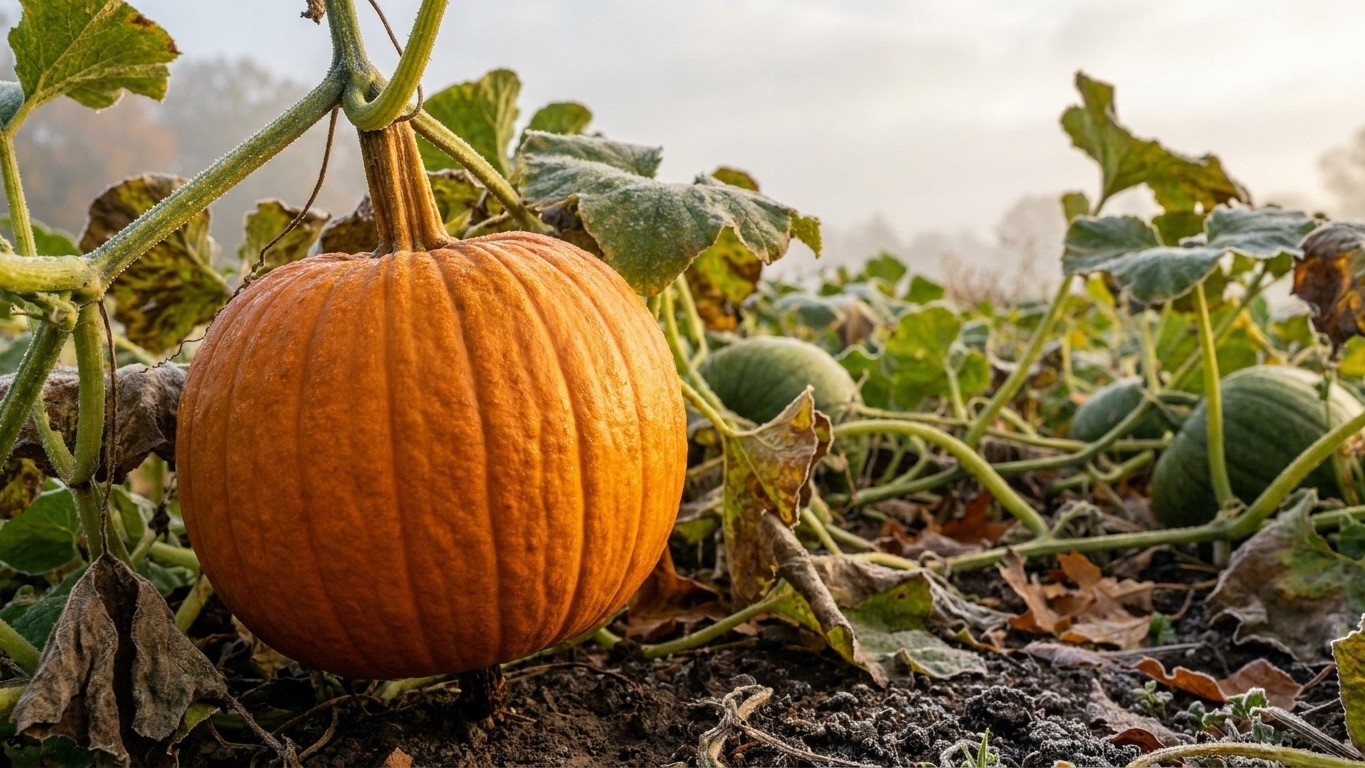

Wyoming’s first fall frost lands between September 24 and October 5 most years, and a pumpkin needs 45 to 55 days from the moment it flowers, not from the day the seed goes into the ground, to turn from green to orange. Count backward from that frost window and the answer comes fast: yes, pumpkins can ripen in Wyoming, but only if the last flower opens by mid-August at the latest. Miss that mark and the fruit stays green until frost ends the season.
The short answer
Start with the frost date, because everything else on a pumpkin calendar hangs off it. NOAA’s 1991-2020 Climate Normals put Wyoming’s first fall freeze somewhere between September 24 and October 5, depending on the year and, more than anything, on elevation. That ten-day spread matters because it’s the wall a pumpkin vine runs into every season, whether the garden sits in a river-bottom near Torrington or a hillside plot outside Sheridan.
Utah State University Extension, the source most growers rely on for the mechanics of pumpkin timing, lists a maturation window of 45 to 55 days measured from the moment a female flower opens, not from the day seed hits soil. That distinction changes everything about how a Wyoming grower should think about the calendar. A seed can sit in cool ground for weeks before it ever produces a flower, and none of that waiting counts against the 45-to-55-day clock.
Run the subtraction both directions and a window appears. Using the earliest frost date, September 24, against the longest maturation stretch, 55 days, pushes the deadline for the last usable flower back to July 31. Using the latest frost date, October 5, against the shortest maturation window, 45 days, allows a flower to open as late as August 21 and still finish. Somewhere between those two dates, July 31 and August 21, sits the real cutoff for any given garden in any given year.
That’s a wide window, not a promise. A grower who happens to get the later frost date and the shorter maturation stretch has three extra weeks of breathing room over a grower who gets hit with an early freeze and a slow-finishing fruit. Neither grower knows in advance which version of the season they’re getting. The safer move is to aim for the early end of that window, July 31, and treat anything past it as a bonus rather than a plan.
None of this accounts for elevation, and in Wyoming that gap is real. NOAA’s normals note roughly 130 frost-free days for gardens sitting near 6,000 feet, and frost is possible in any month once a garden climbs high enough. A grower in Laramie or Jackson is working with a tighter version of this same math than a grower in Torrington or Sheridan, even though both towns fall inside the same statewide frost window on paper.
When to sow here
When to Sow Pumpkins in Wyoming comes down to one specific rule from Utah State University Extension: pumpkins go into the ground when soil temperature holds at 65 F, not when the calendar says the last frost has passed. Those two dates are not the same thing, and treating them as interchangeable is one of the most common mistakes made in a short-season state like Wyoming.
Wyoming’s last spring frost falls between May 7 and May 18 across most of the state, again per NOAA’s Climate Normals. Soil, though, warms far slower than air. Bare dirt sitting under a cool spring sky can take weeks to climb into the mid-60s even after the thermometer stops dropping below freezing at night. A grower who sows the day after the last frost date is very likely sowing into soil that’s still too cold for pumpkin seed to do much besides sit and rot.
- Let the frost window pass first. Treat May 7 to May 18 as the earliest the air is reliably safe, not as sowing day itself.
- Check the soil, not the calendar. Push a soil thermometer four inches down and wait for a steady 65 F reading before committing seed to the ground. In much of Wyoming that reading doesn’t show up until well into the weeks that follow the last frost.
- Warm the bed artificially if the season feels tight. Row covers or black plastic mulch laid over the bed ahead of sowing can buy roughly two weeks, pulling that 65 F threshold earlier into the calendar than bare soil would allow on its own.
- Count forward from whichever sowing date results. The goal is a flowering window that lands inside July 31 to August 21, the safe range established above. If direct sowing after the soil hits 65 F still leaves too little runway, that’s the signal to move to the next step.
- Start seed indoors and transplant if soil warms late. A transplant already has true leaves when it goes into the ground, saving calendar time that direct seeding into cold soil would otherwise lose while germination waits for warmth.
What goes wrong here
Most Wyoming pumpkin failures trace back to the same root cause: a season that’s simply too short for whatever timing mistake got made earlier. The failures below are the ones that show up most often, and each has a fix that starts well before the vine ever flowers.
- A late flower that never turns orange. If the last female flower opens after August 21, the fruit runs out of daylight and heat before it finishes coloring. The remedy sits upstream of the flower itself: sow as soon as soil hits 65 F, and use row covers earlier in spring to pull that date forward rather than trying to rescue a late-season fruit that’s already behind.
- A fruit caught green by the first freeze. Even a fruit that colors on schedule can get nipped if frost arrives at the early edge of the September 24 to October 5 window. Watch the forecast in late September and cover vines with a blanket or tarp on any night frost is possible, rather than assuming the later date will hold.
- A vine that collapses before the rind hardens. Powdery mildew and simple heat stress can take a vine down before the skin has toughened enough for storage, leaving a fruit that looks ripe but bruises and rots within days. Keep vines watered at the base rather than overhead, and thin foliage around the fruit so air moves through the canopy.
- Pest pressure that eats into the calendar. A vine slowed by feeding damage loses time it can’t get back in a state with this few frost-free days. Squash Bugs in Wyoming and Cucumber Beetles in Wyoming both cover identification and control specific to this state’s growing conditions.
Checking this against your own county
Every figure above comes from statewide averages, and Wyoming’s elevation range makes statewide averages a rough guide at best. A garden at 6,000 feet is working with a frost calendar that looks nothing like a garden down near the North Platte, even though both sit inside the same NOAA station’s reporting window.
The University of Wyoming Extension is the office set up to answer exactly this kind of local question, from county-level frost expectations to soil warming patterns specific to your elevation and aspect. Their office network covers every county in the state, and a call or visit before sowing is worth more than any statewide average, including the ones in this article.
Common questions
Can I still get a ripe pumpkin if I sow in June?
It depends entirely on when the soil hit 65 F and when the vine flowers. If flowering still lands inside the July 31 to August 21 window, a June sowing can work. If the flower opens after that window, the fruit is unlikely to color before frost.
Does a green pumpkin ripen after picking?
Utah State University Extension’s guidance covers harvesting with the stem attached before frost and storing fruit where it will not freeze, but it publishes no figures on ripening color after harvest. Treat a green pumpkin pulled ahead of frost as a fruit to use quickly rather than one to store.
Why does soil temperature matter more than air temperature for sowing?
Pumpkin seed needs warmth to germinate reliably, and soil holds cold far longer than air does after a frost passes. A thermometer in the ground is a better guide than a thermometer on the porch.
Do row covers help after the vine is already flowering?
Row covers do their most useful work earlier in the season, warming soil ahead of sowing. Once vines are flowering and need pollinator access, covers are better reserved for frost protection at the end of the season rather than left on full time.