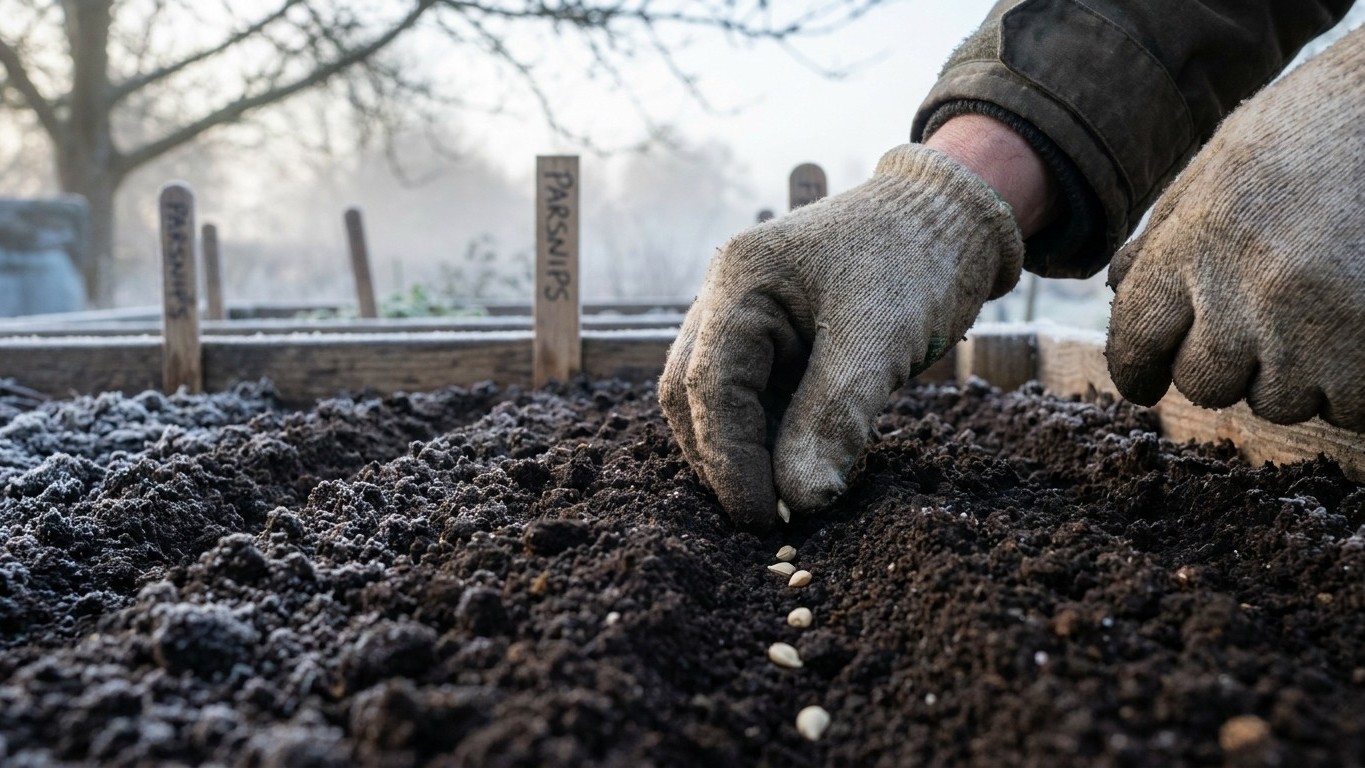

Sow parsnip seed directly outdoors 2 to 3 weeks before the last spring frost. For central Alberta, using Calgary as the reference station, that frost falls on average around May 21, which puts seeding in the last days of April through the first week of May. The bigger question isn’t the calendar date, though. It’s whether Alberta’s climate gives the crop the frost exposure it needs to turn starchy roots into sweet ones, and whether the growing window is long enough to get there at all.
The short answer
Frost exposure and hardiness zone are not the same measurement, and mixing them up is the most common mistake gardeners make when planning a parsnip bed. The number that matters for winter survival is the mean daily minimum of the coldest month, and in Calgary that figure sits at 8.2 F. That’s a genuinely cold reading, well below freezing on an average night in the depths of winter, not just on a rare cold snap.
What that number tells you is that Alberta’s ground gets hard and stays hard for a long stretch. It does not, by itself, tell you whether your parsnips will sweeten. Sweetening comes from several weeks of cool, frosty weather converting stored starch into sugar in the root, according to Utah State University Extension. Alberta delivers that in spades. The first fall frost lands on average September 16, and from that point through the depths of a prairie winter, the crop sits through cold snap after cold snap. If anything, the risk here isn’t too little frost exposure, it’s too much, since ground left unprotected can freeze solid enough to damage or trap the roots rather than simply chill them.
So the direct answer to whether a parsnip grown in Alberta will sweeten: yes, comfortably, because the fall and winter cold arrives early and stays hard. A parsnip pulled a few weeks after that September frost, or left under mulch into early winter, will taste noticeably better than one harvested straight from summer heat. The coldest-month figure of 8.2 F is a hardiness warning for the plant left unprotected in the ground, not a reason to worry about flavor. Those are two separate questions, and Alberta answers one of them generously while demanding real caution on the other.
None of this changes the timing math, though. Frost exposure is a matter of season timing and duration, hardiness zone maps average minimum temperatures across a whole winter and don’t describe how many frosty weeks a root crop actually sits through before harvest. For parsnips, the frosty-week count is what decides sweetness, and Alberta’s count is high.
Does the season fit?
Parsnips need 100 to 120 days from seeding to maturity, sown in place rather than transplanted, according to Utah State University Extension. Lining that up against Calgary’s frost dates shows the fit is workable, but only if the sowing date isn’t delayed.
- Start with the average last spring frost: May 21. Sowing happens 2 to 3 weeks before that date, which lands the seed in the ground somewhere between roughly April 30 and May 7.
- Add germination time. Parsnip seed is notoriously slow, taking 14 to 21 days to sprout in cool spring soil. Sown in the first days of May, seedlings won’t reliably show themselves until sometime between mid and late May.
- Count forward 100 to 120 days from the seeding date, not from germination. Seeded around May 5, the low end of 100 days lands near August 13, the high end of 120 days lands near September 2.
- Compare that to the average first fall frost, September 16. Both the 100-day and 120-day maturity dates fall before that frost, which means a prompt early-May sowing fits with days to spare, and those extra days after maturity are exactly the frosty stretch that builds sugar in the root.
- Now shift the sowing date later, say to the first week of June instead. Counting 100 to 120 days from a June 5 seeding pushes maturity to September 13 through October 3, which crowds or blows past the September 16 average frost date entirely, leaving the crop short of full size when the cold arrives.
The arithmetic says this: sown on schedule, 2 to 3 weeks ahead of the May 21 average last frost, the season fits with room to spare, and the extra weeks between maturity and hard freeze are a bonus for flavor rather than a risk. Sown late, into June, the same 100 to 120 day requirement turns tight or fails outright, because Alberta’s frost-free window, from average last frost to average first frost, only runs about 118 days in the first place. Remember too that both frost dates are averages, not guarantees. In roughly half of all years the actual frost lands later than these dates, and in the other half it lands earlier, so a cautious gardener treats the last-frost date as the middle of a window rather than a safe green light, and the first-frost date the same way in reverse.
What goes wrong here
- Forked roots from heavy or stony ground. Alberta’s prairie soils often run heavy or contain stones close to the surface, and parsnip roots that hit an obstruction split into two or more legs instead of growing straight. The remedy is double digging the bed to at least a foot deep, or working in enough sand and compost to loosen the profile before seeding, since a root descending 12 inches unimpeded is a root that grows straight.
- Forked roots from overwatering. This is a separate cause from soil texture and shouldn’t be confused with it. Consistently soggy soil encourages the root to branch rather than grow long. Water enough to keep the bed evenly moist through germination, then ease off once seedlings are established, rather than keeping the bed saturated all season.
- The season running out before the root sizes up. Delay sowing past the first week of May in most of Alberta and the 100 to 120 day clock starts bumping against the September 16 average first frost. The fix is simple: sow as soon as the soil can be worked in that late-April to early-May window, and don’t wait for warmer weather that isn’t necessary for this crop.
- Digging up seed too early, thinking it failed. Parsnip germination takes 14 to 21 days even under good conditions, longer in cold soil. Gardeners who don’t expect that delay often assume the seed is dead and re-sow, or disturb the bed looking for sprouts. Mark the row and wait out the full three weeks before judging it a failure.
- Roots damaged by an unprotected hard freeze rather than sweetened by it. Alberta’s ground freezes deep and stays frozen, reflected in that 8.2 F coldest-month minimum. Roots left in the ground into winter without at least a foot of loose mulch can be damaged by that depth of freeze rather than simply chilled. Harvest before the ground locks up solid, or mulch heavily if the plan is to leave roots in place for a very early spring lift.
Common questions
When exactly should I sow parsnip seeds in Alberta?
Aim for 2 to 3 weeks before the average last spring frost. Using the Calgary area’s average of May 21 as a reference, that puts seeding in the last days of April through the first week of May, as soon as the ground can be worked.
How long before parsnip seeds actually come up?
Give it 14 to 21 days. Parsnip seed germinates slowly even in good conditions, and cool Alberta spring soil can push that toward the longer end. Resist the urge to re-sow or dig around before the full three weeks have passed.
Can I leave parsnips in the ground over an Alberta winter?
Only with heavy protection. A coldest-month mean minimum of 8.2 F means the ground freezes hard and stays that way for months. Roots left unprotected risk freeze damage rather than the gentle chilling that builds sugar. A foot or more of loose mulch reduces that risk if overwintering is the goal, but harvesting before the ground locks solid is the more reliable path.
Why do my parsnip roots come out forked or hairy instead of straight?
Two separate causes produce this, and they call for different fixes. Heavy or stony soil deflects the taproot and needs to be loosened by double digging or amending with sand and compost before seeding. Overwatering, on the other hand, encourages branching even in loose soil, and the fix there is steadier, more moderate watering rather than a saturated bed.