
Asparagus rewards patience before it rewards the fork. According to Utah State University Extension, gardeners should not harvest asparagus until year 3 after planting. From there the picking window grows on its own schedule: four weeks in year 3, six weeks in year 4, eight weeks in year 5 and every year after that. The plant itself decides when each season ends, not a date circled on a calendar.
The short answer
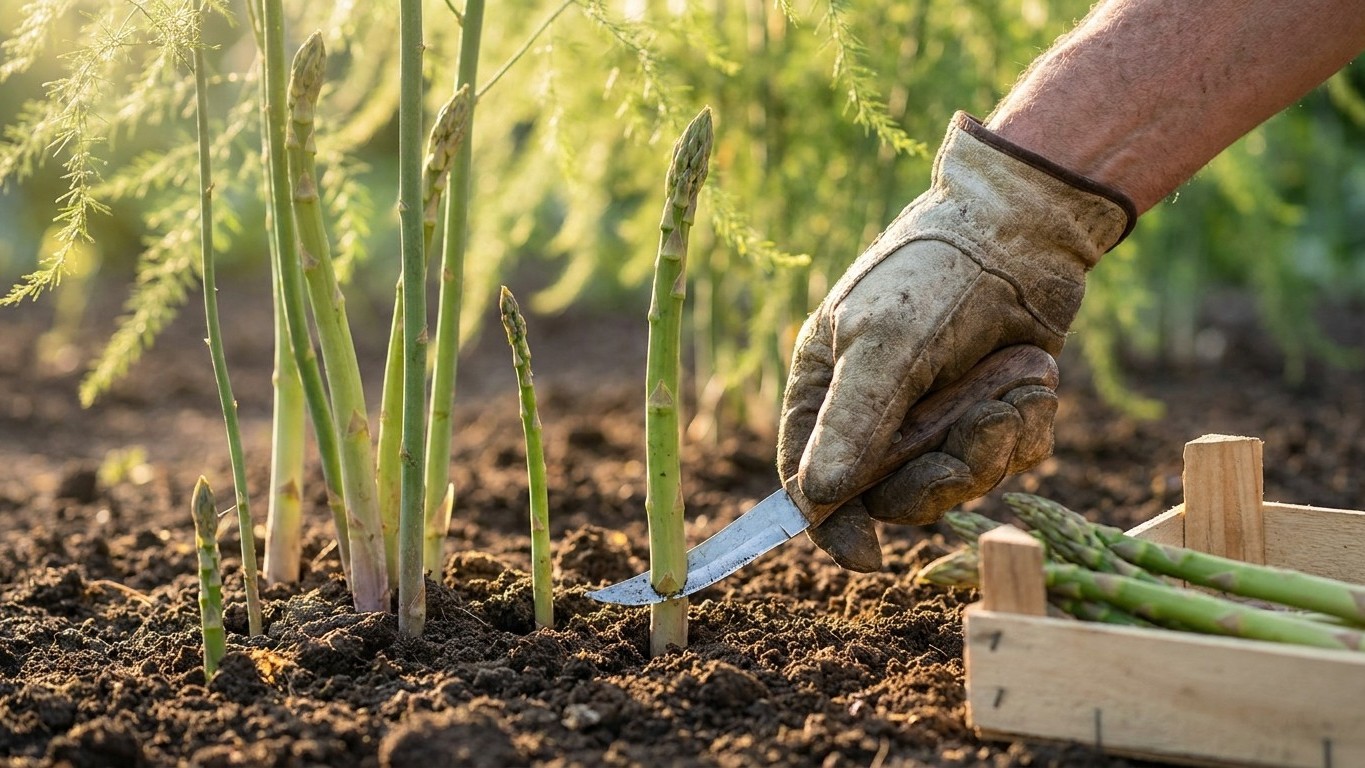
Utah State University Extension is direct about the timeline, and the numbers are worth repeating exactly because gardeners tend to round them down. In year 3, plants may be harvested for up to 4 weeks, and the guidance is specific about how: cut 9 inch tall spears at ground level. Skip a step there and you either bruise the crown or waste tender spear tissue.
Year 4 stretches the window to 6 weeks. Year 5 and every season afterward, the bed can be picked for up to 8 weeks. That’s the full progression as published: zero, then four, then six, then eight. Nothing in between, and nothing beyond eight weeks even on an established, vigorous bed.
What stops each season isn’t a number of days. Utah State University Extension gives a physical signal instead: stop harvesting when the majority of spears are smaller than a pencil in diameter. Once the bed is throwing mostly thin spears, cutting stops for the year, whether that happens on week three or week eight. Clemson Extension describes the same threshold from a different angle: stop harvesting when the diameter of the spears has been reduced to pencil-size and allow the spear to grow to full height. Two land-grant extensions, one shared rule, and it isn’t tied to a specific week number in either case.
There’s also a ceiling on the whole enterprise. Expect the plant to produce spears for 10-15 years. An asparagus bed isn’t a permanent fixture of the garden. It has a productive run, and the four-then-six-then-eight progression happens inside that run, not forever. A gardener planting a bed today is planting something with a working lifespan measured in over a decade, not something that will produce at the same eight-week clip indefinitely without eventual decline.
None of this is guesswork stitched together from general gardening advice. It comes from one named source, Utah State University Extension’s guidance on asparagus in the garden, and the numbers hold regardless of climate zone, because the underlying limiting factor is the plant’s own root reserves, not the weather that particular spring.
What actually decides it
Crown reserves build slowly
A newly planted asparagus crown spends its first two years growing roots and storing carbohydrates underground, not producing harvestable spears. That’s why harvest doesn’t start until year 3. By year 3, the crown has enough stored energy to support four weeks of cutting without collapsing the bed’s future output. Each additional year the crown sits in the ground, it banks more reserves, which is exactly why the window widens from four weeks to six, then to eight, rather than jumping straight to a long harvest the first time cutting is allowed.
the Pencil Rule replaces the calendar
A date-based cutoff would be a poor substitute for what’s actually happening underground. As harvest continues through the season, the crown draws down its stored reserves to keep pushing new spears. Thinner spears are the visible sign that reserves are running low. That’s why the stopping rule is an object, not a number: stop harvesting when the majority of spears are smaller than a pencil in diameter. Once that happens, the remaining spears need to grow to full height and leaf out into ferns, which is how the crown rebuilds what the harvest spent. This is also why the same rule works whether a bed is in a warm region or a cold one: the spear diameter reports on the crown’s condition directly, and a calendar date can’t do that.
A finite productive lifespan
The four-week, six-week, eight-week progression isn’t a permanent ladder that keeps climbing. It plateaus at eight weeks in year 5 and stays there for the remainder of a run that’s expected to last 10-15 years total. That ceiling matters for planning: a bed established this spring is a project with a working horizon, and the harvest length in any given year says nothing about how many years are left in the bed overall.
How to do it
- Set the crowns at planting time. Clemson Extension instructs gardeners to set the crowns 15 to 18 inches apart and 6 to 8 inches deep. At this stage, four varieties commonly available are named only by their sex, with no published guidance on flavor or yield differences between them: Jersey Giant and Jersey Knight are all-male varieties, while UC 157 F1 and Purple Passion are male/female varieties.
- Leave the trench open, not filled. The crown does not go in buried at full depth on day one. It sits in the bottom of an open furrow with just enough soil to cover it initially.
- Backfill gradually as spears emerge. Clemson Extension describes the process precisely: continue to pull soil over the crowns, about 2 inches every two to three weeks, until the trench is filled and the crowns are 6 to 8 inches deep. Filling it all at once instead of gradually is one of the more common ways a new bed fails to establish.
- Do not harvest in year 1 or year 2. Utah State University Extension is explicit that harvesting should wait until year 3 after planting, giving the crown time to build the root reserves that will support future cutting.
- Begin cutting in year 3, for up to 4 weeks. Cut 9 inch tall spears at ground level rather than snapping them or cutting below the soil surface.
- Watch the spears, not the date. Stop harvesting for the season once the majority of spears are smaller than a pencil in diameter, letting the remaining growth mature into fern.
- Extend the window as the bed ages. Harvest for 6 weeks in year 4, then up to 8 weeks in year 5 and every year after, always ending on the same pencil-diameter signal rather than a fixed week count.
What Goes Wrong
- Harvesting in year 1 or year 2. The crown hasn’t built the reserves needed to support cutting, and early harvest sets the bed back. Wait until year 3, when up to 4 weeks of harvest is supported.
- Filling the trench in one pass at planting. Burying the crown to full depth immediately is a common way to lose a bed. Backfill gradually instead, about 2 inches every two to three weeks, until the crowns reach the intended 6 to 8 inch depth.
- Ignoring the pencil signal and cutting past it. Continuing to harvest once most spears have thinned to pencil size draws down reserves the crown needs to rebuild through its fern growth. Stop as soon as the majority of spears are pencil-thin, regardless of how many weeks have passed.
- Cutting below ground level or letting spears grow taller than 9 inches before cutting. The guidance calls for cutting 9 inch tall spears at ground level; deviating in either direction either damages the crown’s buds or wastes tender spear length.
- Crowding crowns too close together. Planting tighter than the 15 to 18 inch spacing Clemson Extension describes competes root systems against each other before the bed has a chance to mature.
- Expecting a fixed lifespan number beyond what’s published. A bed’s productive run is described as 10-15 years, a range rather than a guaranteed figure, so treating any single year within that span as a hard cutoff isn’t supported by the source.
Common questions
Can I harvest just a few spears in year 1 or year 2?
No. Utah State University Extension states plainly not to harvest asparagus until year 3 after planting, without a partial exception for a light picking in earlier years.
How do I know when to stop harvesting each year?
Stop when the majority of spears are smaller than a pencil in diameter, per Utah State University Extension, a sign echoed by Clemson Extension’s instruction to stop once spear diameter is reduced to pencil-size and let the spear grow to full height. It’s a physical signal, not a set number of weeks.
How deep should asparagus crowns be planted?
Clemson Extension recommends setting crowns 15 to 18 inches apart and 6 to 8 inches deep, reached gradually by pulling soil over the crowns about 2 inches every two to three weeks until the trench is filled, rather than burying them at full depth immediately.
How many years will an asparagus bed keep producing?
Expect the plant to produce spears for 10-15 years, with the harvest window itself building from 4 weeks in year 3 to 6 weeks in year 4 and up to 8 weeks in year 5 and beyond, within that overall span.