
Fifteen years is the outer edge of an asparagus bed’s working life, and the source on this crop is blunt about what it needs to get there: soil that drains. Alaska’s representative state soil, the Tanana series, is officially rated poorly drained, which means the answer to whether it holds a bed that long depends less on the state and more on which patch of ground a gardener actually digs into.
The short answer
Start with what’s actually mapped for this territory. The Tanana series, the soil USDA lists as representative of Alaska, is a Gelisol, meaning permafrost sits within reach of the soil profile. Its surface horizon runs strongly acid at a pH around 4.7, texture is a loam to silt (30 percent sand, 7 percent clay, 63 percent silt), and organic matter averages about 90 percent. That last number is the tell: a surface layer that’s almost entirely organic matter isn’t a worked garden bed at all, it’s a natural peat, muck, or forest-litter layer, the kind of ground that sits wet because it’s built out of partly decomposed plant material sitting over permafrost. USDA’s own drainage rating for this series is poorly drained.
Set that against what an asparagus crown asks for. Utah State University Extension’s guidance on the crop is short on soil chemistry and long on one requirement: drainage. Most soils will grow asparagus, the source says, provided they’re well drained. A bed that sits in standing water through spring thaw, or that never fully drains because a frozen layer sits a few feet down, is the one condition this fifteen-year crop can’t tolerate. Crowns rot in saturated ground. There’s no amendment that fixes permafrost.
None of this means a garden in Alaska can’t hold asparagus for fifteen years. It means the state soil is a starting point, not a diagnosis of one back yard. The Tanana series describes representative surface conditions across mapped components of that series, not every soil type in the state, and river bottoms, hillside soils, and any ground a builder has cut, filled, or graded will behave completely differently from the mapped norm. A gardener whose plot sits on well-drained fill, or on a raised, sandier pocket away from a poorly drained lowland, may have soil that suits this crop just fine.
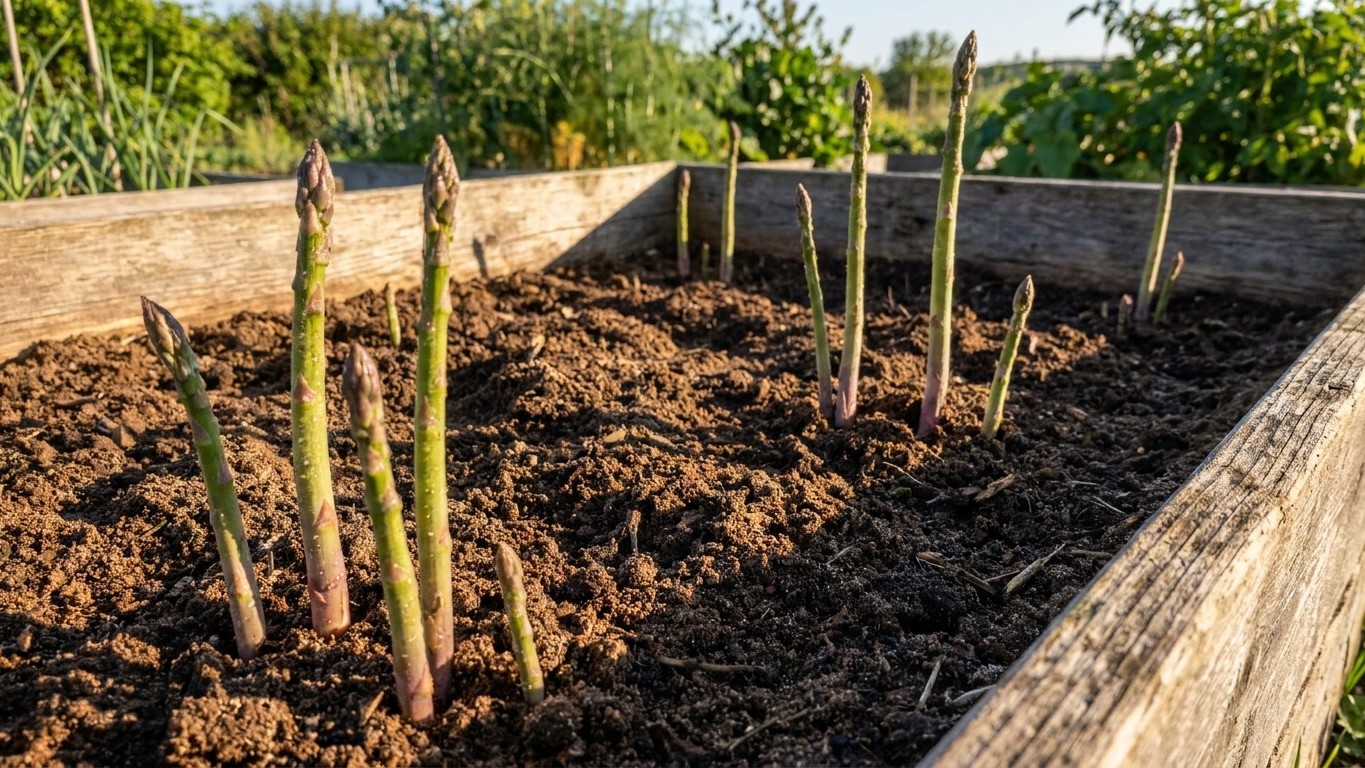
The practical move is to test before committing fifteen years to one spot. If a hole dug a foot down fills with water and stays that way, or if the ground stays soggy well into what should be a dry week, that’s a drainage problem this crop won’t forgive. The standard fix is to build up rather than dig down: a raised bed, four to six inches above grade at minimum, filled with a loam mix that isn’t sitting over saturated native ground, gives the crowns the drainage the source demands without waiting on the soil underneath to change. Mounding rows slightly and keeping the bed off the lowest point of a yard does the same job on a smaller scale.
Will the summer here water it for you?
The source’s watering schedule is specific: 1 to 2 inches every other week for the first two years while the crowns establish, then a lighter routine of every three weeks once the planting matures. Whether a garden needs a hose at all comes down to comparing that schedule against what actually falls from the sky here, using the region’s 1991-2020 normals as the baseline.
- June, the establishment months. The reference station’s normal for June is 1.02 inches for the whole month, which is well short of even one 1-to-2-inch application, let alone the two the schedule calls for in a typical every-other-week June. A newly planted bed in its first two summers will need the difference made up with a hose almost every other week through June.
- July, a partial recovery. The normal climbs to 1.82 inches for the month, closer to a single scheduled application but still short of the two the every-other-week rule implies across four weeks. Supplemental watering is still the safer default rather than the exception.
- August, the wettest of the three. At 2.93 inches, August comes closest to meeting the every-other-week target on its own, and in a year running near normal a mature bed’s lighter every-three-week need may largely be met by rainfall alone.
- The summer total. Adding the three months gives about 5.8 inches across June, July, and August, against a bed’s full-summer establishment need that can run well past that once the every-other-week schedule is worked out over roughly thirteen weeks. The gap is real, and it’s front-loaded into the driest month, June.
- What that means at the tap. A gardener growing a new bed here should plan to run supplemental water through most of June and much of July, then ease off as August’s normal rainfall closes more of the gap. Once the bed matures past year two and moves to the every-three-week schedule, an established bed on this territory’s normal rainfall pattern needs far less supplemental water, particularly if August performs close to normal.
None of these are forecasts. They’re 1991-2020 averages for one reference station, and a rain shadow, a slope, or a particularly dry or wet season will move the numbers in either direction. A rain gauge on the actual bed, checked weekly through the growing season, settles the question a normal never can.
When to put the crowns in
Crowns go into the ground in early spring, planted into furrows about 8 inches deep. In this territory, early spring means working around the mean last spring frost date, which the 1991-2020 normals put somewhere around May 3 to May 12 for the reference station tied to these figures. That’s a mean, not a guarantee, so treat it as a target window to plan toward rather than a date to circle and plant on exactly. Local microclimates, particularly outside the mildest parts of the state, will push that window later; the Interior and points further north run a shorter frost-free season than the reference station’s roughly 143 frost-free days, though the long daylight hours of an Alaska summer partly offset the shorter calendar.
Once crowns are in the furrow, the source is specific about how the trench gets filled back in: gradually, not all at once. Backfill about 2 inches of soil every other month across the season, rather than covering the crowns completely at planting. That staged fill lets the developing shoots keep pushing up through loose soil rather than fighting through a deep, compacted layer from day one.
Seed is the alternative route, though it asks for more patience than crowns. Starting from seed adds time to an already long commitment before the bed reaches the point crowns start from, since seed-grown plants need a season of growth before they’re at crown stage. The source doesn’t publish specific seed-starting dates or transplant timing for this territory, so a gardener choosing that route is working from general nursery practice rather than a documented schedule.
On variety, the only names carried by Utah State University Extension’s guidance come sorted by sex, not by performance. Jersey Giant and Jersey Knight are listed as all-male varieties; UC 157 F1 and Purple Passion are listed as producing both male and female plants. The source doesn’t rank them for flavor, yield, or cold tolerance, and no nursery is named as a recommended source, so choosing among them comes down to what’s locally available rather than a documented reason to prefer one over another.
Patience matters most in what comes after planting. There’s no harvest at all in the first two years, and the first cutting doesn’t come until year three, and even then it’s brief: about 4 weeks of harvest that year, extending to roughly 6 weeks the following year, then up to about 8 weeks in following seasons as the crowns mature further. The signal to stop cutting each season isn’t a date on a calendar. It’s the spears themselves: once most of what’s coming up runs thinner than a pencil, harvest stops for the year and the plant is left to grow into fern that feeds the crown for the following season.
Common questions
Does asparagus need acidic soil to grow well in Alaska?
The source guiding this crop’s care doesn’t publish a soil pH requirement, so no pH figure should be treated as the target here. The state’s representative soil runs strongly acid at a surface pH around 4.7, but that figure describes a mapped soil series, not a recommendation, and a garden’s own soil test is the only reliable way to know what’s actually in the ground being planted.
Can I plant asparagus in a raised bed if my yard has poor drainage?
Yes, and it’s the standard fix where native soil doesn’t drain well enough. Raising the bed above grade with a well-drained mix sidesteps the drainage problem entirely, which matters more here than almost anywhere else on this site given that this crop is expected to occupy the same ground for ten to fifteen years.
How many years until I get a full harvest?
There’s no cutting at all in the first two years after planting. The first harvest comes in year three and runs about 4 weeks, extending to roughly 6 weeks the year after, and up to about 8 weeks once the planting is fully mature.
Is there a cold-hardiness or chilling requirement I should plan around?
That figure isn’t published in the source this article draws from. The guidance covers planting depth, watering, and harvest timing, but it’s silent on any winter chilling hours needed, and no hardiness-zone-based chilling number should be assumed in its place.