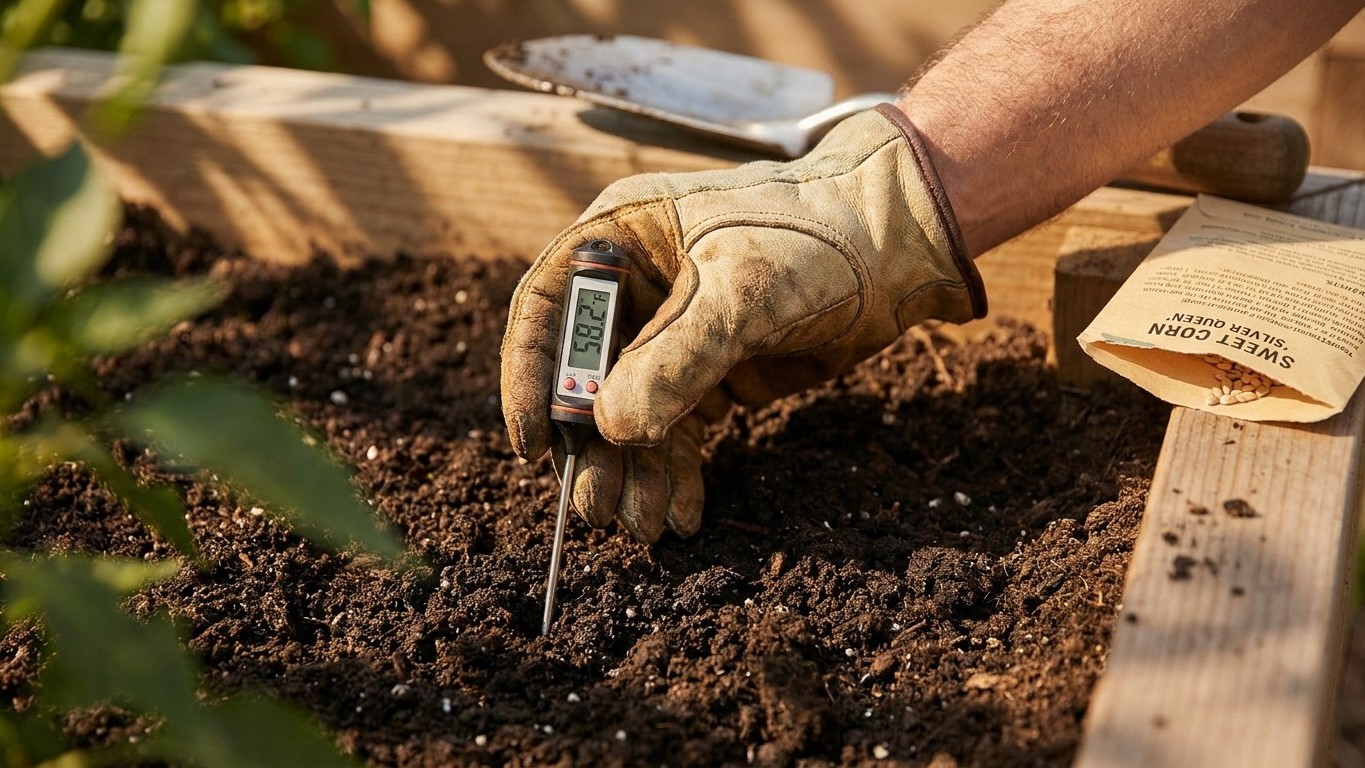

Sweet corn in Ontario goes into the ground only once the soil itself, not the calendar, holds steady above 60°F, a threshold that lands well after the province’s mean last spring frost of April 30. From there, growers are working with a 60 to 90 day maturity window measured against a mean first fall frost of October 16. That arithmetic, more than any date printed on a seed packet, decides when to sow.
The short answer
Start with the mechanism, because it explains everything else. Air warms fast in spring; soil does not. A sunny week can push daytime temperatures well past 60°F while the top few inches of garden bed are still cold and damp from snowmelt or spring rain. That lag is why the April 30 mean last frost date, drawn from Environment and Climate Change Canada’s 1981-2010 normals for the Toronto Lester B. Pearson International Airport station, tells you almost nothing about when soil is actually fit to receive sweet corn seed. Seed sown in cold, wet soil rots before it germinates, or comes up so unevenly that half the stand is stunted from the start.
There is a second problem with treating April 30 as a green light. It is a mean, not a safe cutoff. In roughly one year out of two, the last frost at that station falls later than April 30, sometimes considerably later. Anyone using that date as a planting trigger is gambling on the better half of the historical record, not the whole of it. The honest approach is to stop watching the calendar once the frost has passed and start watching the soil itself, ideally with a simple soil thermometer pushed a few inches into the bed, waiting for a run of days where the reading holds above 60°F rather than just touching it once.
Once that threshold is met, the second clock starts: 60 to 90 days from planting to harvest. Do the arithmetic on the two mean dates and the outer frame of the season runs about 169 days, from April 30 to October 16. That sounds generous. It is not, because none of those early spring days are usable for sweet corn, given the soil-warming lag described above. The real workable window is shorter than the headline number, and it shrinks further outside the Toronto area. The Pearson Airport station sits in one of the milder, most developed corners of the province; northern districts and higher-elevation farmland typically lag weeks behind those same dates. Add to that a climate that recorded zero mean days per year reaching 90°F or higher at the reference station, a sign of fairly modest summer heat accumulation, and it becomes clear why leaning toward the shorter end of any variety’s stated maturity range is the safer bet across most of Ontario, not just a cautious preference.
Does a late variety fit here?
Maturity length is not a detail to skim past. It is the single number that decides whether a given variety has any realistic chance of finishing before frost returns, and Ontario’s numbers do not treat every maturity class the same way.
A 60-day variety
If soil doesn’t reliably hold above 60°F until several weeks past the April 30 mean, a common and cautious pattern in much of the province, a 60-day variety planted once that threshold is confirmed still matures somewhere in the early-to-mid August range. Measured against the October 16 mean first fall frost, that leaves close to two months of cushion. That kind of margin absorbs a cool, sluggish stretch of weather without pushing harvest anywhere near frost risk, and it fits comfortably with a climate that logs no days above 90°F, since a shorter-season variety needs less accumulated heat to finish its cycle. For most home gardens across the province, this end of the maturity range is the forgiving choice.
A 90-day variety
The same realistic planting timing pushes a 90-day type’s maturity out to roughly early-to-mid September. On paper, that still leaves about a month before the October 16 mean frost. In practice, that month of buffer is thinner than it looks. October 16 is a mean date, not a guarantee, which means frost can arrive earlier than that in a meaningful share of years, cutting straight into whatever cushion a 90-day variety was counting on. Layer on a climate with no days reaching 90°F, and a long-season type is more likely to run behind its labeled maturity count than ahead of it, especially if a cool spring already delayed planting past the ideal window. Said plainly: a 90-day variety does not reliably fit the growing conditions across most of Ontario. It can work in a warm, early year close to the Toronto area, but it is a poor bet for northern or upland districts, and not a variety class worth building a planting plan around.
What goes wrong here
- Soil sown too cold. Seed goes in right after the last frost date passes, before the soil itself has caught up. Result: rot, gaps in the row, or a weak, uneven stand. The fix is to stop planting by frost date alone and confirm actual soil temperature is holding above 60°F before seed goes in the ground.
- A variety too late for the season. A 90-day type is chosen without accounting for how little real margin exists once soil-warming delay and the possibility of an earlier-than-average fall frost are both factored in. The fix is straightforward: favor varieties toward the 60-day end of the range, particularly outside the milder Toronto-area climate the reference station represents.
- Sweetness lost, with no connection to climate at all. Standard sugary (su), sugary-enhanced (se), and supersweet (sh2) types cross-pollinate when their tassels shed pollen at the same time, and the result is starchy, dull-tasting kernels regardless of how well the season’s timing was managed otherwise. There is no published isolation distance to lean on here; the fix is timing, not spacing, staggering planting dates so the different types don’t tassel together, and keeping each type in its own block of three or more rows so pollination stays clean within that block.
Common questions
Is April 30 a safe date to sow sweet corn in Ontario?
No. It is the mean last spring frost date at the Toronto Lester B. Pearson International Airport station, which means frost falls later than that in roughly half of all years. It also says nothing about soil temperature, which is the figure that actually matters for germination, and soil typically stays below the 60°F threshold for some time after that date.
How long is Ontario’s real growing window for sweet corn?
The mean frost-free span between April 30 and October 16 works out to about 169 days on paper. The usable window for sweet corn is shorter than that, because planting can’t begin until soil holds steady above 60°F, a point that comes well after the spring frost date and is not fixed to any single calendar day province-wide.
Should I plant a 60-day or a 90-day variety?
A 60-day variety leaves close to two months of buffer before the October 16 mean fall frost once realistic planting timing is factored in, making it the more forgiving choice across most of the province. A 90-day variety leaves a much thinner margin, and given that October 16 is only a mean date and the region logs no days above 90°F, it is not a reliable fit outside a warm, early-starting season near the Toronto area.
Why did my corn turn starchy instead of sweet even though I planted on time?
Correct timing against frost dates has nothing to do with this problem. It happens when different sweet corn types, standard sugary, sugary-enhanced, or supersweet, shed pollen at the same time as each other nearby. The remedy is to stagger planting dates so the types don’t tassel together, and to grow each type in its own block of three or more rows.