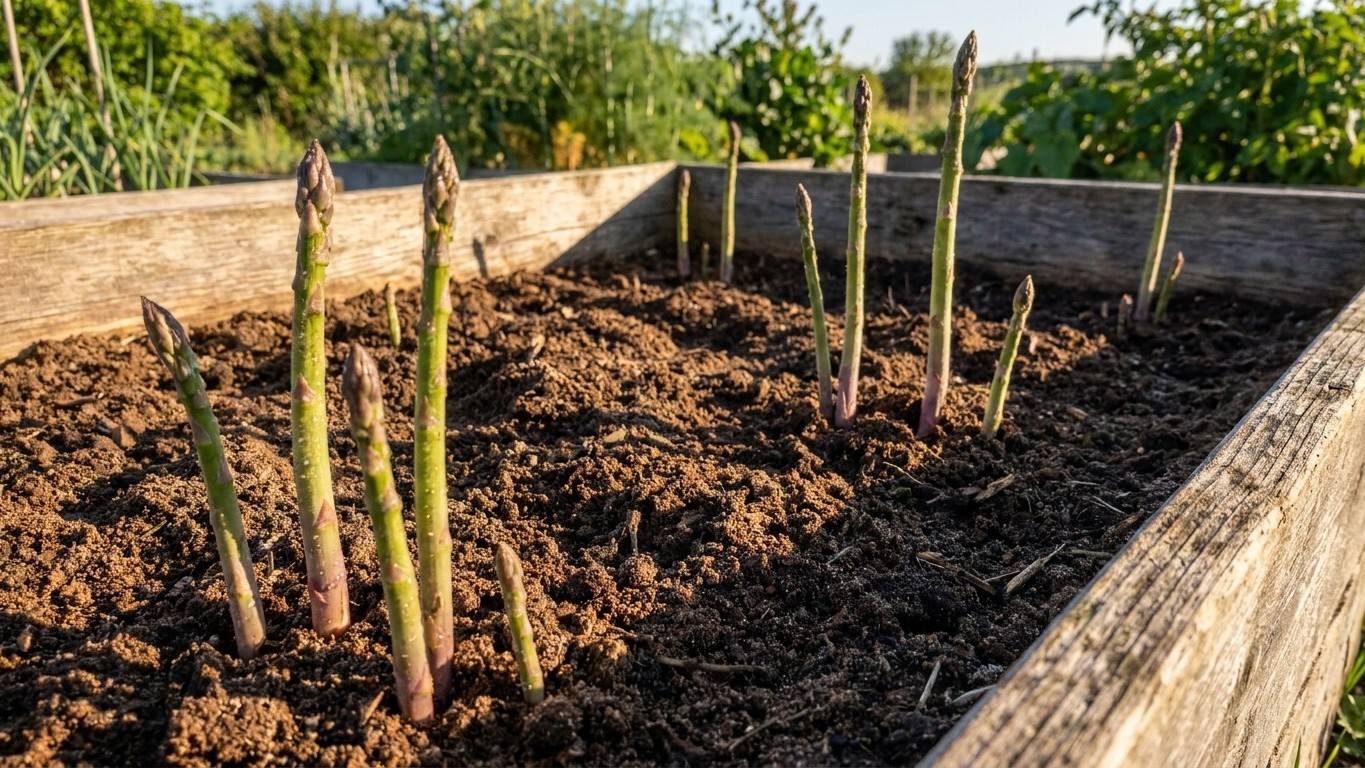

Yes, in most cases: Pennsylvania’s representative soil drains well, and drainage is the one condition an asparagus bed actually demands. But “most cases” isn’t “every backyard,” and a bed planted this spring is still producing when today’s toddlers are driving. Before you commit a corner of your yard to fifteen years of the same crop, it’s worth knowing exactly what the ground under your feet is likely to do with all that water.
The short answer
An asparagus bed isn’t a seasonal experiment. Once crowns go into the ground, the plant settles in for 10 to 15 years, producing nothing at all for the first two seasons and only a modest harvest in the third. That timeline, from Utah State University Extension’s guidance on asparagus in the home garden, comes with a single hard requirement: the soil has to drain. The source doesn’t ask for a particular texture, a particular pH, or any soil amendment beyond that one word, drained.
Pennsylvania’s answer, at least on paper, is favorable. The soil series USDA NRCS lists as representative of the state, the Hazleton series, is classified well drained. It runs loam to silt (46 percent sand, 12 percent clay, 42 percent silt), which is roughly the texture gardeners hope for: enough sand to let water pass, enough silt to hold nutrients, without the heavy clay that turns a wet spring into a swamp. Organic matter sits around 3.0 percent at the surface, a modest but workable number for a cultivated bed.
That said, a state-level soil series describes what the ground tends to do across hundreds of thousands of acres, not what happens in one specific yard. Pennsylvania spans river bottoms, hill country, and plenty of ground a builder has scraped, filled, or compacted with heavy equipment. Any of those can drain far worse than the state’s representative profile. The only way to know for certain is to dig a test hole roughly a foot deep, fill it with water, and time how long it takes to disappear. If water is still standing after an hour or two, that spot will drown asparagus crowns long before year fifteen arrives.
If the ground doesn’t drain fast enough, the fix isn’t to abandon asparagus, it’s to change the bed’s shape. Building a raised bed or a mounded berm, even just 8 to 10 inches above grade, moves the root zone out of the standing water and lets gravity do the draining the native soil won’t. Since the crop stays put for over a decade, that upfront work pays for itself many times over.
One more thing worth flagging before you order crowns: the four varieties commonly available are distinguished only by their reproductive type, not by flavor or yield claims. Jersey Giant and Jersey Knight are all-male varieties; UC 157 F1 and Purple Passion are male-and-female. Utah State University Extension, the only authority behind these facts, doesn’t publish a reason to prefer one over another. Choose based on availability, not marketing.
Will the summer here water it for you?
Asparagus has a two-stage thirst. For the first two years after planting, the bed wants 1 to 2 inches of water every other week. After that, once the root system is established, the schedule relaxes to every three weeks. Neither figure distinguishes between rain and irrigation, so the real question is how much of that the sky supplies on its own.
- What summer actually delivers: NOAA’s 1991-2020 climate normals for the reference station put June, July, and August rainfall at 4.04, 4.38, and 4.29 inches, for a summer total of about 12.7 inches. Spread evenly, that’s roughly an inch a week, which sounds close to the young bed’s every-other-week need.
- Why “close” isn’t “covered”: Rain doesn’t arrive evenly. Summer precipitation in this region tends to come as thunderstorms, dumping an inch or more in an hour and running off a well-drained surface before it soaks deep enough to reach young roots. A rain gauge on the actual bed, checked weekly, is the only way to know if a given two-week stretch cleared the 1-to-2-inch bar.
- The soil’s role in the equation: Because the region’s representative soil is loam to silt and well drained, water that does fall moves through fairly quickly rather than pooling around the crowns, which is good news for root health but means the bed can dry out faster between storms than a heavier clay soil would.
- The first two years, in practice: Expect to supplement with a hose or drip line during any stretch without a soaking rain, particularly in June, the driest of the three summer months at 4.04 inches.
- Years three and beyond: Once the every-three-week schedule kicks in, the region’s typical summer rainfall generally covers the requirement on its own, and supplemental watering becomes more of an insurance policy for dry spells than a routine chore.
When to put the crowns in
Asparagus crowns go into the ground in early spring, planted about 8 inches deep in a furrow. For this territory, “early spring” tracks closely with the last spring frost, which NOAA’s 1991-2020 climate normals for the reference station place around March 29 to April 6. That’s an average window, not a guarantee, and it applies best to the milder parts of the state. Philadelphia and the surrounding southeast sit at the mild end of Pennsylvania’s climate; the northern tier and the Alleghenies typically run two to four weeks later in spring, which pushes the safe planting window into late April or early May in those areas.
Once the crown is set in its furrow, don’t fill the trench all at once. The backfilling happens gradually across the year, adding about 2 inches of soil every other month as the young shoots grow, rather than burying the crown completely on planting day. That gradual approach lets the emerging spears keep reaching sunlight while the plant’s root system deepens.
Seed is the other route into an asparagus bed, and it’s the slower one. Starting from seed rather than a one- or two-year-old crown adds time before the plant reaches the size a transplanted crown already has, which pushes the whole harvest timeline further out. The source doesn’t detail seed-specific spacing or timing beyond noting it as an alternative starting point, so gardeners choosing that path should expect a longer runway before any spears appear at all.
Patience matters most in what comes after planting, regardless of which route you take. There’s no harvest in year one or year two, full stop. In year three, the bed allows a light harvest of about 4 weeks. That window extends to roughly 6 weeks the following year, then 8 weeks in maturity. The stopping point each season isn’t a date on the calendar, it’s a visual cue: when most of the spears coming up are thinner than a pencil, harvesting stops for the year, letting the plant put its energy into building the fern growth that feeds next season’s crop.
None of this touches winter cold tolerance or ideal soil pH for the plant itself. Those figures simply aren’t published in the source behind these facts, and the state’s hardiness zone isn’t a substitute for a chilling requirement, so no number for either is given here.
Common questions
Does Pennsylvania’s soil pH need adjusting before planting asparagus?
The state’s representative soil runs strongly acid, with a surface pH around 4.6. The asparagus source used for this article doesn’t specify a preferred pH for the crop, so no target number is given here. A basic soil test from a local extension lab remains the practical way to know your own bed’s starting point.
Can I harvest anything in the first two years?
No. The bed produces no harvest at all in year one or year two. The first light harvest, about 4 weeks, comes in year three.
How do I know when to stop cutting spears each season?
Stop when most of the spears coming up are thinner than a pencil. That’s a plant signal, not a fixed week count, and it can shift slightly from year to year.
What if my yard has heavy, slow-draining soil?
Test drainage directly by digging a foot-deep hole and timing how fast water disappears. If it’s slow, a raised bed or mounded berm 8 to 10 inches high moves the crowns above the standing water without abandoning the spot altogether.