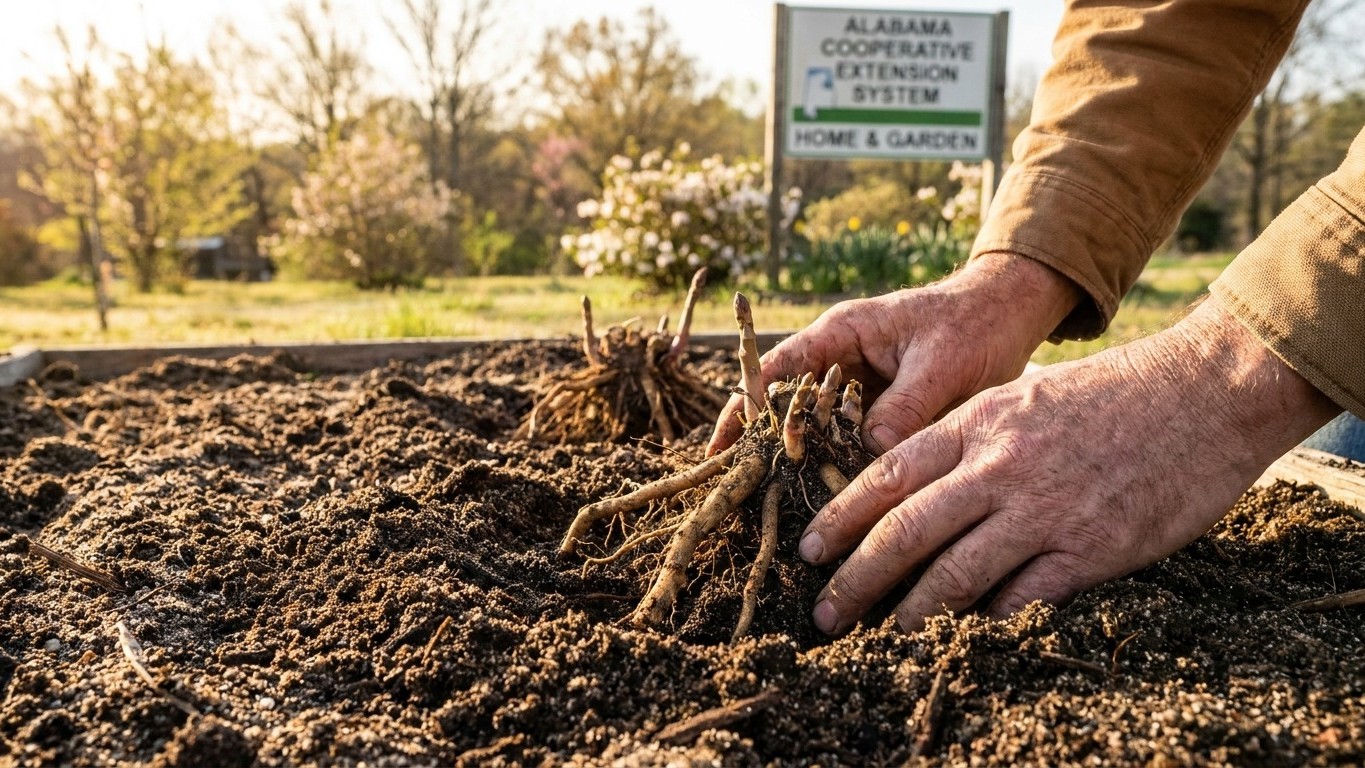

The answer for Prince Edward Island gardeners is straightforward: crowns go into the ground in early spring, timed around the mean last spring frost, which at the Charlottetown A weather station falls around May 16. But that single date only tells you when to dig. What actually decides whether the planting succeeds is what’s underneath the spade, because an asparagus bed isn’t a one-season project. It’s a fixture that will occupy the same patch of ground for 10 to 15 years.
The short answer
Asparagus tolerates most soil types, according to Utah State University Extension, with one non-negotiable requirement: the ground has to drain. That single word carries a lot of weight when the crop in question is staying put for a decade or more. A heavy, slow-draining soil under an annual vegetable is an inconvenience you fix every spring with a new round of compost. Under an asparagus bed, it’s a decision you can’t walk back once the crowns are in the ground and the roots have spread.
Here’s where Prince Edward Island’s ground gets interesting. The most common soil across the province’s mapped agricultural land is a Podzol, the acid soil type that forms under conifer cover as rain leaches minerals out of the topsoil. Texturally, it leans sandy: about 66 percent sand, 27 percent silt, and only 7 percent clay in the surface layer, based on measurements from the Canadian Soil Information Service. Sand usually means quick drainage. Yet the same survey classifies this dominant profile as imperfectly drained, not well drained. That combination, sandy on top but sluggish overall, usually points to something below the surface, a compacted layer, a perched water table, or the shape of the land itself, holding water longer than the texture alone would suggest.
What that means for a gardener eyeing a spot for asparagus: don’t assume drainage from the feel of the soil in your hand. Walk the site after a heavy rain and watch what happens. If water stands for more than a few hours, or the ground stays soggy for days, that’s an imperfectly drained situation working exactly as the provincial data suggests it might. The fix isn’t complicated, but it has to happen before the crowns go in: build the bed up, mound the row, or choose a different part of the yard with a slight slope that lets water move on. Trying to correct drainage after year three, once the crowns have spread their root systems, isn’t realistic.
None of this is a verdict on any one backyard. The provincial figures describe a median across 542 mapped soil components, not the plot behind a specific house. River flats, low ground, and anywhere a builder has scraped or filled the topsoil will behave differently, sometimes completely differently, from the province-wide picture. A basic soil test, or simply an eye on the ground after rain, tells you more about your own patch than any provincial average can.
Once the bed is in and draining well, patience becomes the real test. Utah State University Extension is direct on this point: no harvest at all in the first two years. The third year allows a short four-week cutting window. Extend that to roughly six weeks the year after, and eight weeks once the planting is fully established. The rule for knowing when to stop each season isn’t a date on the calendar. It’s a visual cue: stop cutting once most of the spears coming up are thinner than a pencil, which signals the plant needs to redirect its energy into building next year’s crown instead of feeding you spears.
Will the summer here water it for you?
Rainfall matters just as much as drainage, maybe more, because a young asparagus planting has fairly specific water needs and Prince Edward Island’s summer doesn’t always meet them without help. Here’s how the numbers stack up.
- What the bed asks for, years one and two: the planting wants 1 to 2 inches of water every other week while the crowns are establishing, according to Utah State University Extension.
- What June delivers: Charlottetown A’s 1981-2010 normal for June is 3.89 inches of rain, spread across the month. That’s close to two applications’ worth if it fell evenly, but June rain rarely arrives on a schedule that matches a plant’s biweekly needs.
- What July delivers: July is the driest of the three summer months at 3.15 inches, the point in the season where a young bed is most likely to run short between rain events.
- What August delivers: August brings 3.77 inches, a modest rebound from July but still on the lean side for a planting that’s working hard to establish roots ahead of its first winter.
- The three-month total: across June, July, and August, Charlottetown A averages about 10.8 inches of rain. That’s a reasonable seasonal supply on paper, but it’s not evenly distributed, and on the province’s imperfectly drained but sandy-surfaced ground, a dry stretch in July can dry out a young root zone faster than the monthly average suggests.
- What established beds need, year three onward: once the planting matures, the watering interval stretches to every three weeks, a much lighter demand that PEI’s summer rainfall covers comfortably in most years.
The practical takeaway: don’t assume the sky is doing the job during the first two summers. A rain gauge staked next to the bed is the cheapest tool for knowing whether July’s dry stretch has actually left the soil short, and it beats guessing based on a monthly average that was measured at one weather station and may not match rainfall on your own property.
When to put the crowns in
Crowns go into the ground in early spring, once the soil has thawed and can be worked without turning to mud. On Prince Edward Island, that window is anchored to the mean last spring frost at Charlottetown A, which falls around May 16. The word “around” matters here: a mean date is the midpoint of a range, not a guarantee. In roughly half of all years on record, frost arrives after that date, so treating May 16 as a firm green light rather than the center of a window invites a late cold snap right onto tender new growth.
Utah State University Extension describes the planting method itself: crowns are set into furrows about 8 inches deep. Rather than filling the trench in one pass, the furrow is backfilled gradually across the season, adding roughly 2 inches of soil every other month as the emerging shoots grow taller. That staged backfilling protects the crowns while still letting the young spears reach light and air as they develop.
Crowns aren’t the only starting point. Growing asparagus from seed is the alternative route, though it means raising the plants to crown size before they’re ready for the same 8-inch furrow, adding time to the front end of a project that’s already measured in years rather than weeks. For most home gardeners, buying crowns and skipping that nursery stage is the more direct path to a spring planting.
Whichever route you choose, variety selection on the market comes down mostly to plant sex, at least according to what’s published by Utah State University Extension. Jersey Giant and Jersey Knight are all-male varieties. UC 157 F1 and Purple Passion are male and female. The source doesn’t rank these on flavor, yield, or any other performance measure, and no nursery is named here. The choice among them isn’t settled by published data, at least not the data available through this source, so it comes down to what’s on offer locally and what a gardener wants to try.
Common questions
Can I plant asparagus crowns in fall instead of spring on Prince Edward Island?
The source used for this guide, Utah State University Extension, specifies early spring planting for crowns and doesn’t address a fall planting option. Given how close the province’s growing season runs to its frost windows, spring planting gives the crowns the longest possible stretch of open ground before winter returns.
How do I know if my soil drains well enough for asparagus?
Watch a patch of ground after a heavy rain. If water stands for hours or the soil stays waterlogged for days, drainage is a problem worth solving with raised beds or a different site before you commit 10 to 15 years to that spot. PEI’s dominant provincial soil profile is classified as imperfectly drained despite its sandy texture, so a visual check matters more than assuming texture equals drainage.
Why can’t I harvest asparagus the first two years?
The plant needs those first two seasons to build a strong root and crown system underground. Cutting spears too early robs the plant of the energy it needs to establish itself, which is why Utah State University Extension holds off any harvest until the third year, and even then limits it to about four weeks.
What’s the soil pH asparagus needs, and does PEI soil match it?
The Utah State University Extension source used here doesn’t publish a pH requirement for asparagus, so no comparison to Prince Edward Island’s provincial soil pH is offered in this guide. A local soil test remains the most reliable way to check pH for a specific garden site.