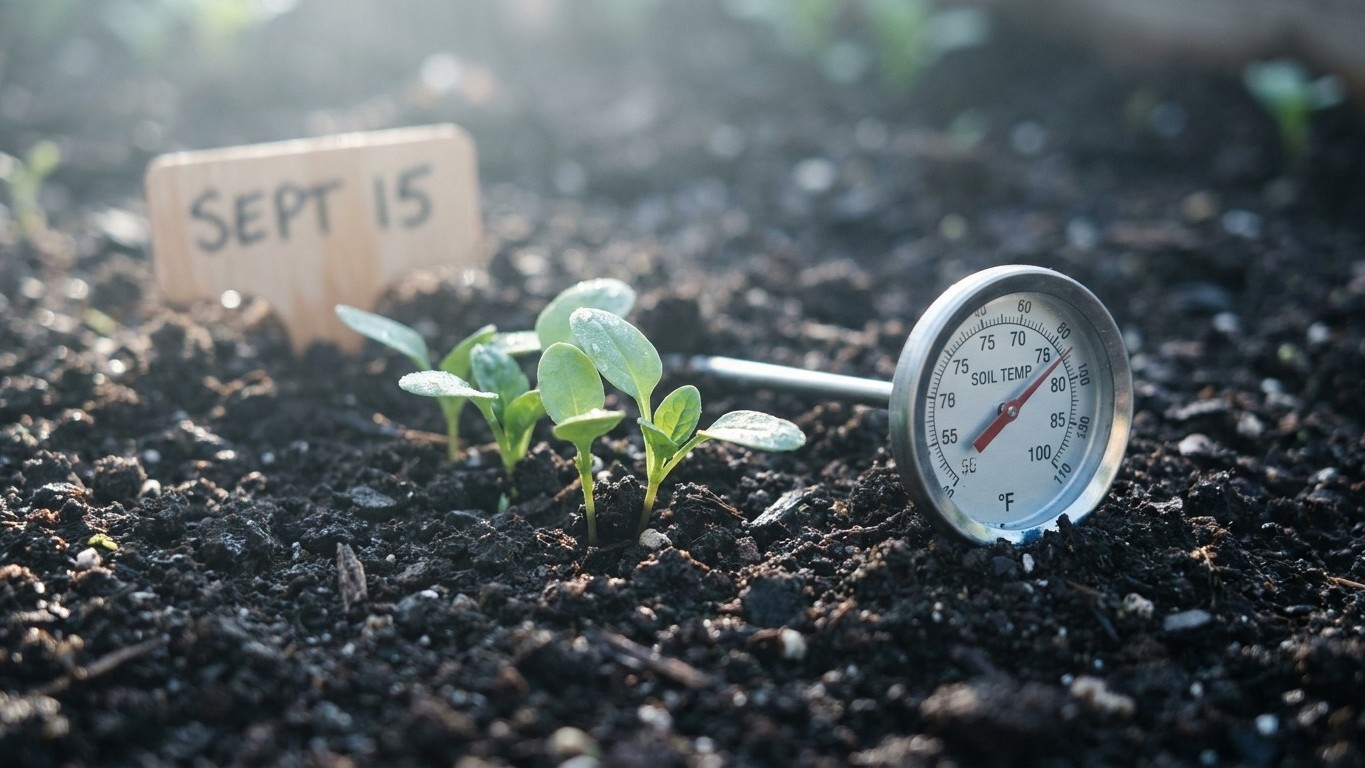

Rhode Island gardeners can Sow Autumn Spinach roughly from early August through mid-September, timed by counting back 50 to 75 days from a target harvest set ahead of the first fall frost, which arrives at the reference station between October 24 and November 3. The real obstacle at that end of the calendar isn’t cold at all. It’s warm soil: spinach seed germination drops once soil temperature climbs above 80°F, so the true opening of the fall window depends on when the ground finally cools, not on a date circled on a calendar.
The short answer
On the longest day of the year, Providence gets 15 hours and 2 minutes of daylight. For most vegetables that sounds like a bonus. For spinach it’s closer to a warning label. Bolting, the shift from producing tender leaves to throwing up a flower stalk, is triggered by day length just as much as by heat. A day that stretches past 15 hours pushes a spinach plant toward flowering whether the thermometer is friendly or not, which means a mild Rhode Island summer doesn’t hand gardeners a few free extra weeks the way it might with a crop that’s only fighting temperature.
Heat piles on top of that. The reference station averages 9.4 days a year at 90°F or hotter, and spinach growth quality already falls apart once temperatures push past 75°F, a threshold that also marks where the leaves start turning bitter. So the honest answer to “what’s holding spinach back here” is both mechanisms at once. Day length does the early damage as the solstice approaches in June, and heat finishes the job through midsummer. Neither one waits for the other; they overlap.
That’s why spinach in Rhode Island is really a two-season crop, not a one-shot planting. There’s a spring run that has to get established and finish before the days lengthen and the mercury climbs, and there’s a second, autumn run that has to wait for the soil to cool enough to germinate but still finish before frost shuts things down. Neither window is generous. Both reward gardeners who plant by counting backward from a limit, rather than by guessing forward from a start date.
Framed that way, the calendar question answers itself: sow spring spinach as early as frost risk allows, and Sow Autumn Spinach as late as the coming frost allows, while making sure the soil has actually cooled enough for the seed to sprout. Everything else is detail on those two constraints.
How long the spring window really is
- Starting point. Spinach seed can go in the ground about two to three weeks before the average last spring frost, since the crop tolerates a light freeze far better than heat.
- Local last frost. At the reference station near Providence, that average last frost falls between April 7 and April 17. Counting back two to three weeks puts a realistic outdoor sowing date in the second half of March for most of the state, though rural and higher-elevation gardens should expect that date to arrive later, sometimes by a week or two.
- When good growth ends. Spinach keeps making usable leaves only while temperatures stay under that 75°F ceiling. As the season moves from late spring into early summer, days lengthen toward the June solstice and afternoons warm past that mark with increasing frequency, and the plant responds by bolting rather than filling out.
- Net usable window. Put together, that leaves roughly eight to nine weeks of dependable spring growing in most of Rhode Island, from late March sowing to a finish somewhere before the solstice pushes day length and heat past what the plant tolerates. It’s a workable window, but not one with much slack for a late start.
Succession sowing every week or two inside that stretch is the standard way to stretch a harvest across the spring window rather than getting one big flush that all bolts at once.
The autumn crop, and when the soil lets you sow
The fall crop flips the spring problem on its head. Instead of racing day length and heat forward, the gardener is working backward from a frost that will eventually end the season, while waiting for soil that’s still carrying summer’s heat to finally cool down enough to sprout seed.
Soil still too warm to germinate
Germination falls off once soil temperature climbs above 80°F, and early August soil in Rhode Island is often still holding that heat, especially after a summer that averages 9.4 days at 90°F or hotter. That’s the real reason autumn spinach sowing tends to cluster later than gardeners expect. Rather than treating early August as an automatic start date, it makes more sense to check soil directly, water heavily before sowing to pull temperature down, or simply wait until a stretch of cooler nights has taken the edge off the ground. Shade cloth over a freshly sown bed for the first week can also buy a few useful degrees.
The frost that ends the season
At the reference station, first fall frost typically lands between October 24 and November 3, though suburban and rural gardens away from the airport station often see frost arrive a week or two earlier, and more than that at elevation. Counting back 50 to 75 days from a harvest target set just ahead of that frost gives a sowing window running from roughly August 10 through mid-September, depending on which end of the frost range and which end of the 50-to-75-day range a gardener plans around. Sowing on the earlier side of that window gives more cushion against an early frost; sowing later trims closer to it but gives the soil more time to cool first.
Four spinach varieties commonly grown in home gardens, Bloomsdale, Melody, Teton, and Olympia, are named by Utah State University Extension without published days-to-maturity or heat-tolerance figures for any of them. That means variety choice isn’t where the timing math comes from here; the 50-to-75-day harvest count and the soil-temperature check are the two numbers that actually govern when to sow.
Common questions
Can I sow spinach in summer to skip the wait for cooler soil?
Sowing during the hottest stretch of summer runs straight into the germination problem: soil above 80°F simply won’t sprout seed reliably, so a July sowing usually fails or comes up sparse no matter how good the seed is.
Does shade cloth actually help autumn germination?
Shading a bed lowers surface soil temperature by keeping direct sun off it, which can be enough to nudge soil under the 80°F threshold a week or two earlier than it would drop on its own, though it won’t overcome a genuinely hot stretch of weather.
Is there a hard-freeze date I should plan around instead of the first frost?
The published figures here only cover the 32°F frost window for the reference station, October 24 to November 3; no separate hard-freeze threshold is available, so treat that frost range itself as the line to count backward from.
Why does spinach bolt even in a cool Rhode Island summer?
Because day length, not just heat, drives bolting. At over 15 hours of daylight on the longest day, Rhode Island summers push spinach toward flowering regardless of how mild the temperatures feel, which is why the plant doesn’t get a break just because a particular summer runs cooler than usual.