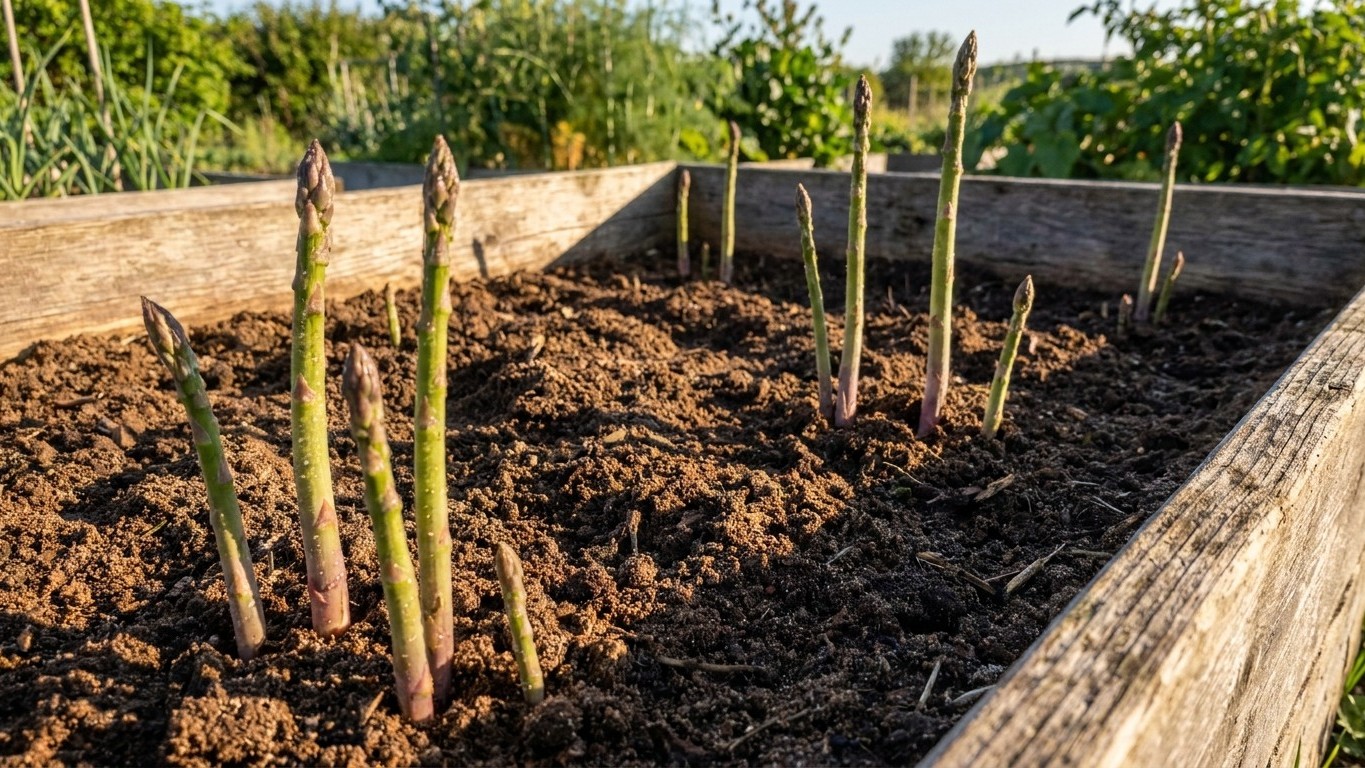

Yes, in most of South Dakota, but the state’s own soil survey data draws a line: an Asparagus Bed only asks for drainage, and not every acre in the state clears that bar. The dominant series, the Houdek, does drain well. What decides the fifteen-year question isn’t the state average, though. It’s the specific patch of dirt a gardener is about to commit to for a decade or more.
The short answer
South Dakota’s official state soil is the Houdek series, a Mollisol, the deep, dark prairie soil that built the Corn Belt. Its surface horizon runs close to neutral, about pH 6.7, with a texture that USDA describes as 38 percent sand, 22 percent clay and 40 percent silt, and organic matter around 3.0 percent. The state legislature named it the official soil in 1990, and USDA NRCS lists it as well drained. That last word is the one that matters here.
Asparagus, according to Utah State University Extension, is planted as crowns and stays in the ground producing for ten to fifteen years once it starts. That’s a commitment few other vegetables ask a gardener to make. A bed of lettuce that turns out to sit in a soggy corner gets replanted somewhere else next season. an Asparagus Bed doesn’t get that second chance without tearing out a decade of growth. So the single question worth answering before the first crown goes in the ground isn’t pH, isn’t fertility, isn’t even sun exposure. It’s whether the water that falls on that spot leaves again within a reasonable time.
The Houdek series, on paper, does that job. A loam-to-silt texture with only 22 percent clay doesn’t hold water the way a heavy clay pan does, and the state soil’s well-drained rating reflects that. If a garden happens to sit on ground close to this profile, drainage isn’t the thing to lose sleep over.
But a state soil describes hundreds of square miles, not one backyard. South Dakota spans river bottoms along the Missouri, hill country in the west, and plenty of suburban lots where a builder’s grading equipment scraped off the original topsoil and left compacted subsoil or fill dirt behind. None of those match the Houdek profile, and some of them hold water for days after a rain. The state soil is a starting point, not a diagnosis of one garden.
The practical fix is simple and doesn’t require a lab: dig a hole about a foot deep where the bed is planned, fill it with water, and watch how fast it drains. Standing water after several hours points to a spot that won’t suit a fifteen-year planting without help. Raising the bed, or working substantial organic matter into a wide area beforehand, are the usual answers. What isn’t a good answer is planting anyway and hoping the crowns adjust. Asparagus crowns that sit in wet soil over winter tend to rot, and a rotted crown doesn’t announce itself until spring, when nothing comes up.
Will the summer here water it for you?
Utah State University Extension’s guidance is specific about water: a new bed wants 1 to 2 inches every other week through its first two years, then eases back to about 1 to 2 inches every three weeks once established. South Dakota’s own summer doesn’t hand that over automatically, and the shortfall shows up mostly in one month.
- Total summer rainfall. NOAA’s 1991-2020 normals for the reference station put June, July and August combined at about 10.8 inches, out of 27.9 inches for the full year. Spread evenly, that’s a reasonable base to work from.
- Month by month, it isn’t even. June averages 4.23 inches, July drops to 3.25 inches, and August climbs back slightly to 3.34 inches. July is the driest of the three, and it’s also the month a young bed still needs its every-other-week soaking.
- Do the arithmetic against the bed’s own schedule. A young bed asking for 1 to 2 inches every two weeks needs roughly 2 to 4 inches a month. June’s 4.23 inches covers that on its own in most years. July’s 3.25 inches sits right at the low end, or under it, depending on how the rain actually falls.
- Rain that falls all at once isn’t rain that soaks in. Summer precipitation in this region tends to arrive as thunderstorms rather than steady drizzle, and a hard downpour on well-drained, silt-heavy ground runs off or percolates through fast rather than sitting in the root zone where the plant can use it.
- A mature bed has more slack, but not unlimited slack. Once past year two, the bed’s own demand drops to 1 to 2 inches every three weeks, roughly 1.3 to 2.6 inches a month. Every summer month on the books clears that bar on paper. The real-world gap still shows up during a dry stretch in July, especially on a well-drained soil that doesn’t hold reserve moisture long.
- The working rule for a new bed: treat June as mostly covered, watch July closely, and plan to run a hose or drip line at least once during that month in a typical year. A rain gauge staked in the actual garden, not a station average, is what tells a gardener whether that year needs the extra water or not.
When to put the crowns in
Crowns go into the ground in early spring, and for South Dakota that means working around the last spring frost, which NOAA’s 1991-2020 normals put at around April 29 to May 9 for the reference station. That’s a mean date built from three decades of records, not a promise for any single spring, and gardens outside town, especially at elevation or in low-lying frost pockets, often see frost linger later than that window suggests. The safest approach is to hold off on planting crowns until that window has passed for a given county, and to check a local extension office’s frost guidance rather than lean on the reference-station figure alone.
Utah State University Extension describes an 8-inch furrow as the planting method: the crown sits at the bottom, and the furrow gets backfilled gradually, adding about two inches of soil every other month across the season rather than filling it in all at once. That gradual fill gives the emerging shoots room to push through loose soil rather than fighting their way up through several inches of compacted fill on day one.
Seed is the alternative route, though it isn’t the one the extension source details step by step here. What is clear is that seed-grown asparagus takes longer to reach a harvestable crown than starting with a purchased crown does, since the plant has to build that root system from scratch rather than arriving with two years of growth already banked. For a gardener working toward the ten-to-fifteen-year harvest window, crowns are the faster path to that first cutting.
On variety, the published record is narrow. Utah State University Extension names four: Jersey Giant and Jersey Knight, both all-male hybrids, and UC 157 F1 and Purple Passion, both male-and-female types. That’s the extent of what’s documented, sex only.
| Variety | Sex type |
|---|---|
| Jersey Giant | All-male |
| Jersey Knight | All-male |
| UC 157 F1 | Male/female |
| Purple Passion | Male/female |
No flavor comparison, yield figure, or reason to favor one over another appears in that source. A gardener choosing between them is choosing on sex type alone as far as the published guidance goes, and any other claim about taste or productivity isn’t backed by this reference.
Common questions
How soon can a South Dakota gardener cut the first spear?
Not in the first year, and not in the second. Utah State University Extension is direct on this: no harvest happens until year three. Cutting earlier weakens the crown before it has built the reserves to support years of future growth.
How long does the harvest window run once it starts?
It builds gradually rather than opening all at once: about four weeks of cutting the first harvest year, then six weeks, then eight weeks in following years. The stopping point each season isn’t a date on a calendar. It’s an object: once most of the spears coming up are thinner than a pencil, harvest stops for that year, letting the plant put its energy into foliage instead.
Does the soil pH need adjusting before planting?
The extension source used here doesn’t publish a pH requirement for asparagus, so no specific number is given. A soil test through a local extension office is the way to get an actual reading for a given garden rather than borrowing the state soil’s surface pH, which describes the Houdek series generally and not any one cultivated bed.
What if a soil test shows poor drainage after all?
Raised beds are the standard workaround, since they let a gardener build a well-drained profile above ground rather than fighting native soil that holds water. Working in organic matter across a wide planting area before crowns go in also helps, though a truly poor-draining site is one worth reconsidering altogether given how long the planting is meant to last.