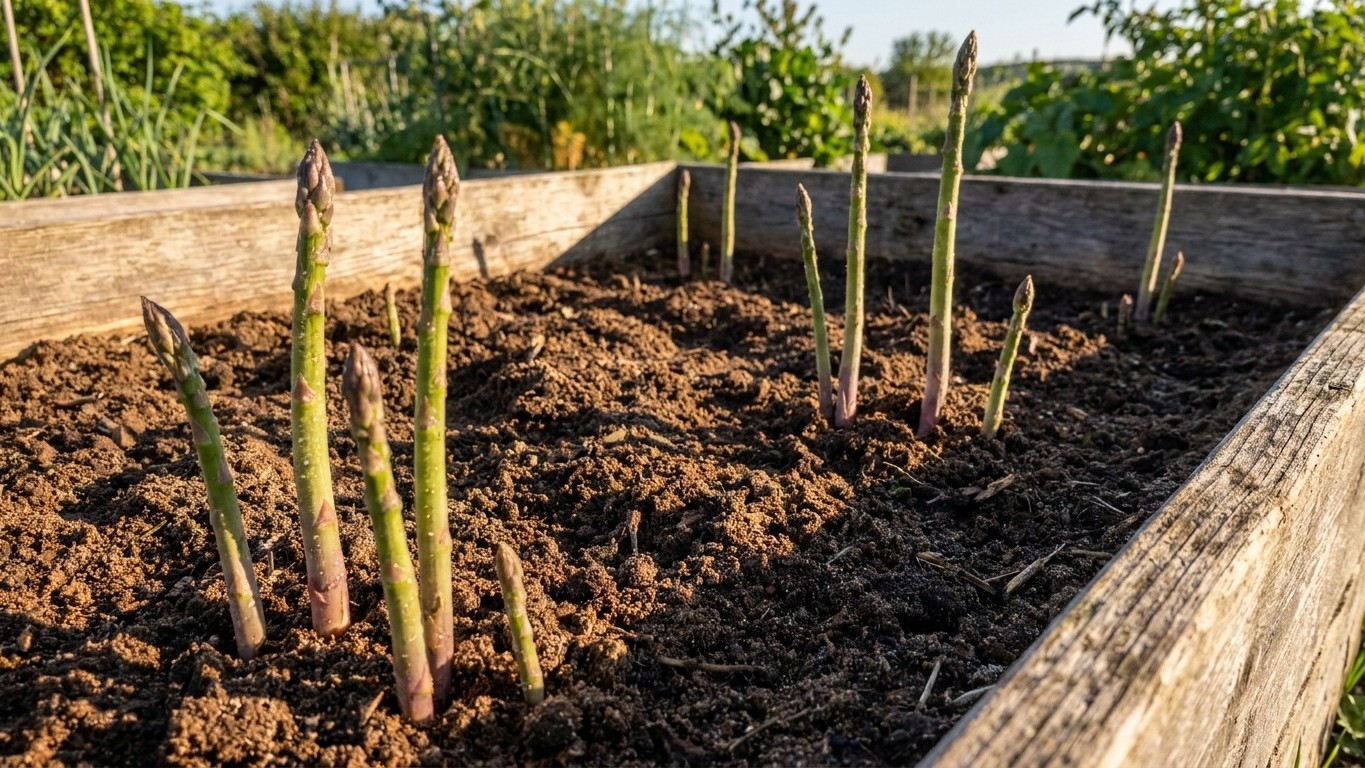

Yes, in most cases, but the answer hinges entirely on drainage, not on the state soil chart. Tennessee’s representative ground, the Dickson series, is a silt-heavy loam that USDA classifies as moderately well drained. Asparagus asks for one thing from the ground it sits in for a decade or more: that water not pool around the crown. If a bed sits wet, it fails long before year fifteen, no matter how carefully anything else was done.
The short answer
Asparagus is a crop with a peculiar demand: pick a spot and you are picking it for 10 to 15 years, according to Utah State University Extension. There is no annual do-over, no rotating to a different bed next season the way a gardener might with tomatoes or beans. That single fact changes how much the soil question matters. A heavy, slow-draining patch is an inconvenience in a vegetable bed planted fresh each year. In an asparagus bed, it is a decision that follows the gardener for well over a decade.
The Dickson series, which USDA NRCS lists as representative of Tennessee, runs about 11 percent sand, 20 percent clay and 68 percent silt in its surface horizon, with organic matter around 1.5 percent and a surface pH near 5.0, which is strongly acid. That texture, heavy on silt with a meaningful slice of clay, is not the loose sandy loam that drains in minutes after a storm. But “moderately well drained” is the operative phrase from USDA’s own data, and it means water moves through, just not instantly. For asparagus, whose only published requirement is soil that drains, that is generally enough.
The state soil is a starting point, not a diagnosis of one garden. Dickson soils represent a broad mapped average across the state; a particular yard could sit on river-bottom clay that holds water for days, on rocky hillside ground that drains almost too fast, or on fill dirt a builder pushed around during construction, none of which behaves like the mapped series at all. That is why the number that actually matters is not on any state chart. It is what happens in the specific spot a gardener is eyeing, twenty minutes after a hard rain.
The test for that is almost embarrassingly simple: dig a hole about a foot deep, fill it with water, and watch. If the water is gone within a few hours to about a day, the ground drains well enough for a fifteen-year asparagus bed. If it is still standing the next morning, the site needs help before crowns go in, not after.
Where drainage is marginal, the fix is not a soil additive poured in once. It is elevation. Building the bed as a raised mound, even a modest one, lifts the crown zone above the water table that pools in the surrounding soil after storms. Raised beds and berms are the standard answer wherever the native ground runs heavy, and for a crop that stays put for over a decade, that upfront grading work is far cheaper than replacing a failed bed in year six.
Will the summer here water it for you?
Asparagus has a two-stage watering rule, and neither stage matches what a Tennessee summer delivers on its own. For the first two growing seasons, the bed wants 1 to 2 inches of water every other week while the crowns build the root system that will carry them for the next decade. After that establishment period, the schedule relaxes to roughly the same amount every three weeks. Here is how that lines up against what actually falls from the sky, based on 1991-2020 climate normals for a reference station in the state:
- June averages 4.36 inches of rain, which is close to what a young bed needs across the month if that rain arrives evenly rather than in one or two big storms.
- July brings 4.16 inches on average, again roughly matching the every-other-week target on paper, though a week of dry heat followed by a single downpour is not the same as steady soaking.
- August is the driest of the three, averaging 3.79 inches, and that is the month most likely to leave a young bed short of what it needs without a hose.
- Across the whole summer, the three months add up to about 12.3 inches, against roughly 12 inches of target watering for an establishing bed spread over the same period, so on paper the totals are close.
- Totals rarely mean even delivery. Rain in this region tends to arrive as thunderstorms rather than gentle multi-day soaks, and a single heavy storm dumps water that runs off a silt-heavy Dickson-type soil faster than it soaks into the crown zone.
The practical upshot: a gardener should not assume the sky is handling irrigation just because the seasonal averages look adequate. A rain gauge staked next to the bed is the only honest way to know whether a given two-week stretch met the target, and a soaker hose on hand for the dry weeks, August especially, keeps a young bed from stalling in its most vulnerable seasons. Once the bed is past its second year and the schedule eases to every three weeks, summer rainfall alone comes much closer to covering the need on its own, though a dry August is still worth watching.
When to put the crowns in
Crowns go into the ground in early spring, and in Tennessee that window sits around the last spring frost date, which for a reference station in the state runs from March 31 to April 12, per NOAA NCEI 1991-2020 climate normals (source). That is a mean date built from thirty years of freeze probabilities, not a fixed calendar entry, so “around” is the honest word here rather than a guarantee tied to any specific date. East Tennessee and the Cumberland Plateau run cooler and later than the middle of the state, so a gardener up in that higher country should lean toward the later end of the window, or later still, rather than planting to match a date recorded lower down.
The planting method itself is specific: crowns are set into furrows about 8 inches deep, then the furrow is backfilled gradually across the season, adding roughly 2 inches of soil back over the crowns every other month rather than filling the trench in one pass. That staged backfill lets the emerging shoots keep reaching sunlight as the trench fills, instead of being buried under a foot of soil on planting day.
Seed is the alternative route, and it is a slower one. Starting from seed pushes the harvest timeline back further than starting from crowns, since the plant needs an extra season of growth before it reaches crown size. For a bed meant to produce for a decade or more, most gardeners weigh that extra year against the lower cost of seed and decide based on how much waiting they are willing to do before the first real harvest.
On variety, Utah State University Extension names four without ranking them by flavor, yield, or any other performance measure: Jersey Giant and Jersey Knight, both all-male types, and UC 157 F1 and Purple Passion, both male and female. No reason to prefer one over another is published by that source, and no nursery recommendation is offered here either. The choice comes down to what is available locally and what look the gardener wants, since Purple Passion, produces purple-tinted spears rather than the standard green.
Whichever variety or method is chosen, the harvest clock does not start on planting day. No spears are cut in the first year at all. Year three brings the first harvest, limited to about 4 weeks. Year four extends that to about 6 weeks, and year five to about 8 weeks. Every season after that, harvest stops not on a calendar date but when most of the spears coming up have gone thin, roughly pencil-width or narrower, which signals the plant needs to shift back into building energy for next year rather than continuing to be cut.
Common questions
Does Tennessee’s soil pH need to be adjusted before planting asparagus?
The Utah State University Extension source used for this article’s planting guidance is silent on soil pH for asparagus, so no target number is given here. The Dickson series does show a strongly acid surface pH near 5.0, and a standard soil test from a local extension office is the way to find out where a specific plot actually stands before planting.
Can an asparagus bed go into raised soil instead of the native ground?
Yes, and where a drainage test shows standing water lingering overnight, a raised bed or mounded row is the standard fix, since it lifts the crown zone above the wetter soil below rather than asking the native ground to drain faster than it naturally does.
How much winter cold does asparagus need in Tennessee?
This is not published in the sources behind this article. No chilling-hour figure or dormancy requirement is given for asparagus here, and none should be assumed from the state’s hardiness zone alone.
Is one of the four named asparagus varieties better for Tennessee specifically?
No preference is published by Utah State University Extension among Jersey Giant, Jersey Knight, UC 157 F1, and Purple Passion beyond noting their sex type (all-male versus male and female). No flavor, yield, or regional-suitability comparison is offered in that source.