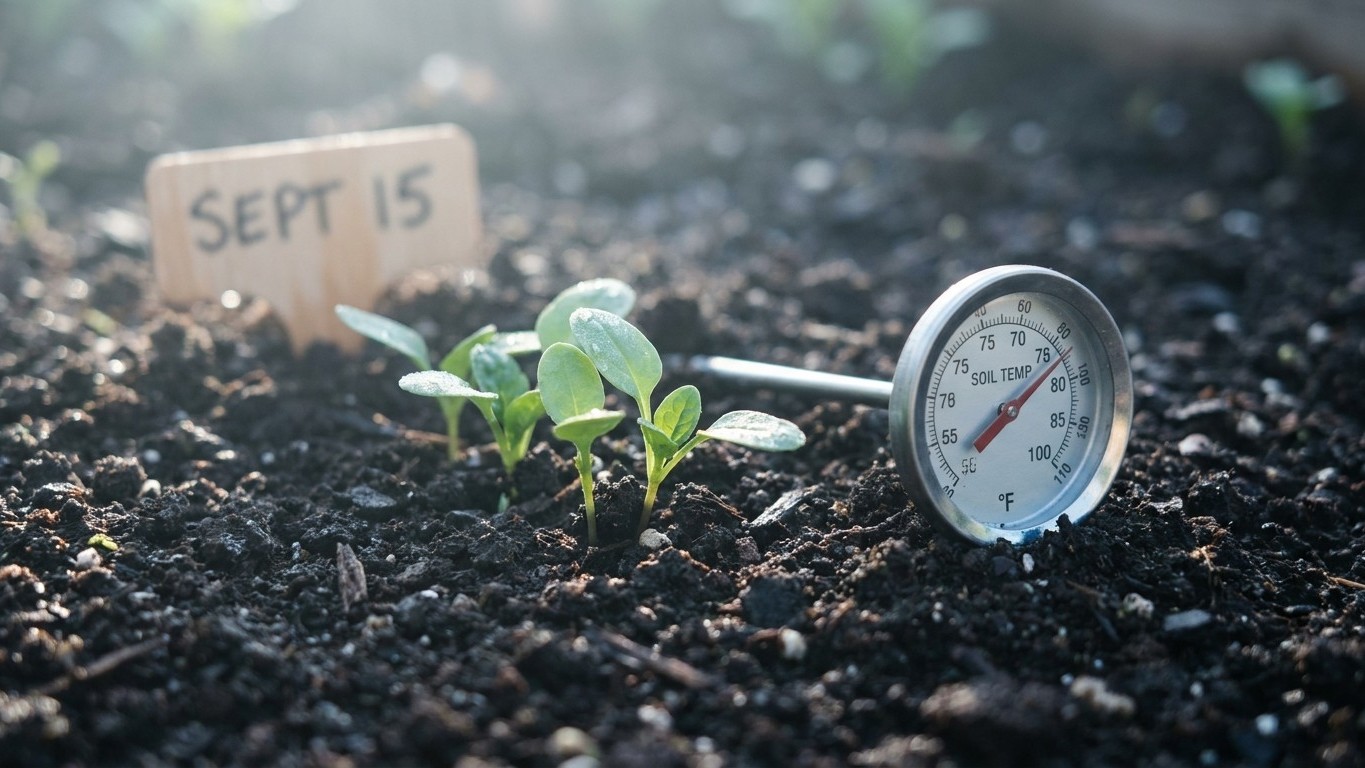

The reliable sowing window for autumn spinach in the Houston area runs from mid-September into late October, once soil temperatures start easing back down from summer highs. That timing is built by working backward from the first fall frost (December 1 to December 19) and counting 50 to 75 days to harvest. Get the soil temperature wrong, though, and none of that math matters.
The short answer
On the longest day of the year, the Houston area logs 13 hours and 56 minutes of daylight. That number matters more than most gardeners expect, because spinach bolts under long days combined with warm temperatures. A cool summer wouldn’t rescue a spinach crop planted in June even if one existed here, because the day length itself is part of what triggers flowering, not just the heat. But Houston doesn’t offer a cool summer to test that theory against. It offers 102.4 days a year at 90°F or hotter, according to NOAA NCEI climate normals for the reference station. That’s a heat load few cool-season crops survive, spinach included.
So which is the limiting factor, day length or heat? Here, it’s both, and they arrive together. Spinach grows best where temperatures stay under 75°F, and that ceiling isn’t just about survival, it’s also a bitterness threshold. Push a spinach plant past that mark and even if it doesn’t bolt outright, the leaves turn sharp and unpleasant. Houston’s long midsummer days line up almost exactly with its hottest stretch, so the two pressures reinforce each other instead of offsetting one another. There’s no version of a Houston June or July where spinach thrives.
That’s why the two usable seasons here, spring and autumn, both sit in the narrow bands where day length is moderate and temperatures haven’t yet crossed 75°F. Miss either window and the plant either bolts to seed or the soil simply won’t let seed germinate in the first place.
One caution worth repeating: Texas spans four USDA hardiness zones, and every figure here comes from the Houston reference station (IAH), representing the mild Gulf Coast end of the state. The Panhandle sees frost months earlier in autumn and months later in spring. Hill Country and North Texas run on their own separate calendars. Even inside the Houston metro, Hobby Airport typically runs about two weeks milder than IAH. None of the dates in this article should be applied outside the Gulf Coast region without adjustment.
How long the spring window really is
Working out the usable spring window means starting from the last frost date and tracking forward until the heat ceiling closes things down. Here’s how that math plays out for the Houston area:
- The last spring frost at the reference station falls somewhere between February 4 and March 1, based on NOAA’s 1991-2020 climate normals for a 30-70% freeze probability band.
- Spinach seed is typically sown 2 to 3 weeks before that last frost date, which puts the earliest sowing somewhere in mid-to-late January.
- From that sowing point, the plant needs to grow and mature before regular temperatures push past the 75°F ceiling where growth quality and flavor both decline.
- Given that Houston averages 102.4 days a year at 90°F or above, the ramp from mild winter temperatures into serious heat happens fast, usually compressed into just a few weeks once spring arrives in earnest.
- That leaves a spring window best measured in weeks, not months. The exact crossover date into 75°F-plus conditions isn’t published in the source data used here, but the heat-day count alone signals a short runway, one reason spring spinach in this region is often described as a race against the calendar rather than a leisurely crop.
The practical takeaway is that spring spinach in Houston isn’t a set-it-and-forget-it crop. It’s an early-and-fast proposition, sown while frost risk still lingers because the heat risk arrives so much sooner.
The autumn crop, and when the soil lets you sow
Autumn flips the constraint. Frost isn’t the enemy waiting at the start of the season, it’s the one waiting at the end. The obstacle blocking an early autumn sowing is warm soil, not cold air.
Soil too warm to germinate
Spinach seed germination drops once soil temperatures climb above 80°F, according to Utah State University Extension. In a region logging 102.4 days a year above 90°F in the air, soil temperatures lag behind but stay elevated well into what feels like autumn on the calendar. Practically, that means early September sowing dates are risky here even though the calendar suggests fall has arrived. Waiting until the heat load genuinely breaks, typically as September progresses toward October, gives seed a realistic chance to sprout instead of sitting dormant or rotting in soil that’s still summer-hot.
Counting back from first frost
The first fall frost at the reference station arrives between December 1 and December 19. Utah State University Extension’s guidance for a fall crop is to sow 50 to 75 days before the harvest date you’re aiming for. Counting back from early December gives a sowing date around mid-to-late September; counting back from a harvest closer to December 19 pushes sowing into late October. Combine that with the soil-temperature constraint above, and the realistic practical window for the Houston area narrows to roughly late September through late October, sown late enough that soil heat has broken, but early enough that the plant reaches harvest size before hard frost ends the season.
Four spinach varieties are commonly named in extension guidance: Bloomsdale, Melody, Teton, and Olympia. No days-to-maturity figures or other performance data for any of these four are published in the source used here, so none should be assumed. Whatever variety a gardener chooses, the sowing math above, soil below 80°F, harvest 50 to 75 days out, before first frost, applies regardless of which of the four is in the packet.
Common questions
Can spinach be sown in a Texas summer if I water it well?
No. Watering addresses drought stress, not bolting. Bolting is triggered by long days combined with warm temperatures, and Houston’s summer delivers both simultaneously. Irrigation won’t change day length or the 75°F growth ceiling.
What if soil is still warm in mid-September?
Wait. Germination drops once soil passes 80°F, and sowing into overheated soil usually means poor or no germination rather than a slow start. It’s worth delaying a couple of weeks rather than sowing into soil that hasn’t cooled.
Is the spring or autumn window better for spinach in this region?
Autumn tends to be the more forgiving of the two, since the season ends with a frost date rather than a fast-arriving heat wall. Spring sowing has to outrun rising temperatures, while autumn sowing mainly needs the soil to cool before seed goes in.
Does this timing apply across all of Texas?
No. These dates come from the Houston reference station, representing the mild Gulf Coast end of a state that spans four USDA hardiness zones. The Panhandle, Hill Country, and North Texas all run on different frost calendars, sometimes by months in either direction.