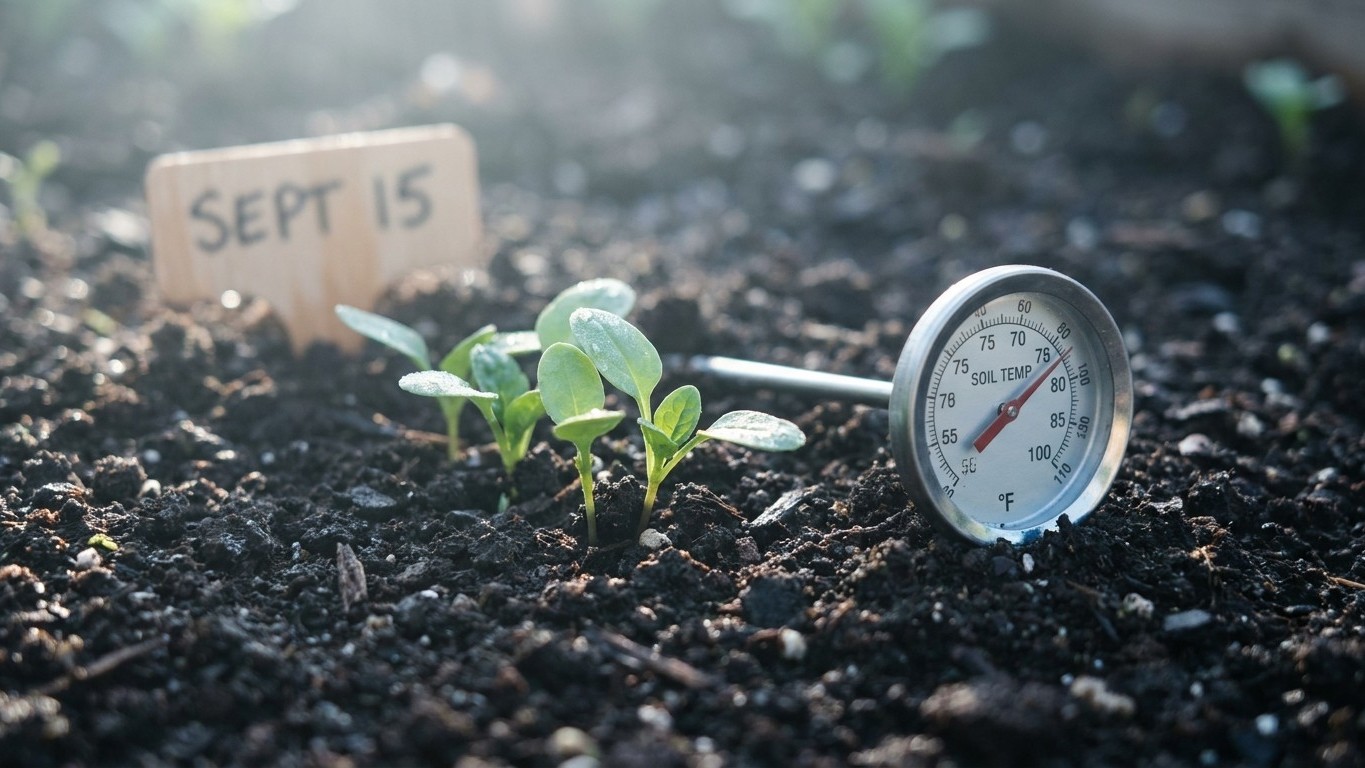

In western Washington, Sow Autumn Spinach roughly from the last days of August through early October. That window comes from counting back 50 to 75 days from the region’s first fall frost, which typically lands between November 13 and November 30. Get the timing right and you’re harvesting through fall; get it wrong and the crop either won’t germinate or won’t finish before the cold sets in.
The short answer
On the longest day of the year, the Seattle area logs 15 hours and 45 minutes of daylight. That number matters more than most gardeners realize, because spinach bolts during long days and warm temperatures together. A cool, mild summer here does not buy extra growing weeks the way it might for other crops, because day length alone is enough to push spinach toward flowering once the calendar rolls past the solstice. The plant doesn’t wait around to see if the thermometer cooperates.
That’s worth sitting with, because western Washington’s summers are genuinely mild. The reference station logs an average of just 3.0 days a year at 90 F or hotter. Compare that to inland regions that bake for weeks on end, and it’s tempting to assume spinach here should sail through summer with no trouble. It doesn’t, and the reason isn’t heat. Spinach grows best where temperatures stay below 75 F, and while western Washington rarely blows past that ceiling by much, the bigger constraint is the light itself. Long days trigger bolting whether or not the air feels like summer.
So which is it, heat or day length? Here, the answer leans hard toward day length. The region’s mild heat load means spinach isn’t fighting off scorching afternoons the way it would in a continental climate. But the sun sitting up in the sky for nearly 16 hours a day in June does the same job that a heat wave would do elsewhere: it tells the plant to stop making leaves and start making seed. That’s why the spring crop has a hard stop well before the actual hot weather arrives, and why the entire autumn strategy in this region is built around dodging that long-day window rather than dodging heat.
This distinction shapes everything that follows. A gardener in a hot, dry climate times autumn spinach around when the soil finally cools off. A gardener here has milder soil to work with, but a narrower slice of the calendar where day length stays short enough and temperatures stay mild enough at the same time. The autumn planting has to slip into that gap: after the days have shortened enough to stop triggering bolting, but early enough that there’s still 50 to 75 days of growing time left before frost shuts things down.
How long the spring window really is
Spinach seed goes in 2 to 3 weeks before the last frost, and growth quality falls apart once temperatures climb past 75 F. Working through the western Washington numbers step by step shows just how tight that spring opportunity actually is.
- The region’s last spring frost falls somewhere between February 27 and March 18, based on NOAA’s 30-year climate normals for the area. Counting back 2 to 3 weeks puts the theoretical earliest sowing date in early to mid-February.
- In practice, that early date is mostly theoretical. Cold, saturated soil and short winter daylight in western Washington slow germination and early growth well past the point where the calendar alone would suggest planting is possible. Most gardeners end up sowing closer to the actual last frost date, not weeks ahead of it.
- From that point, spinach has a runway of roughly 10 to 12 weeks before two things converge: day length approaches the June solstice peak of 15 hours 45 minutes, and temperatures start bumping against that 75 F growth ceiling.
- Because the region logs only about 3 days a year above 90 F, the heat side of that equation stays mild. The day-length side does not. By late May and into June, the days are long enough on their own to push spinach toward bolting, regardless of how comfortable the temperature feels.
- The practical result: the spring window in western Washington runs from roughly mid-March through late May or the first days of June. That’s a usable window of about 10 to 12 weeks before the crop needs to be finished, pulled, or replaced with something else for summer.
The autumn crop, and when the soil lets you sow
Autumn spinach faces two separate obstacles, and they sit at opposite ends of the season. One blocks germination in late summer. The other ends the growing season outright once winter arrives.
Soil still too warm to germinate
Spinach seed germinates poorly once soil temperatures climb above 80 F, according to Utah State University Extension. In many hot, dry climates this is the dominant obstacle for fall sowing, since soil there can hold summer heat well into September. Western Washington has an easier time on this front. With only about 3 days a year reaching 90 F in the air, soil rarely bakes hard enough or long enough to keep germination suppressed for long stretches. That said, late July and early August soil can still run warm enough to slow things down, particularly in raised beds or sunny, south-facing plots that heat up faster than open ground. A light mulch or afternoon shade during that stretch can help seed germinate more evenly.
The frost that ends the season
The other boundary is fixed and unforgiving: the first fall frost, which arrives in western Washington between November 13 and November 30. Working backward from that window using the 50-to-75-day rule gives a clear planting range. Counting back 75 days from November 13 lands on August 30. Counting back 50 days from November 30 lands on October 11. In practice, most gardeners split the difference, sowing between late August and the first couple weeks of September to leave a comfortable margin rather than cutting it close to either edge of that frost window.
Four spinach varieties commonly come up in extension guidance for fall planting: Bloomsdale, Melody, Teton, and Olympia. Utah State University Extension doesn’t publish days-to-maturity or performance data for any of these specific varieties, so there’s no verified figure to compare them by here. Choosing among them comes down to what’s available locally and what other gardeners in the region have had success with, rather than a published number.
One more note for anyone gardening east of the Cascades: this entire timeline, the frost dates, the daylight hours, the mild heat load, describes western Washington’s maritime climate. Eastern Washington is high desert with a much shorter, harsher season, and applying this same calendar there would set a fall crop up to fail. Gardeners on that side of the state need frost and heat data specific to their own region, which isn’t part of what’s published here.
Common questions
Can I sow spinach in western Washington in July for a fall crop?
It’s possible, but risky. Soil temperatures in July can still run warm enough to slow germination, and a July sowing may mature into the long-day stretch of late summer that pushes plants toward bolting rather than steady leaf growth. Late August tends to give more reliable results.
Does the mild western Washington summer mean I can grow spinach straight through July and August?
No. Even though heat load is low here (just 3 days a year above 90 F), day length near and after the June solstice is long enough on its own to trigger bolting. The mild summer doesn’t cancel that effect.
What happens if I sow spinach too close to the November frost window?
The plants may not reach a harvestable size before growth stops. The 50-to-75-day rule exists precisely to build in that margin, since sowing without enough runway before the November 13 to November 30 frost dates risks losing most of the crop.
Is there a hard-freeze date separate from the first frost that I should plan around?
Not one that’s published in the data behind this article. The only figures available here are the 32 F frost probability window from NOAA’s climate normals for this station. Any additional threshold beyond that isn’t part of the verified record for this region.