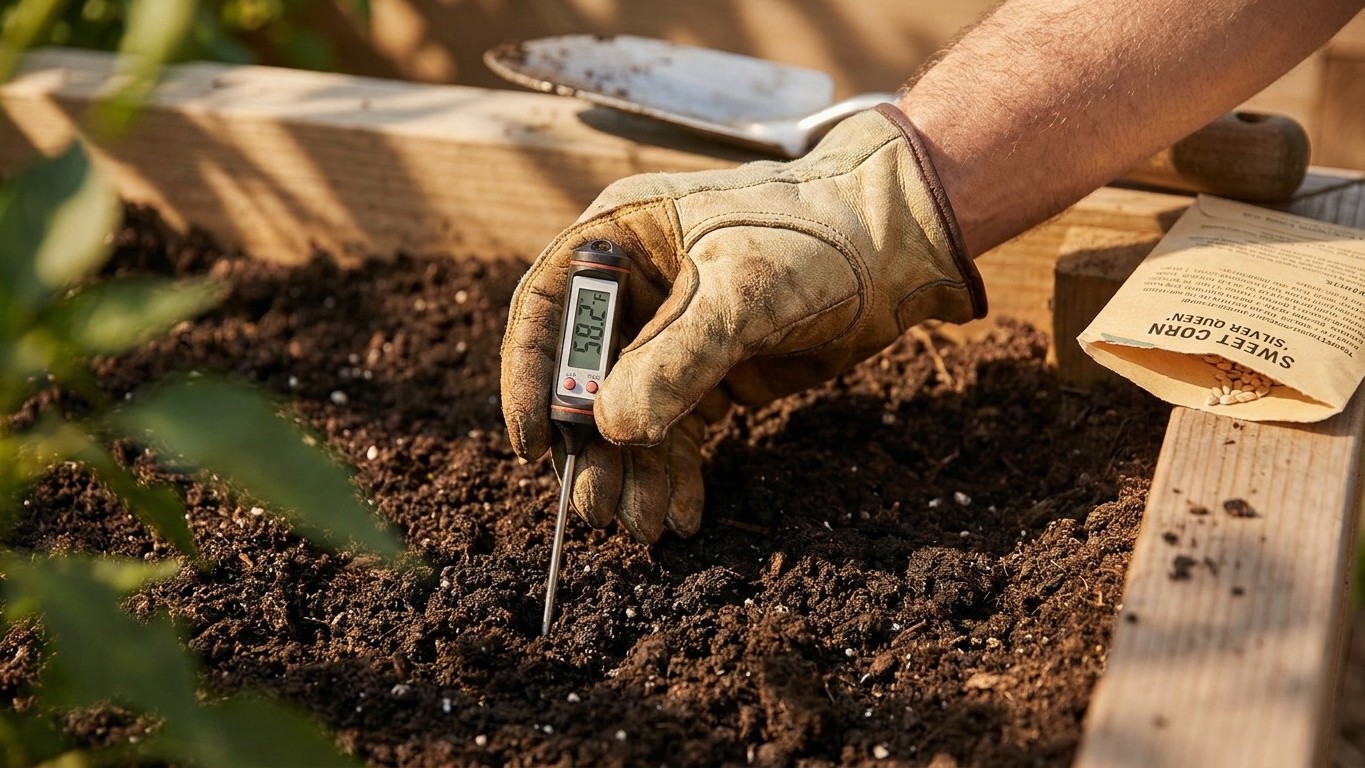

In West Virginia’s lower valleys, sweet corn seed should go into the ground once soil temperature holds reliably above 60°F, a threshold that lands well after the last spring frost (April 9 to April 23 at the reference station). That later start still leaves enough of the growing season, typically five to six months before the first fall frost arrives, to fit the 60 to 90 days most sweet corn varieties need to mature.
The short answer
Air temperature and soil temperature don’t move on the same clock. The last spring frost at the Charleston-area reference station falls somewhere between April 9 and April 23, but that date only tells you when the freezing risk to tender shoots drops off. Soil is a slower system. It holds onto winter cold longer than the air above it, so the ground doesn’t climb past that 60°F mark corn seed needs until well after the frost window has closed. Sowing on the frost date itself, rather than waiting for the soil to actually warm, is one of the most common missteps gardeners make here.
Once the soil does cross that line, the math works in the gardener’s favor. The first fall frost at the same reference station typically arrives between October 18 and November 1. That’s a stretch of roughly five to six months between the soil warming up in spring and the season closing down in fall, plenty of room to fit a 60-day variety, a 90-day variety, or even a staggered sequence of both without crowding the calendar.
Heat is the other half of the equation, and it’s not a minor detail here. The reference station averages 16 days a year at or above 90°F. That’s not the average summer temperature, it’s a measure of how many days the crop faces real heat stress and elevated water demand, particularly during pollination when tasseling and silking are happening. A stretch of 90-degree days landing right during silk emergence can affect kernel fill even when the calendar math otherwise looks fine. Watering consistently through that stretch matters as much as picking the right sowing date.
None of this changes much if a gardener is working from higher ground. The Charleston-area station sits in a river valley, and valleys hold heat longer than ridges and plateaus. Anyone gardening at higher elevation across the state should expect the first fall frost to show up earlier than the October 18 to November 1 window listed here, which trims the safety margin on the back end of the season even though the front end, the wait for 60°F soil, tends to run later too.
Does a late variety fit here?
Sweet corn varieties are generally grouped by how many days they need from planting to harvest, and West Virginia’s frost-to-frost window is generous enough to handle either end of that range. The question isn’t really whether the season is long enough, it’s how much margin a gardener wants to keep against an early fall frost, especially at elevation.
A 60-day variety
A variety needing around 60 days from planting fits this territory with room to spare. Even sown well into summer, after the soil has warmed and the early flush of garden work has settled, a 60-day crop can still mature and be harvested weeks before the first fall frost shows up in mid-October at the earliest. This is also the variety type that makes a second planting realistic for gardeners who want a longer harvest stretch, since it can go into the ground again a few weeks after the first sowing and still finish comfortably.
A 90-day variety
A 90-day variety also fits, but the margin shrinks. Counting backward from the earliest fall frost date in this data, October 18, a 90-day crop needs to be in the ground by roughly the third week of July at the very latest to guarantee it matures before frost risk returns. Planted any earlier in the season, which is easy to do once soil has crossed 60°F, it has no trouble finishing well ahead of schedule. The catch is for gardeners at higher elevation, where frost tends to arrive sooner than the valley reference dates suggest. There, the safe planting window for a 90-day variety closes earlier than it does around Charleston, and pushing a late sowing right up against that July cutoff carries more risk than it would at lower elevation.
What goes wrong here
- Soil sown too cold. Seed dropped into ground still under 60°F germinates poorly or rots outright before it ever breaks the surface, especially in a wet spring when the soil takes longer to warm. The remedy is simple and doesn’t require guesswork: check the actual soil temperature with a thermometer rather than sowing on the calendar date of the last frost, since the two are not the same event and the gap between them can run to several weeks.
- A variety too late for the season. This shows up mainly at higher elevation, where the growing season is shorter than the valley reference dates suggest. A 90-day variety sown late, say in early August rather than by the third week of July, risks running into frost before the ears finish filling out. The fix is to count backward from the local first-frost expectation, not the valley average, before choosing a late-maturing variety.
- Sweetness lost because two types tasseled together. This one has nothing to do with climate. When standard (su), sugary-enhanced (se), and supersweet (sh2) types release pollen at the same time nearby, cross-pollination degrades the sweetness and texture of the sh2 and se ears in particular. The fix isn’t distance, it’s timing: stagger planting dates so the different types tassel in separate windows, and keep each type planted in its own block of three or more rows rather than a single thin line, which improves pollination within the block itself.
Common questions
What’s the earliest safe date to sow sweet corn in West Virginia?
There isn’t a fixed calendar date, because the trigger is soil temperature, not the frost date. Once soil holds above 60°F, which lags behind the last spring frost (April 9 to April 23 at the reference station) by several weeks, seed can go in. Testing the soil directly is more reliable than counting days from the frost date.
Can I get two plantings of sweet corn in one season here?
The frost-free window, roughly five to six months between soil warming and the first fall frost (October 18 to November 1), leaves enough room for a first planting once soil hits 60°F and a second planting several weeks later, as long as both types are staggered so their tasseling windows don’t overlap if they’re different varieties.
How do I know when the corn is actually ripe?
Look for three signs together, not just one: silks that have turned dry and brown, husks that are still moist and green, and a milky liquid when a kernel is punctured. Any one of those signs on its own can be misleading; all three together are the reliable marker.
Does elevation change the sowing schedule?
Yes. The reference dates here come from a river valley, which holds heat longer than higher ground. Gardeners at elevation should expect the first fall frost earlier than the October 18 to November 1 range and the soil warming in spring later, which tightens the season on both ends, especially for a 90-day variety.
Some gardeners also time this by the Moon: when to plant corn by the moon, as almanac tradition rather than fact.