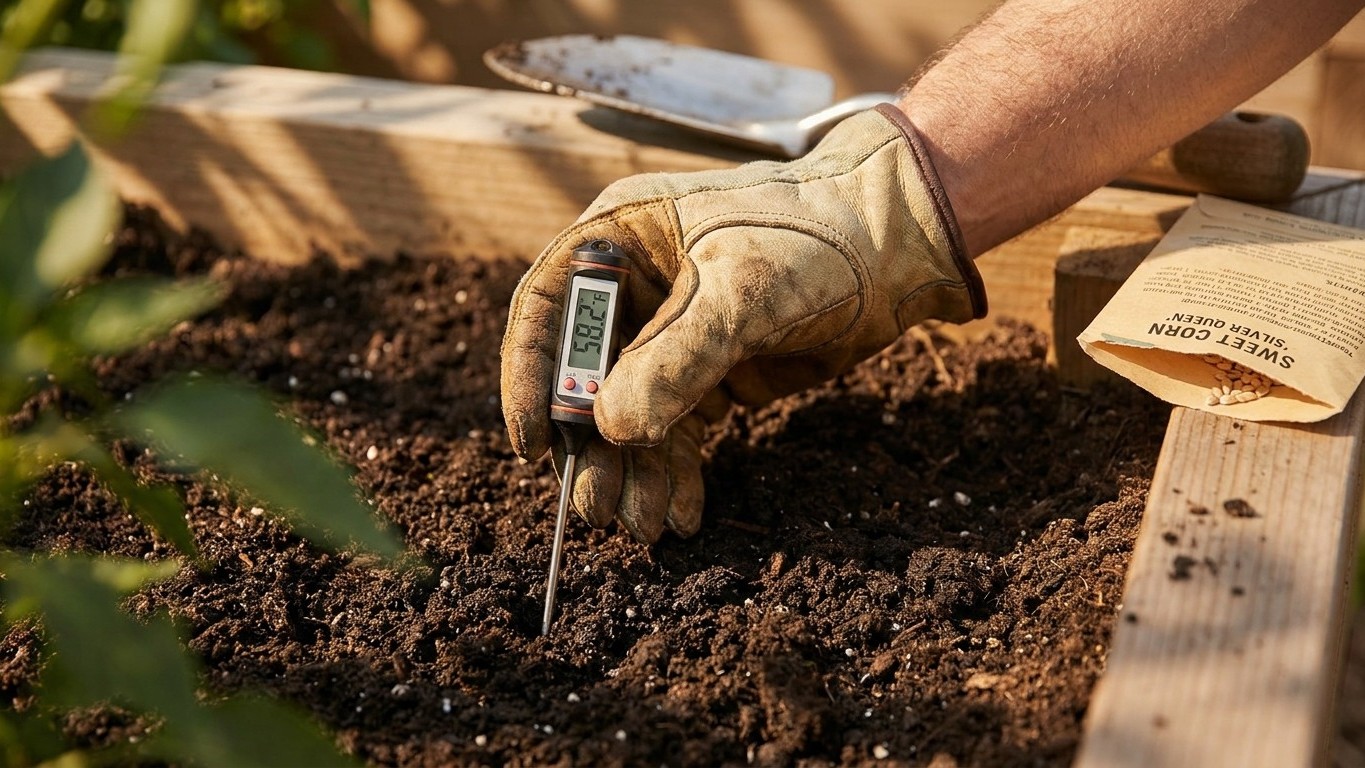

Sweet corn in Wisconsin goes into the ground once soil temperatures climb past 60°F, which happens well after the last spring frost has cleared out. From that point, a variety needing 60 to 90 days to mature has enough runway before the first fall frost arrives in mid-to-late October. The trick is knowing how much cushion that really leaves.
The short answer
Wisconsin’s last spring frost falls somewhere between April 16 and April 29, depending on where in the state you garden, according to NOAA NCEI’s 1991-2020 Climate Normals for freeze probabilities. That date matters for tender transplants like tomatoes, but it is not the signal sweet corn is waiting for. Corn seed rots in cold, wet soil, and it germinates poorly until the ground itself reaches 60°F. That threshold typically doesn’t arrive until several weeks after the frost has passed, sometimes stretching into early June if the spring is cool and rainy. Anyone who plants the day after the last frost, using the frost date as a green light, is almost always planting into soil that’s still too cold for good germination.
Once the soil does warm up, the countdown starts. Sweet corn needs 60 to 90 days from planting to reach harvest, a window that comes from Utah State University Extension’s guidance on growing sweet corn in the home garden. Wisconsin’s first fall frost lands between October 17 and October 29, so the real question isn’t whether corn can be planted here, it’s whether there’s enough room between a realistic planting date and that fall frost to let a full-season variety finish.
Do the arithmetic and the picture is reassuring. Even a late planting in early June still leaves well over 130 days before the earliest fall frost date on record for this climate normal period. That’s more than enough for the entire 60-to-90-day range, though the cushion shrinks the further north you garden and the further into a cold spring your soil stays wet. Summer heat plays a supporting role too. Milwaukee’s reference station averages just 7.0 days a year at 90°F or hotter, according to NOAA NCEI’s Climate Normals. That’s a fairly mild heat load, not the kind of scorching summer that pushes corn through its growth stages fast, which is one more reason not to assume a late-season variety will race to the finish line the way it might in a hotter state.
Does a late variety fit here?
Days-to-maturity numbers tell you how long a variety takes from seed to harvest, but they only mean something once you place them against your actual local calendar. Wisconsin’s frost dates and soil-warming lag change how much room a 60-day variety has compared to a 90-day one.
A 60-day variety
A quick-maturing 60-day type is the easy case here. Planted once soil finally clears 60°F, even a late planting in early June still finishes well before the earliest fall frost date of October 17. That leaves a comfortable margin, often a month or more, which matters if a stretch of cool weather slows growth mid-summer or if you want to stagger a second planting for a later harvest. This is the safer choice for gardeners in the northern part of the state, where frost tends to arrive earlier than in the milder Lake Michigan shoreline zone, and for anyone whose spring soil stays cold and wet longer than usual.
A 90-day variety
A full 90-day variety asks more of the season, but the math still works for most of Wisconsin. Planted as soon as soil hits 60°F, typically no later than early June even in a slow spring, a 90-day type still has roughly 130 to 150 days of room before the first fall frost arrives. That’s a real cushion, not a photo finish. Where it gets tighter is in northern Wisconsin, where frost can show up closer to the early end of the October 17 to October 29 range, and in any year where planting gets pushed later than usual by a cold, soggy spring. Combine a late planting with the state’s modest summer heat load (that 7.0-day average above 90°F) and a 90-day variety can run closer to the edge than the calendar first suggests. It generally fits, but it leaves far less room for error than the 60-day option, so gardeners north of the state’s midline or those who tend to plant late should weigh that trade-off before committing a full bed to a long-season type.
What goes wrong here
- Soil sown too cold. Planting right after the last spring frost, rather than waiting for the soil itself to clear 60°F, is the most common mistake in this climate. Seeds sit in cold, wet ground, rot before they sprout, and gardeners end up reseeding weeks later, which then squeezes the maturity window from the other end. The fix is patience: check the soil, not just the calendar, and hold off until it has genuinely warmed.
- A variety too late for the season. Choosing an extra-long-season type without checking it against the local frost window can leave ears unfinished when cold weather moves in, especially after a late, wet spring or in the northern part of the state where frost arrives earlier. When planting has been delayed, or when gardening in a cooler pocket of Wisconsin, switching to a variety on the shorter end of the 60-to-90-day range protects the harvest.
- Sweetness lost through mismatched tasseling, and this one has nothing to do with the weather. Sweet corn types (standard su, sugary-enhanced se, and supersweet sh2) cross-pollinate if they shed pollen and show silk at the same time, and the result is starchy, disappointing ears regardless of how well the plants grew. Utah State University Extension’s guidance doesn’t publish a specific isolation distance for keeping types apart, so the safeguard is timing and layout rather than a measured gap: stagger planting dates so different types don’t tassel together, and grow each type in its own block of three or more rows rather than mixing types row by row.
Common questions
Can I use the last frost date to decide when to plant sweet corn?
Not on its own. The last frost date (April 16 to April 29 across Wisconsin) tells you when the air has stopped freezing, but sweet corn seed needs soil above 60°F to germinate reliably, and that threshold arrives later, sometimes well into May or early June. Planting on the frost date alone risks seed rotting in cold soil.
How do I know when the corn is actually ripe?
Look for three signs together, not just one: the silks have turned dry and brown, the husks are still moist and green, and a punctured kernel releases milky juice rather than clear liquid. Any single sign alone can be misleading.
Why does the guidance mention planting in blocks of rows instead of long single rows?
Sweet corn is wind-pollinated, and pollen needs to reach silks across a block of plants for full, well-filled ears. A block of three or more rows, per Utah State University Extension, pollinates far more reliably than one long, thin row where pollen simply blows past.
Can I grow two different sweet corn varieties in the same garden?
Yes, as long as they don’t tassel at the same time. If a standard and a supersweet type shed pollen and show silk together, cross-pollination turns the supersweet ears starchy. Stagger planting dates between types, or separate them by maturity length, so their tasseling windows don’t overlap.