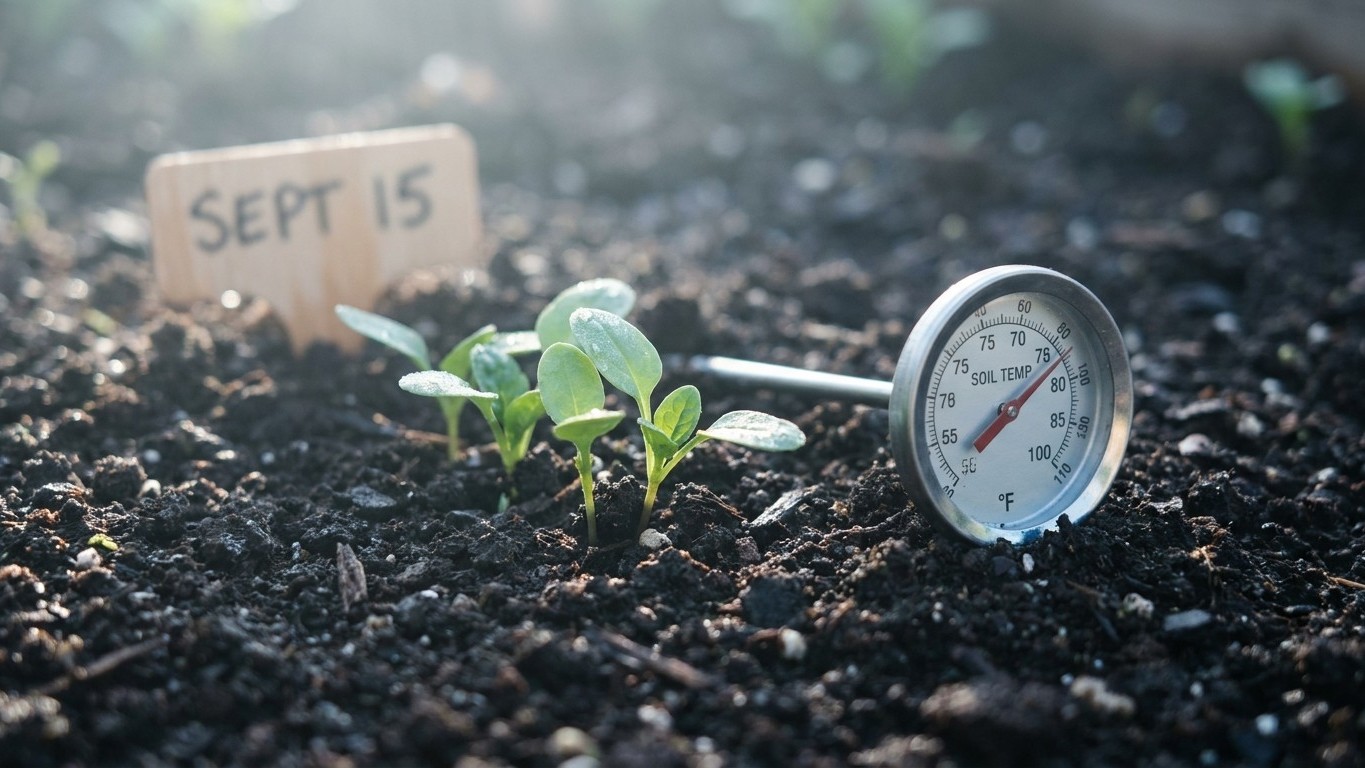

Sow autumn spinach in Wyoming between mid-July and mid-August, counting back 50 to 75 days from the first fall frost, which arrives statewide between September 24 and October 5. But don’t just circle a date on the calendar. The seed won’t germinate reliably until the soil itself has cooled below 80 F, which in most Wyoming gardens doesn’t happen until the second half of July, right when that 50-to-75-day countdown wants to start.
The short answer
On the longest day of the year, Wyoming gets 14 hours and 58 minutes of daylight. That number matters more than most gardeners realize, because spinach bolts under long days as reliably as it bolts under heat. A cool mountain summer does not cancel that out. Even if July nights drop into the 40s, the plant is still tracking day length, and nearly 15 hours of light is more than enough to flip a spinach plant from leaf production into a seed stalk. So the first thing to accept here: a mild Wyoming summer does not buy extra weeks of spinach. The clock that matters is the sun’s, not the thermometer’s.
Heat plays a smaller, but real, supporting role. Wyoming’s reference station averages only 10.4 days a year above 90 F, which is a modest heat load compared to much of the country. Spinach grows best where temperatures stay under 75 F, and above that ceiling the leaves turn bitter even before the plant fully bolts. With so few days crossing 90 F, straight heat stress is not the dominant threat in most Wyoming gardens. Day length is.
That makes Wyoming a slightly unusual case. In hotter, lower-elevation states, growers fight both long days and scorching soil at the same time, and the two problems reinforce each other. Here, the elevation and latitude combination means the sun does the damage on its own schedule, while heat mostly nudges the plant along or adds bitterness on the handful of 90-degree afternoons. Practically, this means shade cloth or afternoon shade helps less in Wyoming than it does farther south, because you can’t shade your way out of a 15-hour day. What actually works is timing sowing so the plant’s productive leaf stage falls in the weeks when day length is shorter, not longer, which points squarely at early spring and late summer, and away from the long, bright stretch of June and early July.
So to answer plainly: in Wyoming, day length is the primary limit on spinach, with the modest heat load acting as a secondary pressure that mostly affects flavor rather than survival. Any planting plan here has to start from the sun angle, not the forecast.
How long the spring window really is
- Start with the frost date. The last spring freeze at the reference station falls between May 7 and May 18, with real spread possible above 6,000 feet, where frost can show up in almost any month.
- Back up two to three weeks. Spinach seed goes in the ground before that last frost date, not after, since the crop tolerates cold soil far better than it tolerates heat. That puts spring sowing somewhere around late April to the first days of May, depending on how quickly a given garden’s soil thaws and drains that year.
- Track the 75 F ceiling forward. Wyoming’s growing season warms gradually at elevation, but by mid-to-late June, afternoon soil and air temperatures in most valley gardens are pushing past that 75 F growth threshold on a regular basis, especially once the ten-ish annual days above 90 F start clustering in July.
- Add the day-length factor on top. Even before the thermometer crosses 75 F for good, the calendar is closing in on the summer solstice, when daylight peaks near 14 hours 58 minutes. That long-day trigger for bolting arrives whether or not the heat does, which shortens the usable window from both directions at once.
- The result is a spring window of roughly six to eight weeks. Seed goes in around late April, and the plant has a productive run through most of May and into the first half of June before rising day length and warming soil push it toward bolting. That’s a workable window, but not a generous one, and it explains why so many Wyoming gardeners treat spring spinach as a quick, early crop rather than a season-long staple.
The autumn crop, and when the soil lets you sow
Fall spinach in Wyoming has to thread a narrower needle than the spring crop, because it’s bounded by two separate obstacles rather than one. The soil has to cool down enough to let the seed germinate, and the first freeze has to hold off long enough for the plant to reach a useful size before the season simply ends.
Soil still too warm to germinate
Spinach seed germination drops off sharply once soil temperature climbs above 80 F, according to Utah State University Extension. In Wyoming, that’s less of a problem than it is in lower, hotter states, but it still matters in July, when accumulated summer warmth can push topsoil past that mark even if the air rarely hits 90 F for more than ten days a year. Gardeners sowing in mid-July often do better watering the bed heavily the day before, sowing in early morning, and mulching lightly to keep the surface layer from baking, rather than waiting out the heat entirely, since day length is already working against a late start.
The frost that ends the season
The first fall freeze arrives at the reference station between September 24 and October 5. Utah State University Extension’s guidance for a fall crop is to plant 50 to 75 days before the date you want to harvest, not before the frost date itself, so the math has to work backward from whichever harvest target makes sense for a given garden. Counting 50 to 75 days back from September 24 lands sowing between August 5 and July 11. Counting the same range back from October 5 lands sowing between August 17 and July 22. Together, that puts the realistic autumn sowing window across most of Wyoming somewhere between mid-July and mid-August, which is exactly the stretch where the soil-temperature obstacle and the frost-countdown obstacle overlap.
Garden centers in Wyoming commonly stock Bloomsdale, Melody, Teton, and Olympia spinach as fall options. Utah State University Extension does not publish days-to-maturity figures for any of these varieties, and no maturity data appears in the source used here, so growers are better served by working from the 50-to-75-day planting window than from any date printed on a seed packet.
Common questions
Can I sow spinach twice in one Wyoming season?
Yes. The spring window (roughly late April into early June) and the fall window (mid-July into mid-August) are separated by the hottest, longest-day stretch of summer, when spinach would bolt almost immediately if sown. Treating spinach as two short crops, rather than one long one, fits Wyoming’s climate better than trying to stretch a single planting across the summer.
Does elevation change these dates within Wyoming?
It can shift things meaningfully. The frost dates and heat figures here come from a single reference station, but gardens above 6,000 feet can see frost in almost any month, which tightens both the spring and fall windows further. Gardeners at higher elevations should treat the ranges given as a starting point and watch their own soil and overnight temperatures closely rather than relying on the calendar alone.
Is bolting caused by heat or by day length in Wyoming?
Both play a role, but day length is the dominant factor here. Nearly 15 hours of daylight on the longest day triggers bolting regardless of how mild the temperatures stay, which is why a cool Wyoming summer doesn’t extend the harvest the way it might for a crop that responds mainly to heat.
What does the 75 F threshold actually control?
It does two things at once. Below 75 F, spinach grows well and stays mild; above it, growth slows and the leaves start turning bitter, even before the plant fully bolts. It’s a growing ceiling and a flavor threshold in one number, not a date on the calendar, so it’s worth tracking soil and air temperature directly rather than assuming a fixed cutoff week.