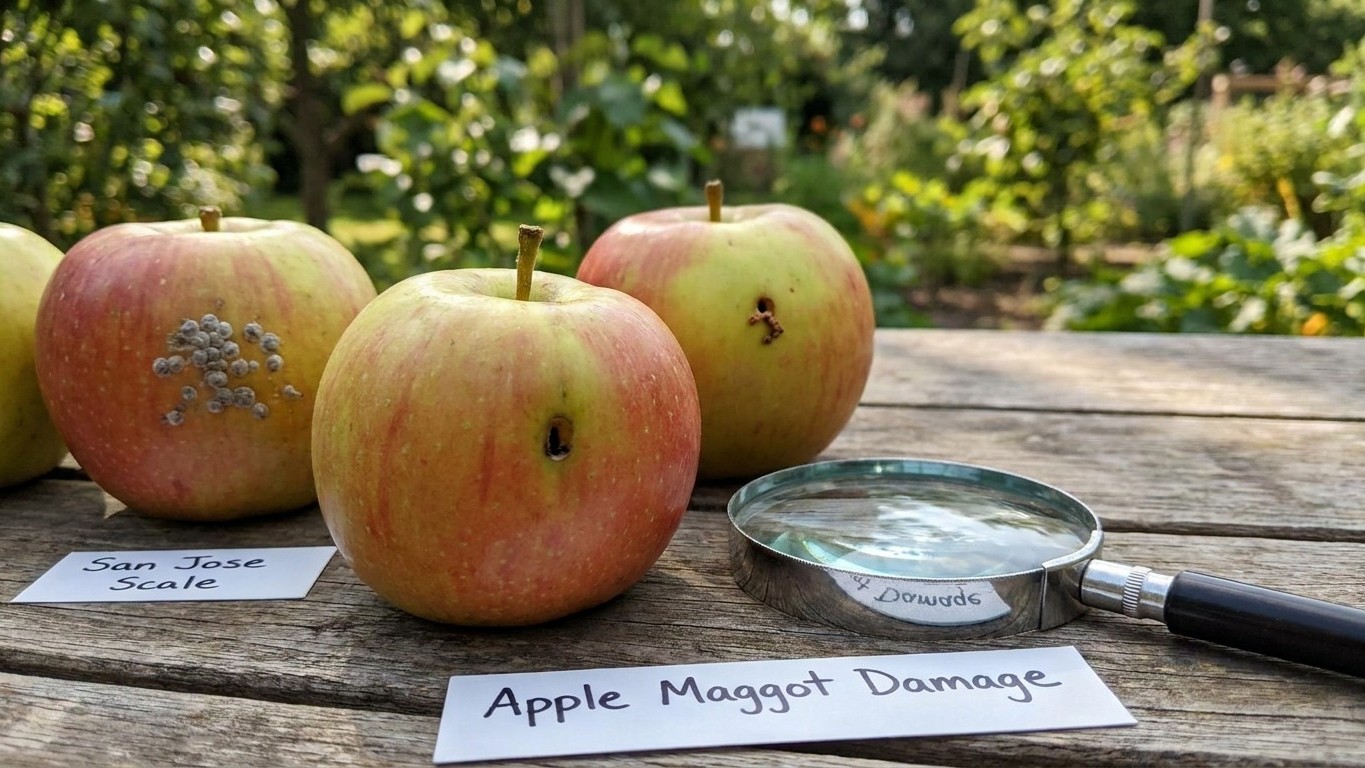

Look at the fruit or the shoot first, not the calendar. A tunnel plugged with brown frass near the stem end means codling moth. A crescent-shaped cut in young green fruit means plum curculio. Dimpled, sunken skin over faint brown threads means apple maggot, and white cottony tufts on shoot tips mean woolly apple aphid. Fine stippling and bronzing on leaf surfaces, often with faint webbing underneath, points to apple Spider Mites. Check fruit and shoots at petal fall, the point right after the blossoms drop, since that’s when several of these marks first appear.
Why it matters
Matching the mark on the fruit to the pest that made it stops you from spraying for the wrong problem, or spraying at the wrong point in the tree’s year. A crescent scar from apple Plum Curculio and a dimpled patch from apple maggot both show up on the fruit surface, but they call for scouting at different stages, and mistaking one for the other means the pest actually at work keeps feeding while you chase the wrong life stage.
This kind of identification belongs across most of the tree’s growing season: from green tip in spring, when the first aphid colonies show up on unfolding leaves, through petal fall, when curculio and apple Codling Moth start marking fruit, and into summer, when apple maggot flies are active alongside Japanese Beetles skeletonizing leaves. If you’re new to Growing Apples, this is the habit worth building before you plant a second or third tree. Look at what’s actually on the fruit and leaf, not just what month it is.
Tree size and scouting
Tree size decides how much of the canopy you can actually see. A tree on M.9 rootstock tops out at 8 to 12 feet according to USU Extension, low enough to check every shoot tip from the ground. A seedling rootstock tree can reach 35 to 40 feet by the same USU figures, which means scale insects and aphid colonies working the top third of the canopy go unnoticed until damage shows up on fruit you can actually reach. If you’re still deciding on rootstock, How to Plant an Apple Tree, and How Deep is worth reading before you commit, since the rootstock you choose now sets how easy scouting will be for the next twenty years.
When to do it
Stages that trigger each pest
Pest marks appear on a schedule set by the tree’s own stages, not by the date on a calendar. Dormancy is when San Jose scale is easiest to spot on bare wood, sitting as small gray bumps on twigs and branch crotches with no leaves to hide them. Green tip, when the first leaf tissue shows at the bud, is when woolly apple aphid colonies start forming on new shoots. Pink, just before the blossoms open, is when plum curculio adults move into the tree from the ground litter where they overwintered. Petal fall, the point right after the blossoms drop, is when curculio starts scarring young fruit and codling moth begins laying eggs near the calyx end.
What moves each of these stages from one week to the next is temperature, specifically the warmth the tree has logged since it broke dormancy, so the same stage lands on a different date every year and a different date in every county. That’s a reason to read the stage off the tree itself rather than off a sprayer’s calendar.
Bloom groups stretch the window
Bloom group also widens the calendar. Clemson Cooperative Extension’s HGIC 1350 groups apple varieties by how early they flower relative to each other: group A, Anna and Dorsett Golden, opens first; group B, which includes Fuji, Gala, Ginger Gold, Granny Smith, and Red Delicious among others, follows; group C, Arkansas Black, Golden Delicious, Jonagold, Ozark Gold, Priscilla, Rome Beauty, and Stayman, opens last. Plant varieties from more than one group and petal fall doesn’t happen in a single week. It happens in waves, which stretches the curculio and codling moth window across the whole orchard instead of closing it after a few days on one tree.
How to do it

Scouting for the mark, not the insect, is usually easier since most of these pests are small, nocturnal, or both. Walk the tree at each stage and check four spots: the fruit surface, the underside of leaves, the shoot tips, and the bark at branch crotches. Carry a hand lens if you have one. A mark you can photograph and compare later beats a guess made standing in the orchard.
- Fruit surface: scars, dimples, entry holes, or a plug of frass
- Leaf undersides: colonies, stippling, or fine webbing
- Shoot tips: cottony tufts or a curled, distorted leaf
- Bark and branch crotches: scale bumps or egg masses
Codling moth

The mark is a small hole in the fruit, usually near the stem or calyx end, plugged with a crumb of brown frass. Cut the fruit open and you’ll often find a tunnel running straight to the core, sometimes with the larva still inside: pinkish-white, brown-headed, about half an inch long. The adult moth is gray-brown with a bronze patch at the wingtip, but you’ll see the fruit damage long before you see the moth itself.
Plum curculio

The mark is a crescent-shaped cut or scar in the skin of young, still-green fruit, made when the female lays an egg beneath the surface. The scar often heals into a dimpled, corky patch as the fruit grows, which is a useful clue for telling old curculio damage from a fresh apple maggot dimple. The adult is a small, mottled brown beetle with a long curved snout, easy to miss on the bark since it plays dead when disturbed.
Apple maggot

The mark starts as a tiny dimple in otherwise smooth fruit skin, which develops into a sunken, lumpy patch with faint brown threads visible just under the surface when you slice through it. The adult fly is black with white bands crossing the abdomen and dark zigzag markings on the wings, roughly the size of a housefly.
Woolly apple aphid

The mark is a white, cottony tuft clustered on a shoot tip, a pruning wound, or a bark crack. Wipe it and you’ll find soft-bodied, blue-gray aphids underneath, along with a smear of white wax on your finger. Left alone, colonies also move to the roots, where they raise galls that weaken the tree’s anchorage over several seasons.
San Jose scale

The mark on fruit is a small circular bump ringed with a faint reddish-purple halo, and on bark it’s a crust of tiny gray to dark brown discs, each about the size of a pinhead. A branch with a heavy scale population looks dusty gray rather than smooth brown, which is often the first thing that catches your eye before you spot any individual insect.
What goes wrong
Confusing one pest for another
The most common mistake is spraying before confirming which pest actually made the mark, which means treating for codling moth when the damage was actually curculio, or the reverse. The two are easy to confuse on fruit that’s already a few weeks old, since a curculio scar can smooth over into something that looks a lot like an early codling moth entry hole. Cutting the fruit open settles it: curculio leaves a shallow crescent-shaped cavity near the surface, codling moth leaves a tunnel running straight to the core.
Bird pecks and deer browsing add another layer of confusion, since fruit that’s already scarred by an insect softens faster and draws birds to the same spot. If you’re seeing torn, ragged damage on top of what looks like an older insect scar, the insect mark came first. Keeping Birds and Deer Off an Apple Tree is worth reading if browsing damage keeps showing up on fruit that also carries insect scarring, since treating the secondary damage without addressing the pest that opened the fruit first won’t stop either problem.
Timing mistakes
Timing mistakes cost more than misdiagnosis does. Spraying during bloom, when the tree is covered in open blossoms, risks killing the pollinators the crop depends on regardless of which pest you’re targeting, and it’s the single window most extension services tell growers to avoid outright. Waiting until damage is obvious from outside the fruit is the other common error. By the time a codling moth tunnel or an apple maggot patch is visible on the surface, the larva has usually already done the damage that matters, and no spray applied at that point changes the fruit you’re holding.
| What you see | Looks like | Actually is |
|---|---|---|
| Crescent scar on green fruit | Hail nick or thorn scratch | Plum curculio egg-laying scar |
| Ragged torn skin | Fresh bird peck | Bird feeding on fruit already softened by an insect scar |
| Dimpled, sunken patch | Bruise from a fall | Apple maggot tunnel developing under the skin |
What changes where you are
Regional pest pressure
The stages dormancy, green tip, pink, bloom, and petal fall hold true everywhere an apple tree grows. What changes is how fast the tree moves through them and which of these pests are actually present. A tree in a short, cold growing season might pass from green tip to petal fall in a couple of weeks, compressing the scouting window for curculio and codling moth into a short stretch. A tree in a milder climate can spread the same stages over a longer run of weeks, and may support a second or even third generation of codling moth in a single season where a colder climate allows only one.
Pest pressure itself varies by region. Apple maggot is a serious problem in some parts of the country and largely absent in others, and the same is true of San Jose scale, which tends to build up faster where winters are mild enough that populations aren’t knocked back each year. Check with your state’s extension service for which of these pests are actually confirmed in your area before you build a scouting routine around all of them, since watching all season for a pest that doesn’t exist locally is time spent on the wrong problem.
Rootstock and climate
Rootstock choice interacts with climate too. Where winter wind is strong or the establishment period before dormancy is short, a smaller rootstock such as M.26 or G.11, maturing at 12 to 15 feet according to USU Extension, comes into full scouting range faster than a seedling rootstock tree, which can take years longer to reach its full 35 to 40 foot height by the same USU figures. That’s one more reason the rootstock decision made at planting keeps paying off, or costing you, every season you scout after it.
Common questions
What’s eating holes in my apples?
A round hole plugged with brown crumbs near the stem or calyx end is almost always codling moth. A crescent-shaped cut on young green fruit is plum curculio instead, and a dimpled patch with brown threads under the skin points to apple maggot. Cut the fruit open if you’re not sure. The tunnel shape tells the three apart faster than the outside mark does.
Why does my apple tree have white fuzzy stuff on the branches?
That’s almost certainly woolly apple aphid, a soft-bodied aphid that covers itself in white waxy filaments while feeding on shoot tips, pruning wounds, and bark cracks. It’s usually more unsightly than dangerous on the branches themselves, but colonies that move underground can raise galls on the roots that weaken the tree over several years.
Do I need to spray if I only see a few pests?
Not necessarily. A handful of curculio scars or one small aphid colony rarely justifies a spray program on its own, and many home orchards tolerate light pest pressure without losing a meaningful share of the crop. Your state extension service can tell you what threshold, if any, is worth acting on for your area, and which products are labeled for home use there.
Can I tell these pests apart before the fruit shows damage?
Sometimes, but it takes checking the tree at the right stage rather than waiting for fruit symptoms. San Jose scale and overwintering plum curculio adults can both be spotted on bark and in leaf litter before bloom, and woolly apple aphid colonies show up on shoot tips at green tip, well before there’s any fruit on the tree to damage.